THE CLASSIC COLLECTION✦PoemsCLASSIC FREE BOOKS
Poems
Katherine Mansfield
THE CLASSIC COLLECTION · 1900
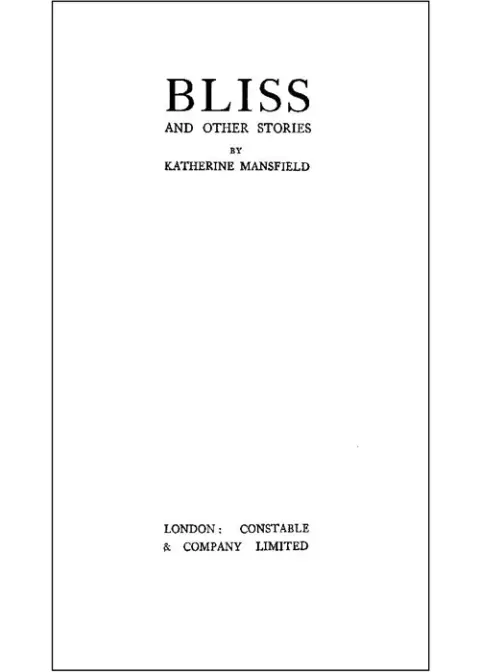
"Bliss, and Other Stories" by Katherine Mansfield is a collection of short stories written in the early 20th century. The narratives explore intricate themes of human emotion, social dynamics, and the nuances of domestic life, often through the perspective of women navigating their roles and relationships. One of the key characters presented is Linda Burnell, a mother deeply involved in the complexities of her family life as they move from city living to the countryside. The opening of the work introduces readers to Linda Burnell's hurried preparations for a significant transition as her family relocates. In a chaotic scene filled with children and luggage, we see Linda's mixed feelings of excitement and stress as she must leave her daughters, Lottie and Kezia, behind temporarily. Kezia’s innocence and curiosity are highlighted, particularly as she interacts with her surroundings and expresses a childlike fascination with the new environment. The scene sets a tone of impending change, hinting at deeper emotional currents and complexities that will unfold as the story progresses, foreshadowing the themes of bliss versus the latent struggles that lie beneath the surface of seemingly idyllic life.
Introduction adapted from the source catalogue; source summaries may be automatically generated.
Free to read · English · 66,663 words · No account needed
MAKE TIME FOR A GOOD BOOK
On by default. Untick to stop anonymous reading totals. Each page counts after 10 seconds in view. How this works.
Anonymous counting is on unless you have switched it off.
“When can I come again?” she asked, tying the music up again in the blue silk case. “I want to take as many lessons as I can just now. Oh, Mr. Peacock, I do enjoy them so much. May I come the day after to-morrow?”
“Dear lady, I shall be only too charmed,” said Reginald, bowing her
out.
Glorious girl! And when they had stood in front of the mirror, her white sleeve had just touched his black one. He could feel—yes, he could actually feel a warm glowing spot, and he stroked it. She loved her lessons. His wife came in.
“Reginald, can you let me have some money? I must pay the dairy. And will you be in for dinner to-night?”
“Yes, you know I’m singing at Lord Timbuck’s at half-past nine. Can you make me some clear soup, with an egg in it?”
“Yes. And the money, Reginald. It’s eight and sixpence.”
“Surely that’s very heavy—isn’t it?”
“No, it’s just what it ought to be. And Adrian must have milk.”
There she was—off again. Now she was standing up for Adrian against
him.
“I have not the slightest desire to deny my child a proper amount of milk,” said he. “Here is ten shillings.”
The door-bell rang. He went to the door.
“Oh,” said the Countess Wilkowska, “the stairs. I have not a breath.” And she put her hand over her heart as she followed him into the music-room. She was all in black, with a little black hat with a floating veil—violets in her bosom.
“Do not make me sing exercises, to-day,” she cried, throwing out her hands in her delightful foreign way. “No, to-day, I want only to sing songs. . . . And may I take off my violets? They fade so soon.”
“They fade so soon—they fade so soon,” played Reginald on the piano.
“May I put them here?” asked the Countess, dropping them in a little vase that stood in front of one of Reginald’s photographs.
“Dear lady, I should be only too charmed!”
She began to sing, and all was well until she came to the phrase: “You love me. Yes, I know you love me!” Down dropped his hands from the keyboard, he wheeled round, facing her.
“No, no; that’s not good enough. You can do better than that,” cried Reginald ardently. “You must sing as if you were in love. Listen; let me try and show you.” And he sang.
“Oh, yes, yes. I see what you mean,” stammered the little Countess. “May I try it again?”
Your reading position is saved on this browser. Take it to another device with a library code. Reading pages adapt to text, rather than matching a printed edition.
Katherine Mansfield
Katherine Mansfield
Katherine Mansfield
BEHIND THE BOOK
This eBook is for the use of anyone anywhere in the United States and most other parts of the world at no cost and with almost no restrictions whatsoever. You may copy it, give it away or re-use it under the terms of the Project Gutenberg License included with this eBook or online at www.gutenberg.org. If you are not located in the United States, you will have to check the laws of the country where you are located before using this eBook. Read the source licence.
The original source file, including credits and licence, is retained by this library. Request an original-format copy at no charge. Please include the book title and Project Gutenberg identifier #44385.
KEEP YOUR CURIOSITY GOING
Coulson Kernahan

Maurice Baring
Frances Wright
Cécile Tormay

Frederic Jesup Stimson

W. H. P. (William Henry Pope) Jarvis