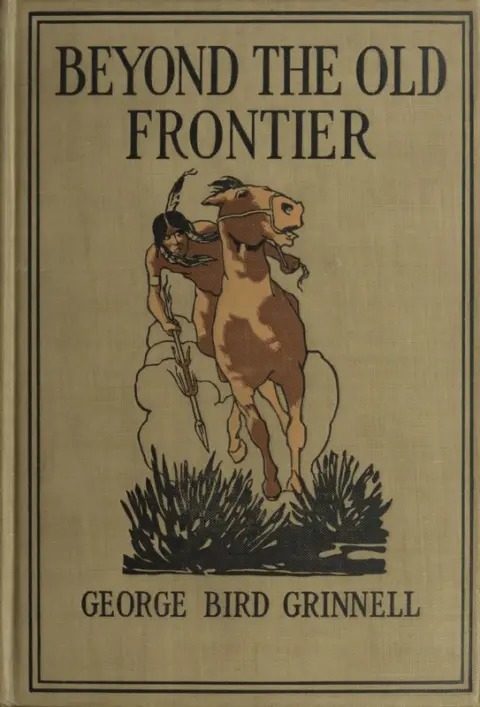
Beyond the Old Frontier: Adventures of Indian-Fighters, Hunters, and Fur-Traders
George Bird Grinnell
THE CLASSIC COLLECTION · 1892
"Blackfoot Lodge Tales: The Story of a Prairie People" by George Bird Grinnell is a collection of Native American tales and narratives centered around the Blackfoot tribe, likely written in the late 19th century. The work delves into the traditional stories, adventures, and cultural practices of the Blackfoot people, reflecting their societal values and historical experiences. At the start of the book, the narrator sets a contemplative scene around a peaceful gathering in a Blackfoot lodge, where elders engage in storytelling and discussions about the differences between their ways and those of the white settlers. A notable conversation reveals the significance of knowledge and education, highlighting the struggles of the Blackfoot in adapting to changing times and the loss of their culture. The initial focus on storytelling as a means of preserving their history and identity emphasizes the importance of oral traditions in understanding the Blackfoot people and their relationship with the world around them.
Introduction adapted from the source catalogue; source summaries may be automatically generated.
Free to read · English · 101,209 words · No account needed
MAKE TIME FOR A GOOD BOOK
On by default. Untick to stop anonymous reading totals. Each page counts after 10 seconds in view. How this works.
Anonymous counting is on unless you have switched it off.
At the time of the Medicine Lodge, he would take her to the lodge and point out to her the Medicine Lodge woman. He would say: "There is a good woman. She has built this Medicine Lodge, and is greatly honored and respected by all the people. Once she was a girl just like you; and you, if you are good and live a pure life, may some day be as great as she is now. Remember this, and try to live a worthy life."
At the time of the Medicine Lodge, the boys in the camp also gathered to see the young men count their coups. A man would get up, holding in one hand a bundle of small sticks, and, taking one stick from the bundle, he would recount some brave deed, throwing away a stick as he completed the narrative of each coup, until the sticks were all gone, when he sat down, and another man stood up to begin his recital. As the boys saw and heard all this, and saw how respected those men were who had done the most and bravest things, they said to themselves, "That man was once a boy like us, and we, if we have strong hearts, may do as much as he has done." So even the very small boys used often to steal off from the camp, and follow war parties. Often they went without the knowledge of their parents, and poorly provided, without food or extra moccasins. They would get to the enemy's camp, watch the ways of the young men, and so learn about going to war, how to act when on the war trail so as to be successful. Also they came to know the country.
The Blackfeet men often went off by themselves to fast and dream for power. By no means every one did this, and, of those who attempted it, only a few endured to the end,--that is, fasted the whole four days,--and obtained the help sought. The attempt was not usually made by young boys before they had gone on their first war journey. It was often undertaken by men who were quite mature. Those who underwent this suffering were obliged to abstain from food or drink for four days and four nights, resting for two nights on the right side, and for two nights on the left. It was deemed essential that the place to which a man resorted for this purpose should be unfrequented, where few or no persons had walked; and it must also be a place that tried the nerve, where there was some danger. Such situations were mountain peaks; or narrow ledges on cut cliffs, where a careless movement might cause a man to fall to his death on the rocks below; or islands in lakes, which could only be reached by means of a raft, and where there was danger that a person might be seized and carried off by the S[=u]'-y[=e] t[)u]p'-pi, or Under Water People; or places where the dead had been buried, and where there was much danger from ghosts. Or a man might lie in a well-worn buffalo trail, where the animals were frequently passing, and so he might be trodden on by a travelling band of buffalo; or he might choose a locality where bears were abundant and dangerous. Wherever he went, the man built himself a little lodge of brush, moss, and leaves, to keep off the rain; and, after making his prayers to the sun and singing his sacred songs, he crept into the hut and began his fast. He was not allowed to take any covering with him, nor to roof over his shelter with skins. He always had with him a pipe, and this lay by him, filled, so that, when the spirit, or dream, came, it could smoke. They did not appeal to any special class of helpers, but prayed to all alike. Often by the end of the fourth day, a secret helper--usually, but by no means always, in the form of some animal--appeared to the man in a dream, and talked with him, advising him, marking out his course through life, and giving him its power. There were some, however, on whom the power would not work, and a much greater number who gave up the fast, discouraged, before the prescribed time had been completed, either not being able to endure the lack of food and water, or being frightened by the strangeness or loneliness of their surroundings, or by something that they thought they saw or heard. It was no disgrace to fail, nor was the failure necessarily known, for the seeker after power did not always, nor perhaps often, tell any one what he was going to do.
Your reading position is saved on this browser. Take it to another device with a library code. Reading pages adapt to text, rather than matching a printed edition.
George Bird Grinnell
George Bird Grinnell

Caspar Whitney & George Bird Grinnell & Owen Wister
George Bird Grinnell
BEHIND THE BOOK
This eBook is for the use of anyone anywhere in the United States and most other parts of the world at no cost and with almost no restrictions whatsoever. You may copy it, give it away or re-use it under the terms of the Project Gutenberg License included with this eBook or online at www.gutenberg.org. If you are not located in the United States, you will have to check the laws of the country where you are located before using this eBook. Read the source licence.
The original source file, including credits and licence, is retained by this library. Request an original-format copy at no charge. Please include the book title and Project Gutenberg identifier #11547.
KEEP YOUR CURIOSITY GOING

Maurice Baring
Francis Greenleaf Allinson & Anne C. E. (Anne Crosby Emery) Allinson
Stuart Dodgson Collingwood
Percy Keese Fitzhugh
Mary Macleod & Edmund Spenser

Cooke Don-Carlos