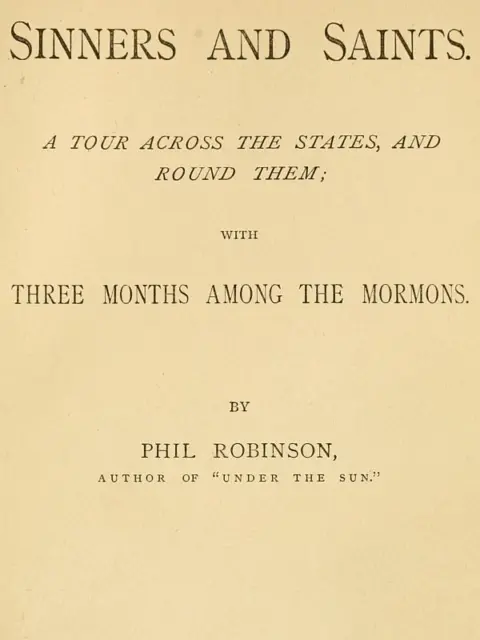
Sinners and Saints A Tour Across the States and Round Them, with Three Months Among the Mormons
Phil Robinson
THE CLASSIC COLLECTION · 1894
"Birds of the Wave and Woodland" by Phil Robinson is a natural history book written in the late 19th century. The work focuses on British birds, exploring their characteristics, habits, and songs, and presents a detailed examination of their seasonal behaviors and migration patterns. The book serves as both an informative guide for birdwatchers and a reflection on the beauty and significance of these creatures in the natural world. At the start of the book, Robinson discusses the representation of various birds throughout the seasons, highlighting the thrush, blackbird, and swallow as key examples. He elaborates on the thrush as a symbol of spring, detailing its early songs amidst the lingering winter landscape and dispelling misconceptions about its migratory behavior. The narrative sets an engaging tone by weaving poetry and personal reflections into the descriptions of bird life, ultimately establishing a deep appreciation for their roles in the ecosystem. The opening portion lays the groundwork for an exploration of not only the avian world but also the interactions humans have with these familiar yet enigmatic creatures.
Introduction adapted from the source catalogue; source summaries may be automatically generated.
Free to read · English · 36,117 words · No account needed
MAKE TIME FOR A GOOD BOOK
On by default. Untick to stop anonymous reading totals. Each page counts after 10 seconds in view. How this works.
Anonymous counting is on unless you have switched it off.
But no treason of the robin! More than any other bird it has endeared itself to our race, and our earliest literature bears witness to the national affection for "the charitable ruddock." Somehow or another, the pretty fancy has attached itself to the bird, that it "covers the bodies of unburied men," and long before Shakespeare utilised it to beautify a passage it had passed into the proverbs of the country. But even those who do not remember the charming legend with which the story of "The Babes in the Wood" familiarises every English nursery, love the robin for its beautiful confidence in man and woman, and for its brave-hearted song. While the trees are still bare in spring, and before the thrushes and blackbirds have begun to try their voices, the robin chants his cheery song, so full of bright faith and gladsome hope that the hearer cannot but take fresh heart on hearing him sing of better times. In summer, when "varied music burthens every bough," the voice of the little preacher of the wood is lost for a while, but by-and-by, when the songsters all have gone southward with the sunshine, and the chill rain drips from empty boughs upon the russet drifts of autumn leaves, the robin mounts the vacant choir, and out of the fulness of his own brave little heart utters his sweet brief canticle, "thanking God" so it seems "for a life so fair," and bidding all the sad who listen to him to renew their hopes and be light-hearted, to continue in their joy. And so to December and the end of the year, which the robin-redbreast always sings out with a happy Christmas carol.
Among the Osiers, boyish sport, 202-5
Artifices of birds, 63
Birds:
of the seasons, 13, 14
calendar of, 47
of the months, 54
little noticed, 101
of the sea, 158
flight of coloured, 162
in the poets (see POETS)
Bird-pests, 104, 105
Bird-voices, expressiveness of, 113
song of caged birds, 33, 34
Bittern, its folk-names, 48
Black-backed gull (see GULL)
Blackbird, 30
curious folk-belief about, 31
what becomes of its surplus numbers, 31
its nest, 32
its "piping," 33, 34-37
Blackcap, 101
its song mistaken for the nightingale's, 102
its eggs and nest, 117, 118
"Blasquet chickens," 177
Boyish sport among the osiers, 202-205
British Museum, curious notions as to what it wants, 201, 202
Caged Birds Singing, 33, 34
Calendar of birds, 47
Cat concerts, 35
Colour in flights of birds, 162
Coot, 50
Corn-crake, 113
its cry, 114, 117
Cuckoo, 99
its foster-parents, 100
food and song, 101
Curlew, folk-lore of, 49
Cushat (see WOOD-PIGEON)
Dabchicks, 205
"Davy Jones's locker," 173, 174
Dotterel, 64
its note, 67
Eagle, 71, 72
in poetry, 153
its flight, 154
(see ERNE)
Egg-gathering at Flamborough, 167
Eider-duck, 182
Erne, 155
its haunts, 156
its young, 157, 158
its raids on young birds, 165
raids on puffins and rabbits, 170
and black-backed gull, 183
and skua, 184
Evening sounds, 67, 114, 117
Falcon, 72, 75, 76
a falconry, 75
the Laggar-falcon, 71
Your reading position is saved on this browser. Take it to another device with a library code. Reading pages adapt to text, rather than matching a printed edition.
BEHIND THE BOOK
This eBook is for the use of anyone anywhere in the United States and most other parts of the world at no cost and with almost no restrictions whatsoever. You may copy it, give it away or re-use it under the terms of the Project Gutenberg License included with this eBook or online at www.gutenberg.org. If you are not located in the United States, you will have to check the laws of the country where you are located before using this eBook. Read the source licence.
The original source file, including credits and licence, is retained by this library. Request an original-format copy at no charge. Please include the book title and Project Gutenberg identifier #47191.
KEEP YOUR CURIOSITY GOING

Charles G. (Charles Griffith) Ross
Hannah Webster Foster

Emily Lawless
Edwin Hamlin Carr

Charles De Lano Hine
Andrew Ure