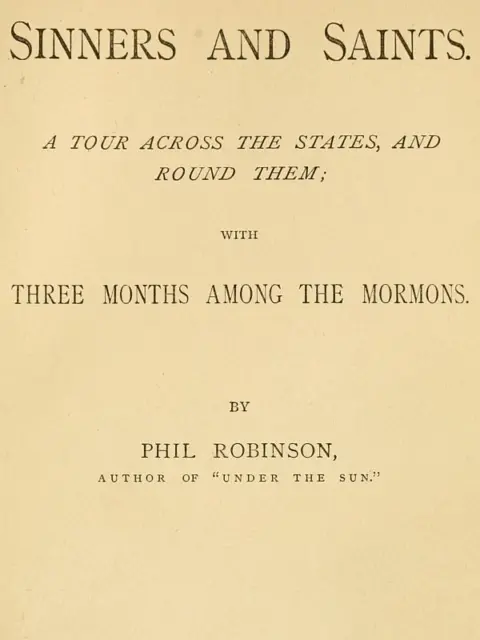
Sinners and Saints A Tour Across the States and Round Them, with Three Months Among the Mormons
Phil Robinson
THE CLASSIC COLLECTION · 1894
"Birds of the Wave and Woodland" by Phil Robinson is a natural history book written in the late 19th century. The work focuses on British birds, exploring their characteristics, habits, and songs, and presents a detailed examination of their seasonal behaviors and migration patterns. The book serves as both an informative guide for birdwatchers and a reflection on the beauty and significance of these creatures in the natural world. At the start of the book, Robinson discusses the representation of various birds throughout the seasons, highlighting the thrush, blackbird, and swallow as key examples. He elaborates on the thrush as a symbol of spring, detailing its early songs amidst the lingering winter landscape and dispelling misconceptions about its migratory behavior. The narrative sets an engaging tone by weaving poetry and personal reflections into the descriptions of bird life, ultimately establishing a deep appreciation for their roles in the ecosystem. The opening portion lays the groundwork for an exploration of not only the avian world but also the interactions humans have with these familiar yet enigmatic creatures.
Introduction adapted from the source catalogue; source summaries may be automatically generated.
Free to read · English · 36,117 words · No account needed
MAKE TIME FOR A GOOD BOOK
On by default. Untick to stop anonymous reading totals. Each page counts after 10 seconds in view. How this works.
Anonymous counting is on unless you have switched it off.
And so we come to December, "the king of the months," and its wren, "the king of the birds." Why king? Because it was once decided in a parliament of the birds, that the one
that flew highest should be king. The wren hid itself on the eagle's back, and when the eagle had flown its highest, the wren flew up a little higher still. And "regulus" it remained, even in science, till quite lately, when some ridiculous fustilarian rechristened it "troglodytes." Imagine the wren being "troglodytes," the same, scientifically, as the gorilla! What a poverty it betrays in nomenclature, what a pitiful "superiority to imagination" to find that the wren and the gorilla are undistinguishable to the eye of a Professor. "Diabolus" would have been even better, for science has got no devil now, so the English wren could never have been mistaken for the great man-ape, and besides, in our folk-lore the wren is a very necromantic and wicked little person. The Evil One, it is said, once took possession of its body to serve his evil ends, and infamous enchanters have done the same. So it came to pass that people said it was a good deed and pious to kill wrens, and it is hunted to this day in many places:
"The wren, the wren, the king of the birds,
St. Stephen's day was caught i' the furze,
Sing holly, sing ivy, sing ivy, sing holly,
Sing heigh! sing ho! to scare melancholy."
This is the wren, troglodytes, in its "demoniacal aspect," to use the language of Gubernatis. In its benign aspect, "the tiny woodland dwarf," "the wren with little quill," is a bird of some sanctity:
"Malisons, malisons mair than ten
Wha harries the queen of heaven's hen."
for, as everybody knows:
"The robin and the wren
Are God Almighty's cock and hen."
And it is in its connection with that other famous bird of December, the robin-redbreast, that the wren, "Jenny Wren," is, perhaps, most popular.
Indeed, it is almost impossible to think of one without the
other, for they have been sweethearts ever since English was spoken:
"'Ah! Robin,
Joly Robin!
Tell me how thy leman doeth,
And thou shalt knowe of myn.'
'My lady is unkinde, perdé.'
'Alacke why is she so?'
'She loveth another better than me,
And yet she will say no.'"
What an enchanting entanglement it is, this of the robin and the wren, and yet we know that it was approved, for when Cock Robin died, all the birds in the air, in sympathy for the dead and for Jenny--
"Fell a sighin' and sobbin'."
Your reading position is saved on this browser. Take it to another device with a library code. Reading pages adapt to text, rather than matching a printed edition.
BEHIND THE BOOK
This eBook is for the use of anyone anywhere in the United States and most other parts of the world at no cost and with almost no restrictions whatsoever. You may copy it, give it away or re-use it under the terms of the Project Gutenberg License included with this eBook or online at www.gutenberg.org. If you are not located in the United States, you will have to check the laws of the country where you are located before using this eBook. Read the source licence.
The original source file, including credits and licence, is retained by this library. Request an original-format copy at no charge. Please include the book title and Project Gutenberg identifier #47191.
KEEP YOUR CURIOSITY GOING

Charles G. (Charles Griffith) Ross
Hannah Webster Foster

Emily Lawless
Edwin Hamlin Carr

Charles De Lano Hine
Andrew Ure