A world of green hills
Bradford Torrey
THE CLASSIC COLLECTION · 1885
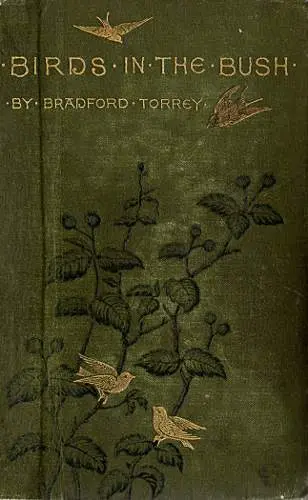
"Birds in the Bush" by Bradford Torrey is a collection of essays on ornithology written in the late 19th century. The work reflects on the beauty and behavior of birds, particularly in urban settings like Boston Common and the White Mountains, exploring the joy they inspire in observers and the observations made by the author. Torrey’s prose paints a vivid picture of birdwatching and offers insightful commentary on the relationship between humans and the avian world. At the start of the collection, readers are introduced to the environment of Boston Common through the eyes of an enthusiastic ornithologist. The author engages with the local avifauna, recounting personal encounters with various bird species, including the cat-bird and the yellow-bellied woodpecker. He reflects on migration patterns and the surprises nature holds, even in busy urban parks. The writing captures the wonder of birdwatching and encourages an appreciation for these creatures, inviting readers to observe the life around them with curiosity and respect.
Introduction adapted from the source catalogue; source summaries may be automatically generated.
Free to read · English · 64,641 words · No account needed
MAKE TIME FOR A GOOD BOOK
On by default. Untick to stop anonymous reading totals. Each page counts after 10 seconds in view. How this works.
Anonymous counting is on unless you have switched it off.
Even as things are, however, the cold season is sure to bring us a few butcher-birds. These come on business, and are now welcomed as public benefactors, though formerly our sparrow-loving municipal authorities thought it their duty to shoot them. They travel singly, as a rule, and sometimes the same bird will be here for several weeks together. Then you will have no trouble about finding here and there in the hawthorn trees pleasing evidences of his activity and address. Collurio is brought up to be in love with his work. In his Mother Goose it is written,--
Fe, fi, fo, farrow!
I smell the blood of an English sparrow;
and however long he may live, he never forgets his early training. His days, as the poet says, are "bound each to each by natural piety." Happy lot! wherein duty and conscience go ever hand in hand; for whose possessor
"Love is an unerring light,
And joy its own security."
In appearance the shrike resembles the mocking-bird. Indeed, a policeman whom I found staring at one would have it that he was a mocking-bird. "Don't you see he is? And he's been singing, too." I had nothing to say against the singing, since the shrike will often twitter by the half hour in the very coldest weather. But further discussion concerning the bird's identity was soon rendered needless; for, while we were talking, along came a sparrow, and dropped carelessly into a hawthorn bush, right under the shrike's perch. The latter was all attention instantly, and, after waiting till the sparrow had moved a little out of the thick of the branches, down he pounced. He missed his aim, or the sparrow was too quick for him, and although he made a second swoop, and followed that by a hot chase, he speedily came back without his prey. This little exertion, however, seemed to have provoked his appetite; for, instead of resuming his coffee-tree perch, he went into the hawthorn, and began to feed upon the carcass of a bird which, it seemed, he had previously laid up in store. He was soon frightened off for a few moments by the approach of a third man, and the policeman improved the opportunity to visit the bush and bring away his breakfast. When the fellow returned and found his table empty, he did not manifest the slightest disappointment (the shrike never does; he is a fatalist, I think); but in order to see what he would do, the policeman tossed the body to him. It lodged on one of the outer twigs, and immediately the shrike came for it; at the same time spreading his beautifully bordered tail and screaming loudly. Whether these demonstrations were intended to express delight, or anger, or contempt, I could not judge; but he seized the body, carried it back to its old place, drove it again upon the thorn, and proceeded to devour it more voraciously than ever, scattering the feathers about in a lively way as he tore it to pieces. The third man, who had never before seen such a thing, stepped up within reach of the bush, and eyed the performance at his leisure, the shrike not deigning to mind him in the least. A few mornings later the same bird gave me another and more amusing exhibition of his nonchalance. He was singing from the top of our one small larch-tree, and I had stopped near the bridge to look and listen, when a milkman entered at the Commonwealth Avenue gate, both hands full of cans, and, without noticing the shrike, walked straight under the tree. Just then, however, he heard the notes overhead, and, looking up, saw the bird. As if not knowing what to make of the creature's assurance, he stared at him for a moment, and then, putting down his load, he seized the trunk with both hands, and gave it a good shake. But the bird only took a fresh hold; and when the man let go, and stepped back to look up, there he sat, to all appearance as unconcerned as if nothing had happened. Not to be so easily beaten, the man grasped the trunk again, and shook it harder than before; and this time Collurio seemed to think the joke had been carried far enough, for he took wing, and flew to another part of the Garden. The bravado of the butcher-bird is great, but it is not unlimited. I saw him, one day, shuffling along a branch in a very nervous, unshrikely fashion, and was at a loss to account for his unusual demeanor till I caught sight of a low-flying hawk sweeping over the tree. Every creature, no matter how brave, has some other creature to be afraid of; otherwise, how would the world get on?
Your reading position is saved on this browser. Take it to another device with a library code. Reading pages adapt to text, rather than matching a printed edition.
Bradford Torrey
Bradford Torrey
Bradford Torrey
Bradford Torrey
BEHIND THE BOOK
This eBook is for the use of anyone anywhere in the United States and most other parts of the world at no cost and with almost no restrictions whatsoever. You may copy it, give it away or re-use it under the terms of the Project Gutenberg License included with this eBook or online at www.gutenberg.org. If you are not located in the United States, you will have to check the laws of the country where you are located before using this eBook. Read the source licence.
The original source file, including credits and licence, is retained by this library. Request an original-format copy at no charge. Please include the book title and Project Gutenberg identifier #28019.
KEEP YOUR CURIOSITY GOING

David Patterson (Spirit) Hatch

David Patterson (Spirit) Hatch

David Patterson (Spirit) Hatch

Ralph Waldo Emerson

Maurice Baring

Oscar Wilde & James McNeill Whistler