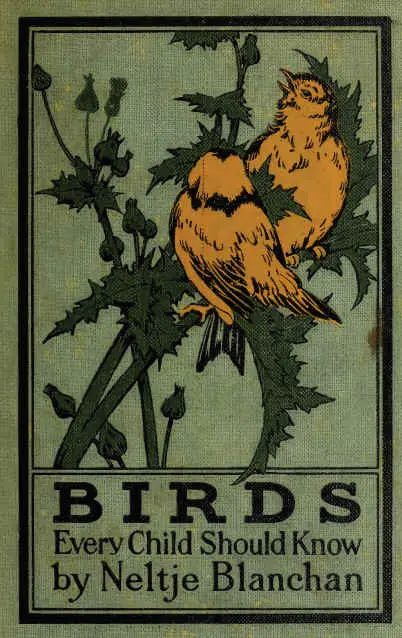
Birds Every Child Should Know
Neltje Blanchan
THE CLASSIC COLLECTION · 1904
"Bird Neighbors" by Neltje Blanchan is a nature guide published in 1897. This groundbreaking work combines scientific information with color illustrations and accessible prose to help readers identify and appreciate common birds. Blanchan organizes birds by habitat, size, and color, making identification practical for everyday observers. Enhanced by vivid descriptions that capture her joy in nature, the book became a bestseller with over 250,000 copies sold, establishing Blanchan as the leading female nature writer of her era.
Introduction adapted from the source catalogue; source summaries may be automatically generated.
Free to read · English · 72,408 words · No account needed
MAKE TIME FOR A GOOD BOOK
On by default. Untick to stop anonymous reading totals. Each page counts after 10 seconds in view. How this works.
Anonymous counting is on unless you have switched it off.
Too much stress is laid on the mischief done by the robins in the cherry trees and strawberry patches, and too little upon the quantity of worms and insects they devour. Professor Treadwell, who experimented upon some young robins kept in captivity, learned that they ate sixty-eight earthworms daily--"that is, each bird ate forty-one per cent. more than its own weight in twelve hours! The length of these worms, if laid end to end, would be about fourteen feet. Man, at this rate, would eat about seventy pounds of flesh a day, and drink five or six gallons of water."
Orchard Oriole
(Icterus spurius) Blackbird and Oriole family
Called also: ORCHARD STARLING; ORCHARD HANG-NEST
Length--7 to 7.3 inches. About one-fourth smaller than the
robin.
Male--Head, throat, upper back, tail, and part of wings black. Breast, rump, shoulders, under wing and tail coverts, and under parts bright reddish brown. Whitish-yellow markings on a few tail and wing feathers.
Female--Head and upper parts olive, shading into brown; brighter on head and near tail. Back and wings dusky brown, with pale-buff shoulder-bars and edges of coverts. Throat black. Under parts olive, shading into yellow.
Range--Canada to Central America. Common in temperate
latitudes of the United States.
Migrations--Early May. Middle of September. Common summer
resident.
With a more southerly range than the Baltimore oriole and less conspicuous coloring, the orchard oriole is not so familiar a bird in many Northern States, where, nevertheless, it is quite common enough to be classed among our would-be intimates. The orchard is not always as close to the house as this bird cares to venture; he will pursue an insect even to the piazza vines.
His song, says John Burroughs, is like scarlet, "strong, intense, emphatic," but it is sweet and is more rapidly uttered than that of others of the family. It is ended for the season early in July.
This oriole, too, builds a beautiful nest, not often pendent like the Baltimore's, but securely placed in the fork of a sturdy fruit tree, at a moderate height, and woven with skill and precision, like a basket. When the dried grasses from one of these nests were stretched and measured, all were found to be very nearly the same length, showing to what pains the little weaver had gone to make the nest neat and pliable, yet strong. Four cloudy-white eggs with dark-brown spots are usually found in the nest in June.
The figures in black-faced type indicate the page upon which the biography of the bird is given.
Accentor, Golden-crowned (see Ovenbird), 180.
Bellbird (see Wood Thrush), 123.
Your reading position is saved on this browser. Take it to another device with a library code. Reading pages adapt to text, rather than matching a printed edition.
BEHIND THE BOOK
This eBook is for the use of anyone anywhere in the United States and most other parts of the world at no cost and with almost no restrictions whatsoever. You may copy it, give it away or re-use it under the terms of the Project Gutenberg License included with this eBook or online at www.gutenberg.org. If you are not located in the United States, you will have to check the laws of the country where you are located before using this eBook. Read the source licence.
The original source file, including credits and licence, is retained by this library. Request an original-format copy at no charge. Please include the book title and Project Gutenberg identifier #37735.
KEEP YOUR CURIOSITY GOING

Charles G. (Charles Griffith) Ross
Hannah Webster Foster

Emily Lawless
Edwin Hamlin Carr

Charles De Lano Hine
Andrew Ure