
Flower Guide: Wild Flowers East of the Rockies (Revised and with New Illustrations)
Chester A. (Chester Albert) Reed
THE CLASSIC COLLECTION · 1906
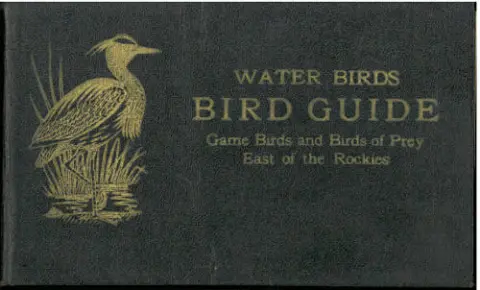
"Bird Guide: Water Birds, Game Birds, and Birds of Prey East of the Rockies" by Chester A. Reed is a scientific publication written in the early 20th century. This guide focuses on the identification and characteristics of various bird species commonly found in North America, particularly those inhabiting wetlands and game environments. The book serves as a resource for birdwatchers and ornithologists alike, providing detailed descriptions and advice on studying these fascinating creatures in their natural habitats. The opening of the guide introduces the reader to the author's motivation for creating a practical bird identification tool that aids enthusiasts in recognizing different species in the wild without the need to capture them. Reed emphasizes the importance of careful observation, noting specific features of the birds and their behaviors that can assist in identification. He discusses the challenges faced by ornithologists in understanding bird behavior and stresses the significance of humane practices in wildlife observation. The beginning sets a tone of curiosity and respect for nature, promising readers a valuable resource for enhancing their appreciation of avian life.
Introduction adapted from the source catalogue; source summaries may be automatically generated.
Free to read · English · 37,448 words · No account needed
MAKE TIME FOR A GOOD BOOK
On by default. Untick to stop anonymous reading totals. Each page counts after 10 seconds in view. How this works.
Anonymous counting is on unless you have switched it off.
Large black patch on the ears; tail only moderately long, and broadly rounded, with large white ends to the outer feathers. Besides the regular cooing notes, common to doves, this species has a peculiar song likened by some, to the first attempts at crowing, of a young rooster.
Nest.—A shabby platform of twigs, lined with bits of weeds, moss and leaves; placed at any height from the ground in bushes, trees or cacti. Eggs white.
Range.—Texas, New Mexico, Arizona and casually southern Florida,
southward.
GROUND DOVE
320. Chæmepelia passerina terrestris. 6.75 in.
Size very small; tail short and nearly square. Back of head blue-gray; forehead and most of underparts pinkish. Bill, feet and eye, more or less red.
Nest.—A frail structure of twigs, lined with pine needles; placed usually at low elevations in bushes. The two eggs are pure white.
Range.—South Atlantic and Gulf States; abundant near the coasts; winters
throughout its range.
320a., Mexican Ground Dove, found from Texas to California, is slightly paler than the eastern species.
INCA DOVE
321. Scardafella inca. 8 in.
Tail long, with the outer feathers tipped with white, and shorter than the middle ones. Feathers mostly margined with brownish-black. The bases of the primaries are bright chestnut, and the whole underwing is of that color; bill black; eye and feet reddish.
Range.—Southern Texas, southern Arizona and southern New Mexico.
VULTURES, HAWKS AND OWLS—Order Raptores AMERICAN VULTURES—Family Cathartidæ
TURKEY VULTURE OR BUZZARD
325. Cathartes aura septentrionalis. 30 in.
Head naked; red or carmine; bill dull whitish; eyes brown; feet pinkish.
Plumage blackish-brown.
Nest.—Their two eggs are laid upon the ground, between rocks, under logs, or in hollow trees; they are whitish, handsomely blotched with brown.
Range.—Breeds from the Gulf north to New Jersey, Illinois, Minnesota and
British Columbia.
BLACK VULTURE
326. Catharista urubu. 24 in.
Entire plumage, including the naked head, black; feet and tip of bill yellowish. Under surface of the wings white, making it very easy to identify.
Nest.—Two eggs, greenish-white, blotched with brownish. (3.00 × 2.00).
Range.—Resident north to North Carolina, southern Illinois and Kansas.
FALCONS, HAWKS AND EAGLES—Family Falconidæ
SWALLOW-TAILED KITE
327. Elanoides forficatus. 24 in.
Tail long and deeply forked; plumage white, and glossy black; feet short but stout; bill black, with cere and feet bluish-gray. The flight of these birds is very swift and swallow-like; at times they circle about for long periods, on motionless wings; at others, they will be seen swooping over marshes and low ground; the evolutions they perform during the mating season are wonderful to behold, floating, sailing, doubling and turning, in all imaginable positions, as though they were a part of the air itself.
Notes.—A shrill whistled “peet-peet.”
Your reading position is saved on this browser. Take it to another device with a library code. Reading pages adapt to text, rather than matching a printed edition.
Chester A. (Chester Albert) Reed
Chester A. (Chester Albert) Reed
Chester A. (Chester Albert) Reed
BEHIND THE BOOK
This eBook is for the use of anyone anywhere in the United States and most other parts of the world at no cost and with almost no restrictions whatsoever. You may copy it, give it away or re-use it under the terms of the Project Gutenberg License included with this eBook or online at www.gutenberg.org. If you are not located in the United States, you will have to check the laws of the country where you are located before using this eBook. Read the source licence.
The original source file, including credits and licence, is retained by this library. Request an original-format copy at no charge. Please include the book title and Project Gutenberg identifier #46516.
KEEP YOUR CURIOSITY GOING

Charles G. (Charles Griffith) Ross
Hannah Webster Foster

Emily Lawless
Edwin Hamlin Carr

Charles De Lano Hine
Andrew Ure