
Flower Guide: Wild Flowers East of the Rockies (Revised and with New Illustrations)
Chester A. (Chester Albert) Reed
THE CLASSIC COLLECTION · 1906
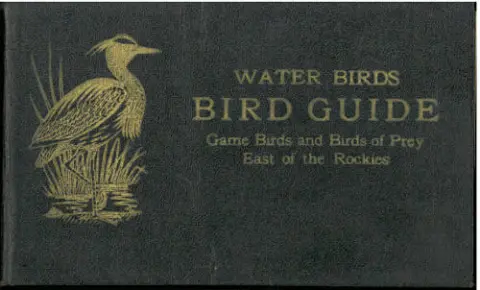
"Bird Guide: Water Birds, Game Birds, and Birds of Prey East of the Rockies" by Chester A. Reed is a scientific publication written in the early 20th century. This guide focuses on the identification and characteristics of various bird species commonly found in North America, particularly those inhabiting wetlands and game environments. The book serves as a resource for birdwatchers and ornithologists alike, providing detailed descriptions and advice on studying these fascinating creatures in their natural habitats. The opening of the guide introduces the reader to the author's motivation for creating a practical bird identification tool that aids enthusiasts in recognizing different species in the wild without the need to capture them. Reed emphasizes the importance of careful observation, noting specific features of the birds and their behaviors that can assist in identification. He discusses the challenges faced by ornithologists in understanding bird behavior and stresses the significance of humane practices in wildlife observation. The beginning sets a tone of curiosity and respect for nature, promising readers a valuable resource for enhancing their appreciation of avian life.
Introduction adapted from the source catalogue; source summaries may be automatically generated.
Free to read · English · 37,448 words · No account needed
MAKE TIME FOR A GOOD BOOK
On by default. Untick to stop anonymous reading totals. Each page counts after 10 seconds in view. How this works.
Anonymous counting is on unless you have switched it off.
Range.—Rocky Mts., from Mexico to Montana and east to South Dakota. 297b., Richardson Grouse (D. o. richardsonii), is found on the eastern slopes of the Rockies, north to British America. Little or no band on the tail.
HUDSONIAN SPRUCE GROUSE
298. Canachites canadensis. 15 in.
Very similar to the next, which is our common species, but the female is not quite as rusty. Found in Labrador and about Hudson Bay.
CANADA GROUSE; SPRUCE GROUSE
298c. C. c. canace. 15 in.
Male black and grayish; female chiefly rusty, barred with black. The Spruce Grouse is usually found in dense thickets and groves or swamps of evergreen woods. It is one of the least suspicious of birds, and in winter, is sometimes knocked down by sticks in the hands of deer hunters. Their flesh is unfit to eat and consequently they are not hunted.
Notes.—A drumming, said to be produced by the wings, when in the air; a clucking by the female.
Nest.—Eggs laid on the ground, usually under low, spreading branches of spruces; bright buff with bold black blotches (1.70 × 1.25).
Range.—Northern New England, New York and Minnesota, northward.
RUFFED GROUSE
300. Bonassa umbellus. 17 in.
Crested and with two large, black, neck-ruffs; plumage brown, black and white. Female with the ruffs smaller and usually brownish. These grouse have two color phases, the general tone of plumage being either reddish brown or gray, independent of age or sex of bird. These naturally wild, shy grouse are the kings of the eastern game birds, their wariness and speed with which they will dodge through the trees being the only reasons they have so long withstood the hunting to which they are subjected. During spring, the male struts often, tail expanded into a half circle, head thrown back to meet the upturned tail, and ruff spread so as to form a complete collar. They make a loud drumming by beating the air with their wings.
Nest.—Eggs on leaves in the woods; plain brownish-buff (1.55 × 1.15).
Range.—Resident from Va. and Ark. north to southern Canada. 300a., Canadian Ruffed Grouse (B. u. togata), is found in the southern British provinces and northern New England.
WILLOW PTARMIGAN
301. Lagopus lagopus. 15 in.
In winter, white with black tail feathers. In summer, usually
reddish-brown with black bars. This species has a much stouter bill than
the next.
Nest.—Eggs laid on the ground. Rich buffy, so heavily blotched and streaked with black as to nearly conceal it (1.75 × 1.25).
Range.—Breeds in the northern half of Canada, migrating southward to
southern Canada.
301a., Allen Ptarmigan (L. l. alleni), found in Newfoundland, is similar, but in winter the shafts of the primaries are always black.
ROCK PTARMIGAN
302. Lagopus rupestris. 14 in.
Your reading position is saved on this browser. Take it to another device with a library code. Reading pages adapt to text, rather than matching a printed edition.
Chester A. (Chester Albert) Reed
Chester A. (Chester Albert) Reed
Chester A. (Chester Albert) Reed
BEHIND THE BOOK
This eBook is for the use of anyone anywhere in the United States and most other parts of the world at no cost and with almost no restrictions whatsoever. You may copy it, give it away or re-use it under the terms of the Project Gutenberg License included with this eBook or online at www.gutenberg.org. If you are not located in the United States, you will have to check the laws of the country where you are located before using this eBook. Read the source licence.
The original source file, including credits and licence, is retained by this library. Request an original-format copy at no charge. Please include the book title and Project Gutenberg identifier #46516.
KEEP YOUR CURIOSITY GOING

Charles G. (Charles Griffith) Ross
Hannah Webster Foster

Emily Lawless
Edwin Hamlin Carr

Charles De Lano Hine
Andrew Ure