
Flower Guide: Wild Flowers East of the Rockies (Revised and with New Illustrations)
Chester A. (Chester Albert) Reed
THE CLASSIC COLLECTION · 1906
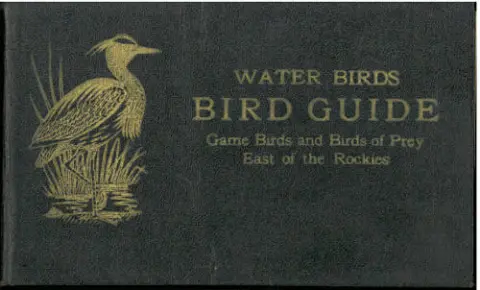
"Bird Guide: Water Birds, Game Birds, and Birds of Prey East of the Rockies" by Chester A. Reed is a scientific publication written in the early 20th century. This guide focuses on the identification and characteristics of various bird species commonly found in North America, particularly those inhabiting wetlands and game environments. The book serves as a resource for birdwatchers and ornithologists alike, providing detailed descriptions and advice on studying these fascinating creatures in their natural habitats. The opening of the guide introduces the reader to the author's motivation for creating a practical bird identification tool that aids enthusiasts in recognizing different species in the wild without the need to capture them. Reed emphasizes the importance of careful observation, noting specific features of the birds and their behaviors that can assist in identification. He discusses the challenges faced by ornithologists in understanding bird behavior and stresses the significance of humane practices in wildlife observation. The beginning sets a tone of curiosity and respect for nature, promising readers a valuable resource for enhancing their appreciation of avian life.
Introduction adapted from the source catalogue; source summaries may be automatically generated.
Free to read · English · 37,448 words · No account needed
MAKE TIME FOR A GOOD BOOK
On by default. Untick to stop anonymous reading totals. Each page counts after 10 seconds in view. How this works.
Anonymous counting is on unless you have switched it off.
ARCTIC TERN
71. Sterna paradisæa. 15.5 in.
Similar to the Common Tern, but tail longer (forked 4.5 in.) and bill wholly red. In winter, bill and feet dark, as are those of the others.
Range.—Breeds from Mass. northwards; winters in the south.
ROSEATE TERN
72. Sterna dougalli. 15.5 in.
This species is the most gracefully formed of the terns. The tail is 7.5 in. long, forked to a depth of 5.25 in. In summer, the bill is blackish, changing to red only at the base. The underparts are a beautiful rosy tint in the breeding season; tail entirely white; feet red. In winter the usual changes occur, and young birds have dusky edges to the feathers of the back and wings. Terns are now becoming more abundant on our coast, their slaughter and persecution for millinery purposes fortunately having been stopped in time to prevent their extinction.
They feed chiefly upon small fish and marine insects, and often gather about fishing boats, waiting for an opportunity to dive after any bit that may be thrown overboard.
Notes.—A harsh “cack” and “tee-arr,” like that of the common Tern.
Nest.—Eggs like those of the similar terns.
Range.—Breeds on the Atlantic coast north to Mass.; winters south of the
U. S.
LEAST TERN
74. Sterna antillarum. 9 in.
Smallest of our terns. Adult in summer.—Crown, nape, and line through the eye, black; forehead and line above the eye, white; bill and feet yellow, the former black at the tip. In winter, the crown is white, the blackish being restricted to the nape and about the eyes.
These pretty little sea swallows were abundant both on the coast and in the interior but are yearly becoming more scarce especially on the Atlantic coast. They are very aggressive when anyone approaches their nesting grounds and will continually dash down at you as they utter their sharp cries of disapproval.
Notes.—A sharp, metallic clattering “cheep, cheep.”
Nest.—Two or three eggs are laid upon the bare sand. They are buffy-gray, sharply specked with blackish (1.25 × .95).
Range.—Breeds north to Mass., the Great Lakes and Calif.; winters south
of the United States.
SOOTY TERN
75. Sterna fuscata. 17 in.
Adult in summer.—Above sooty-black, except the white outer tail feathers. Crown, line through the eye, bill and feet, black; forehead and underparts white; eye red. Young birds are smoky slate color all over, with the tail feathers, and some on the back and breast, tipped with whitish. This is the “egg bird” of tropical countries, thousands of their eggs being taken for food.
Note.—A nasal “ker-wacky-wak” (Chapman).
Nest.—A single egg deposited in a hollow in the sand; it is creamy-white, spotted with blackish-brown.
Your reading position is saved on this browser. Take it to another device with a library code. Reading pages adapt to text, rather than matching a printed edition.
Chester A. (Chester Albert) Reed
Chester A. (Chester Albert) Reed
Chester A. (Chester Albert) Reed
BEHIND THE BOOK
This eBook is for the use of anyone anywhere in the United States and most other parts of the world at no cost and with almost no restrictions whatsoever. You may copy it, give it away or re-use it under the terms of the Project Gutenberg License included with this eBook or online at www.gutenberg.org. If you are not located in the United States, you will have to check the laws of the country where you are located before using this eBook. Read the source licence.
The original source file, including credits and licence, is retained by this library. Request an original-format copy at no charge. Please include the book title and Project Gutenberg identifier #46516.
KEEP YOUR CURIOSITY GOING

Charles G. (Charles Griffith) Ross
Hannah Webster Foster

Emily Lawless
Edwin Hamlin Carr

Charles De Lano Hine
Andrew Ure