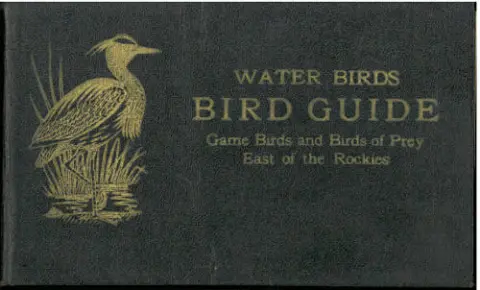
Bird Guide: Water Birds, Game Birds, and Birds of Prey East of the Rockies
Chester A. (Chester Albert) Reed
THE CLASSIC COLLECTION · 1906
"Bird Guide: Land Birds East of the Rockies, from Parrots to Bluebirds" by Chester A. Reed is a scientific publication written in the early 20th century. The book serves as a comprehensive guide to identifying various species of land birds found east of the Rocky Mountains, offering detailed descriptions and drawings of each bird species. It emphasizes the ecological importance of birds in controlling insect populations and encourages conservation efforts through education and observation. The opening of the text provides a preface where Reed discusses the critical ecological role that birds play, particularly in managing insect populations which can otherwise threaten vegetation and crops. He shares alarming statistics on the number of insects consumed daily by bird species and highlights the decline of certain bird populations due to human activities and environmental changes. Reed sets the stage for the guide by establishing the need for better public education about birds, alongside detailed practical advice on how to study and attract these vital creatures to homes, thereby fostering a greater appreciation for avian life.
Introduction adapted from the source catalogue; source summaries may be automatically generated.
Free to read · English · 36,259 words · No account needed
MAKE TIME FOR A GOOD BOOK
On by default. Untick to stop anonymous reading totals. Each page counts after 10 seconds in view. How this works.
Anonymous counting is on unless you have switched it off.
Crown blackish with a central buffy stripe; nape brown and gray; sides of head, breast and flanks, buffy without streaks.
Song.—A weak, insect-like “zee-e-e-e-e.”
Nest.—A grass-lined hollow in a field, with the top arched over so as to keep off the sun and conceal the eggs. In June four or five white, brown-specked eggs are laid (.75 × .55).
Range.—U. S. east of the Rockies; winters in southern U. S.
546b. Florida Grasshopper Sparrow (floridanus), a darker race found on the plains of interior Florida.
HENSLOW SPARROW
547. Passerherbulus henslowii. 5 inches
Crown and nape greenish, streaked with black; breast and sides buffy, streaked with black; tail feathers narrow and pointed.
This species is of a more southern distribution than the last, being rarely found in New England, but quite common in favorable localities south of Virginia.
LECONTE SPARROW
548. Passerherbulus lecontei. 5 inches
Hind head chestnut and gray; sides of head, throat, breast and flanks a
rich buff color.
Song.—A grasshopper-like squeaking.
Nest.—Of grasses in hollows of the ground on prairies; eggs greenish white thickly specked with brownish (.65 × .50).
Range.—Breeds in the Great Plains from Dakota to Manitoba, and winters southeastward to the South Atlantic and Gulf States.
SHARP-TAILED SPARROW
549. Passerherbulus caudacutus. 5¾ inches
Back of head greenish; sides of head, breast, and flanks buff with black streaks; tail feathers sharp.
Salt marshes along the seacoast or along streams emptying into the ocean are the dwelling-places of these finches. They creep about like mice in the salt grass, now running across an open space, now threading their way through the upright stalks.
Song.—A rather weak, squeaky trill.
Nest.—Of seaweed and marsh grass, attached to the grass stalks several inches above ground and often covered by a mass of dry seaweed. Eggs greenish white specked with brown (.78 × .56).
Range.—Atlantic coast of the U. S.
NELSON SPARROW
549a. Passerherbulus nelsoni. 5½ inches
Similar to the last but brighter colored and not streaked below. In the Mississippi Valley north to Manitoba. 549a. Acadian Sharp-tailed Sparrow (sub-virgatus), Atlantic coast, breeding from Maine to New Brunswick.
SEASIDE SPARROW
550. Passerherbulus maritimus. 6 inches
Yellow spot before the eye. General plumage above grayish green with no black markings. All the habits of the Seaside Sparrows are precisely like those of the Sharp-tailed Sparrows. The nests and eggs are indistinguishable and are often found in the same marshes.
Your reading position is saved on this browser. Take it to another device with a library code. Reading pages adapt to text, rather than matching a printed edition.
Chester A. (Chester Albert) Reed
Chester A. (Chester Albert) Reed
Chester A. (Chester Albert) Reed
BEHIND THE BOOK
This eBook is for the use of anyone anywhere in the United States and most other parts of the world at no cost and with almost no restrictions whatsoever. You may copy it, give it away or re-use it under the terms of the Project Gutenberg License included with this eBook or online at www.gutenberg.org. If you are not located in the United States, you will have to check the laws of the country where you are located before using this eBook. Read the source licence.
The original source file, including credits and licence, is retained by this library. Request an original-format copy at no charge. Please include the book title and Project Gutenberg identifier #45630.
KEEP YOUR CURIOSITY GOING

Charles G. (Charles Griffith) Ross
Hannah Webster Foster

Emily Lawless
Edwin Hamlin Carr

Charles De Lano Hine
Andrew Ure