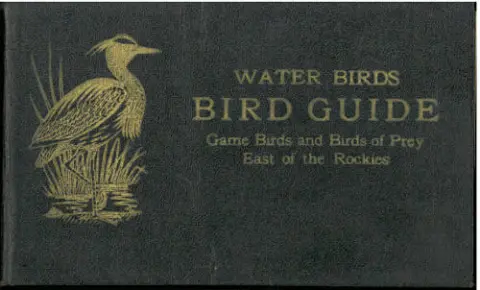
Bird Guide: Water Birds, Game Birds, and Birds of Prey East of the Rockies
Chester A. (Chester Albert) Reed
THE CLASSIC COLLECTION · 1906
"Bird Guide: Land Birds East of the Rockies, from Parrots to Bluebirds" by Chester A. Reed is a scientific publication written in the early 20th century. The book serves as a comprehensive guide to identifying various species of land birds found east of the Rocky Mountains, offering detailed descriptions and drawings of each bird species. It emphasizes the ecological importance of birds in controlling insect populations and encourages conservation efforts through education and observation. The opening of the text provides a preface where Reed discusses the critical ecological role that birds play, particularly in managing insect populations which can otherwise threaten vegetation and crops. He shares alarming statistics on the number of insects consumed daily by bird species and highlights the decline of certain bird populations due to human activities and environmental changes. Reed sets the stage for the guide by establishing the need for better public education about birds, alongside detailed practical advice on how to study and attract these vital creatures to homes, thereby fostering a greater appreciation for avian life.
Introduction adapted from the source catalogue; source summaries may be automatically generated.
Free to read · English · 36,259 words · No account needed
MAKE TIME FOR A GOOD BOOK
On by default. Untick to stop anonymous reading totals. Each page counts after 10 seconds in view. How this works.
Anonymous counting is on unless you have switched it off.
Adults with a concealed orange crown patch; young with none. From the time of their arrival in May until they leave us in August, Kingbirds are much in evidence in farmyards and orchards. They are one of the most noisy birds, always quarreling about something, and usually coming off victorious in whatever they may undertake. Crows are objects of hatred to them, and they always drive them from the neighborhood, vigorously dashing upon and picking them from above and often following them for a great distance. They have their favorite perches from which they watch for insects, usually a dead branch, a fence post, or a tall stalk in the field.
Note.—A series of shrill, harsh sounds like “thsee,” “thsee.”
Nest.—Of sticks, rootlets, grass, string, etc., placed in orchard trees or open woods at any height. Four or five creamy white eggs, specked and spotted with reddish brown (.95 × .70).
Range.—Breeds from the Gulf to southern Canada.
GRAY KINGBIRD
445. Tyrannus dominicensis. 9 inches
Differs from the common Kingbird in being larger and gray above; has black ear coverts, and no white tip to tail.
Like the last species, these are very noisy and pugnacious, and rule their domains with the hand of a tyrant. After they have mated they quarrel very little among themselves, and often several may use the same lookout twig from which to dash after passing flies or moths.
Note.—A rapidly repeated, shrill shriek: “pe-che-ri,” “pe-che-ri.”
Nest.—Rather more shabbily built but of the same materials as those used by our common Kingbird. Placed in all kinds of trees, but more often in mangroves, where they are commonly found. Three to five pinkish-white eggs, profusely blotched with brown (1.00 × .72).
Range.—West Indies and Florida, Georgia and South Carolina. Winters in the West Indies and Central America.
ARKANSAS KINGBIRD
447. Tyrannus verticalis. 9 inches
These tyrant flycatchers are abundant west of the Mississippi, where they are often, and perhaps more aptly, known as the Western Kingbirds. If possible, they are even more noisy and pugnacious than the eastern species. They have a great variety of notes, all rather unpleasant to the ear. Their food, like that of the other Kingbirds, consists of moths, butterflies, ants, grasshoppers, crickets, etc., etc., most of which they catch on the wing.
Note.—A shrill, metallic squeak; a low twittering and a harsh, discordant scream, all impossible to print.
Nest.—Quite large and clumsily made of paper, rags, twigs, rootlets, and grasses, placed in all sorts of locations, frequently in eave troughs or above windows. The eggs are creamy white, spotted with brown (.95 × .65).
Range.—Western United States, breeding from Texas to Manitoba and west to the Pacific; winters south of U. S.
Your reading position is saved on this browser. Take it to another device with a library code. Reading pages adapt to text, rather than matching a printed edition.
Chester A. (Chester Albert) Reed

Chester A. (Chester Albert) Reed
Chester A. (Chester Albert) Reed
BEHIND THE BOOK
This eBook is for the use of anyone anywhere in the United States and most other parts of the world at no cost and with almost no restrictions whatsoever. You may copy it, give it away or re-use it under the terms of the Project Gutenberg License included with this eBook or online at www.gutenberg.org. If you are not located in the United States, you will have to check the laws of the country where you are located before using this eBook. Read the source licence.
The original source file, including credits and licence, is retained by this library. Request an original-format copy at no charge. Please include the book title and Project Gutenberg identifier #45630.
KEEP YOUR CURIOSITY GOING

Charles G. (Charles Griffith) Ross
Hannah Webster Foster

Emily Lawless
Edwin Hamlin Carr

Charles De Lano Hine
Andrew Ure