READ · DISCOVER · ENJOYClassic literature · Always free
Biographical Notices of the Portraits at Hinchingbrook — digital edition cover

THE CLASSIC COLLECTION · 1876

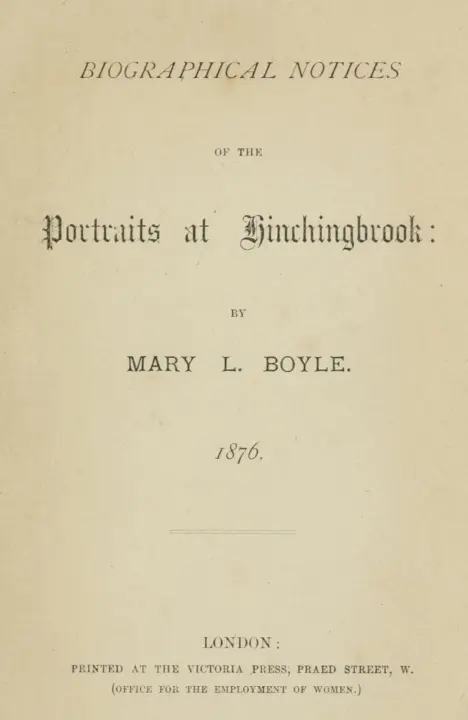
Biographical Notices of the Portraits at Hinchingbrook

"Biographical Notices of the Portraits at Hinchingbrook" by Mary Louisa Boyle is a historical account written in the late 19th century. This work provides detailed descriptions and biographical sketches of the portraits located in Hinchingbrook House, focusing particularly on notable figures from English history. Through these descriptions, Boyle aims to highlight both the larger historical impacts of these individuals and the more intimate aspects of their lives. The opening of the work introduces the context of the portraits at Hinchingbrook House, specifically detailing the life and contributions of Edward Montagu, the first Earl of Sandwich. The narrative outlines his political and military career during a tumultuous period in English history, including his loyalty to the crown and involvement in naval engagements. The text employs a rich blend of historical anecdotes and personal reflections from contemporaries, such as Samuel Pepys, illustrating the earl's complex character and the significance of his legacy within the Montagu family's lineage. This section not only paints a vivid picture of Earl Sandwich's life but also sets the tone for the exploration of other characters represented in the portraits found at Hinchingbrook.

Introduction adapted from the source catalogue; source summaries may be automatically generated.

Start reading ↓

Free to read · English · 44,693 words · No account needed

MAKE TIME FOR A GOOD BOOK

Biographical Notices of the Portraits at Hinchingbrook

On by default. Untick to stop anonymous reading totals. Each page counts after 10 seconds in view. How this works.

Anonymous counting is on unless you have switched it off.

Biographical Notices of the Portraits at Hinchingbrook

“Thus,” says Stirling, “died one of the most unfortunate monarchs, ever cursed by a hereditary crown.”

IN THE ENTRANCE HALL ARE PORTRAITS OF KINGS GEORGE II. AND GEORGE III., BY SHACKLETON AND RAMSAY, OF JOHN, FOURTH EARL OF SANDWICH, AND OF SEVERAL BRITISH ADMIRALS, BY DANCE.

LORD SANDWICH’S ROOM.

Omai, the Otaheitan.

AN ENGRAVING.

He played such a prominent part in the entertainments at Hinchingbrook, and had such a curious life of adventure, that a brief notice will scarcely be misplaced. His father was a man of considerable property in Whetea, one of the South Pacific Islands, which had been conquered by a neighbour, and he took refuge in Huaheine, where he died, leaving Omai, and several other children, in a state of poverty, and dependence. Captain Cook tells us, that Captain Furneaux, visiting these islands, becoming interested in Omai, conveyed him to England, where he became a resident under Lord Sandwich’s roof, (John, fourth Earl, then First Lord of the Admiralty.) Captain Cook and Mr. Cradock give the same character of the half savage, “intelligent, indolent, childlike, full of affection, and gratitude to his noble patron, but cherishing a feeling of revenge towards those of his own countrymen, who had ill-treated his father, and reduced himself to poverty. Lord Sandwich took him about to music meetings, races, etc.” “At Leicester,” says Mr. Cradock, “he divided public attention, with the Earl of Sandwich when that nobleman played on the kettledrum, his favourite instrument at the music meetings. ‘What has become of poor Omai?’ was the question once asked on some festive occasion. ‘Oh,’ was the answer, ‘I have just left him in the tea room, very happy, gallantly handing about bread and butter, to the ladies.’” Omai was not averse to admiration, and adapted himself curiously to his new life, showing such an aptitude for dancing, among other things, that a lady assured me with a little tuition he would make an excellent partner. On one occasion Lord Sandwich proposed that he should dress a shoulder of mutton, after the fashion of his country, and he proceeded accordingly to dig a hole in the lawn at Hinchingbrook, placed fuel covered with clean pebbles at the bottom, then laid the mutton neatly enveloped in leaves at the top, and having closed the hole walked constantly round it, observing the sun. The joint was then served at table, and much commended. Having been offered some stewed morella cherries, he jumped up, and assured the society he no more wished to partake of human blood, than they did. One summer’s day he entered the breakfast room at Hinchingbrook, in great pain, his hand much swollen, not being acquainted with the word “wasp,” he made Dr. Solander, who was present, understand he had been wounded by a “soldier bird,” upon which the doctor remarked: “No naturalist could have better described the obnoxious insect.” “He was,” says Cradock, “naturally genteel, and prepossessing, and fond of good clothes, once finding fault with those prepared for him, as being inferior to the quality of the dress, of the same cut the gentleman who sat beside him wore—this was of Genoese, and Omai’s of English velvet.” So far had he advanced in civilization. The government judged it best, he should return to his own country, lest the natives should suspect us of having made away with him. Mr. Cradock says he bade him good-bye on the steps of the Admiralty, when the poor fellow was deeply affected. Captain Cook says his feelings were mingled: “When he talked on the voyage, about England, and his friends, and protectors there, he was much moved, and could scarcely refrain from tears, so full of gratitude was his heart—but when we spoke of his return to his country, his eyes sparkled in the expectation of the reception he should meet with, on account of his superior knowledge, and still more on account of the treasures, with which he was laden.” The King, Lord Sandwich, Mr. Bankes (afterwards Sir Joseph), and many other friends, had furnished him with every article, which the sailors’ knowledge of the country, made them believe would be acceptable there. In fact, every means had been taken during his abode in England, as also at his departure, to make him the instrument of conveying to the Islands of the Pacific Ocean, an exalted opinion of England’s greatness, and generosity. Omai, as may have been conjectured, was very useful to Captain Cook on the voyage out, serving as interpreter, and mediator, on many occasions, at the Friendly Islands, and elsewhere. On their arrival at Otaheite, several canoes came off, but Omai took no notice of the crews or they of him, neither did they appear to recognise him, as a countryman. At length Ootee, a chief, brother-in-law to Omai, and three or four others, who all knew him before he went to England, came on board. But their meeting was in no wise tender—on the contrary, great indifference was manifested on both sides, till Omai, taking Ootee down into the cabin, displayed his treasures of trinkets etc., but more especially some red feathers, of a few of which, he begged his relative’s acceptance. When this was known on deck, the whole state of affairs was changed, and Ootee, who would scarcely speak to Omai before, now begged they might be Tayos (friends) and exchange names—an honour Omai accepted with dignity, and Ootee, in return for the valuable feathers, sent on shore for a hog. Such were the civilities that passed, on our friend’s return, and it was evident that all the affection was for his property, and not his person. When present at some of the barbarous customs, prevalent in these Islands, Omai, by desire of Captain Cook, expostulated with the chiefs on their cruelty with so much spirit, as to incur their displeasure. The gallant commander gives an elaborate account of the dainties prepared for him, and some of the ship’s crew, when they dined on shore with the two brothers-in-law. Captain Cook endeavoured to persuade Omai to settle at Otaheite, but his wishes turned to Whetea, his native place, where his father had originally held land. The Captain thought he could get it restored to him, if he would make friends with the conquerors, but Omai was a staunch patriot, and refused, begging that he might be reinstated through the intervention of the English arms. No way likely, said Captain Cook, who, however, willing to serve him, sought an interview with the chief men of the Island, to induce them to permit Omai to reside at Huaheine. A grand function took place, when Omai made his offering to the gods, of red feathers, and fine cloth from England; and a set of prayers dictated by himself, was pronounced, in which his English friends were duly remembered, Lord Sandwich and Tootee (Cook) in particular. He also told them of his kind reception in England by the King and his Earees, (nobles), that he had returned enriched with all sorts of treasures, that would be useful to his countrymen, etc., and that it was Captain Cook’s wish that they should give him a piece of land to build a house, etc.; and that if they would not do so——here followed some threats, which the Englishman had to disavow, and the chiefs were so much edified by the gallant sailor’s speech, that one of them assured him, the whole Island was his own, and therefore he could give what portion he pleased, to his friend. The result of all this was, that land was granted, and the ships’ carpenters built Omai a house, and laid out, and planted his small garden. He found several relatives at Huaheine, “who did not indeed rob him,” says Captain Cook, “but I fear they are scarcely of sufficient influence, to protect him from others.” The kind Englishman was under great apprehension, at the danger Omai incurred from being the only rich man in the Island, and he took every precaution he could think of, to ensure his safety, declaring that he would soon revisit the Island, and if any one had proved an enemy to Omai, he might dread the wrath of the British commander. All the English treasures were carried on shore, as soon as Omai’s house had progressed sufficiently—pots, kettles, dishes, plates, and better still, a box of toys and of fireworks—the latter an object of pleasure, and fear to the inhabitants. But most of the English utensils were useless to him here, and he wisely disposed of them, for hatchets, or other tools.

Your reading position is saved on this browser. Take it to another device with a library code. Reading pages adapt to text, rather than matching a printed edition.

More from this author

BEHIND THE WORDS

About Mary Louisa Boyle

Mary Louisa Boyle (1810–1890). Explore Biographical catalogue of the portraits at Longleat in the county of Wilts, the seat of the Marquis of Bath, Biographical Catalogue of the Portraits at Panshanger, the Seat of Earl Cowper, K.G., Biographical Notices of the Portraits at Hinchingbrook in this collection. These books span biography & memoir, history.

Explore this author’s books →

THE READERS’ VERDICT

How did this story stay with you?

Not rated yet
Your rating for Biographical Notices of the Portraits at Hinchingbrook

Be the first to share your verdict.

One rating per browser, which you can change or remove. A necessary browser identifier remembers your vote. How ratings work

A GOOD STORY DESERVES COMPANY

Pass this book along.

A great read is even better when it’s shared.

SEND A LITTLE INSPIRATION

Share this book

BEHIND THE BOOK

Edition & source details.

Title
Biographical Notices of the Portraits at Hinchingbrook
Author
Mary Louisa Boyle
First publication (Open Library catalogue match)
1876
Digital edition publisher
Project Gutenberg
Gutenberg release date
2020-09-14
Language
English
Source edition imprint
Not stated in source catalogue
Source identifier
Project Gutenberg #63204
Contributors
No additional named contributors in source metadata

Public-domain source & licence

This eBook is for the use of anyone anywhere in the United States and most other parts of the world at no cost and with almost no restrictions whatsoever. You may copy it, give it away or re-use it under the terms of the Project Gutenberg License included with this eBook or online at www.gutenberg.org. If you are not located in the United States, you will have to check the laws of the country where you are located before using this eBook. Read the source licence.

Full source licence and obtaining an original copy

The original source file, including credits and licence, is retained by this library. Request an original-format copy at no charge. Please include the book title and Project Gutenberg identifier #63204.

the full Project Gutenberg License must appear
prominently whenever any copy of a Project Gutenberg work (any work
on which the phrase “Project Gutenberg” appears, or with which the
phrase “Project Gutenberg” is associated) is accessed, displayed,
performed, viewed, copied or distributed:

This eBook is for the use of anyone anywhere in the United States and most
other parts of the world at no cost and with almost no restrictions
whatsoever. You may copy it, give it away or re-use it under the terms
of the Project Gutenberg™ License included with this eBook or online
at www.gutenberg.org. If you
are not located in the United States, you will have to check the laws
of the country where you are located before using this eBook.

1.E.2. If an individual Project Gutenberg electronic work is
derived from texts not protected by U.S. copyright law (does not
contain a notice indicating that it is posted with permission of the
copyright holder), the work can be copied and distributed to anyone in
the United States without paying any fees or charges. If you are
redistributing or providing access to a work with the phrase “Project
Gutenberg” associated with or appearing on the work, you must comply
either with the requirements of paragraphs 1.E.1 through 1.E.7 or
obtain permission for the use of the work and the Project Gutenberg
trademark as set forth in paragraphs 1.E.8 or 1.E.9.

1.E.3. If an individual Project Gutenberg electronic work is posted
with the permission of the copyright holder, your use and distribution
must comply with both paragraphs 1.E.1 through 1.E.7 and any
additional terms imposed by the copyright holder. Additional terms
will be linked to the Project Gutenberg License for all works
posted with the permission of the copyright holder found at the
beginning of this work.

1.E.4. Do not unlink or detach or remove the full Project Gutenberg
License terms from this work, or any files containing a part of this
work or any other work associated with Project Gutenberg.

1.E.5. Do not copy, display, perform, distribute or redistribute this
electronic work, or any part of this electronic work, without
prominently displaying the sentence set forth in paragraph 1.E.1 with
active links or immediate access to the full terms of the Project
Gutenberg License.

1.E.6. You may convert to and distribute this work in any binary,
compressed, marked up, nonproprietary or proprietary form, including
any word processing or hypertext form. However, if you provide access
to or distribute copies of a Project Gutenberg work in a format
other than “Plain Vanilla ASCII” or other format used in the official
version posted on the official Project Gutenberg website
(www.gutenberg.org), you must, at no additional cost, fee or expense
to the user, provide a copy, a means of exporting a copy, or a means
of obtaining a copy upon request, of the work in its original “Plain
Vanilla ASCII” or other form. Any alternate format must include the
full Project Gutenberg License as specified in paragraph 1.E.1.

1.E.7. Do not charge a fee for access to, viewing, displaying,
performing, copying or distributing any Project Gutenberg works
unless you comply with paragraph 1.E.8 or 1.E.9.

1.E.8. You may charge a reasonable fee for copies of or providing
access to or distributing Project Gutenberg electronic works
provided that:

• You pay a royalty fee of 20% of the gross profits you derive from
the use of Project Gutenberg works calculated using the method
you already use to calculate your applicable taxes. The fee is owed
to the owner of the Project Gutenberg trademark, but he has
agreed to donate royalties under this paragraph to the Project
Gutenberg Literary Archive Foundation. Royalty payments must be paid
within 60 days following each date on which you prepare (or are
legally required to prepare) your periodic tax returns. Royalty
payments should be clearly marked as such and sent to the Project
Gutenberg Literary Archive Foundation at the address specified in
Section 4, “Information about donations to the Project Gutenberg
Literary Archive Foundation.”

• You provide a full refund of any money paid by a user who notifies
you in writing (or by e-mail) within 30 days of receipt that s/he
does not agree to the terms of the full Project Gutenberg™
License. You must require such a user to return or destroy all
copies of the works possessed in a physical medium and discontinue
all use of and all access to other copies of Project Gutenberg™
works.

• You provide, in accordance with paragraph 1.F.3, a full refund of
any money paid for a work or a replacement copy, if a defect in the
electronic work is discovered and reported to you within 90 days of
receipt of the work.

• You comply with all other terms of this agreement for free
distribution of Project Gutenberg™ works.


1.E.9. If you wish to charge a fee or distribute a Project
Gutenberg™ electronic work or group of works on different terms than
are set forth in this agreement, you must obtain permission in writing
from the Project Gutenberg Literary Archive Foundation, the manager of
the Project Gutenberg™ trademark. Contact the Foundation as set
forth in Section 3 below.

1.F.

1.F.1. Project Gutenberg volunteers and employees expend considerable
effort to identify, do copyright research on, transcribe and proofread
works not protected by U.S. copyright law in creating the Project
Gutenberg™ collection. Despite these efforts, Project Gutenberg™
electronic works, and the medium on which they may be stored, may
contain “Defects,” such as, but not limited to, incomplete, inaccurate
or corrupt data, transcription errors, a copyright or other
intellectual property infringement, a defective or damaged disk or
other medium, a computer virus, or computer codes that damage or
cannot be read by your equipment.

1.F.2. LIMITED WARRANTY, DISCLAIMER OF DAMAGES - Except for the “Right
of Replacement or Refund” described in paragraph 1.F.3, the Project
Gutenberg Literary Archive Foundation, the owner of the Project
Gutenberg™ trademark, and any other party distributing a Project
Gutenberg™ electronic work under this agreement, disclaim all
liability to you for damages, costs and expenses, including legal
fees. YOU AGREE THAT YOU HAVE NO REMEDIES FOR NEGLIGENCE, STRICT
LIABILITY, BREACH OF WARRANTY OR BREACH OF CONTRACT EXCEPT THOSE
PROVIDED IN PARAGRAPH 1.F.3. YOU AGREE THAT THE FOUNDATION, THE
TRADEMARK OWNER, AND ANY DISTRIBUTOR UNDER THIS AGREEMENT WILL NOT BE
LIABLE TO YOU FOR ACTUAL, DIRECT, INDIRECT, CONSEQUENTIAL, PUNITIVE OR
INCIDENTAL DAMAGES EVEN IF YOU GIVE NOTICE OF THE POSSIBILITY OF SUCH
DAMAGE.

1.F.3. LIMITED RIGHT OF REPLACEMENT OR REFUND - If you discover a
defect in this electronic work within 90 days of receiving it, you can
receive a refund of the money (if any) you paid for it by sending a
written explanation to the person you received the work from. If you
received the work on a physical medium, you must return the medium
with your written explanation. The person or entity that provided you
with the defective work may elect to provide a replacement copy in
lieu of a refund. If you received the work electronically, the person
or entity providing it to you may choose to give you a second
opportunity to receive the work electronically in lieu of a refund. If
the second copy is also defective, you may demand a refund in writing
without further opportunities to fix the problem.

1.F.4. Except for the limited right of replacement or refund set forth
in paragraph 1.F.3, this work is provided to you ‘AS-IS’, WITH NO
OTHER WARRANTIES OF ANY KIND, EXPRESS OR IMPLIED, INCLUDING BUT NOT
LIMITED TO WARRANTIES OF MERCHANTABILITY OR FITNESS FOR ANY PURPOSE.

1.F.5. Some states do not allow disclaimers of certain implied
warranties or the exclusion or limitation of certain types of
damages. If any disclaimer or limitation set forth in this agreement
violates the law of the state applicable to this agreement, the
agreement shall be interpreted to make the maximum disclaimer or
limitation permitted by the applicable state law. The invalidity or
unenforceability of any provision of this agreement shall not void the
remaining provisions.

1.F.6. INDEMNITY - You agree to indemnify and hold the Foundation, the
trademark owner, any agent or employee of the Foundation, anyone
providing copies of Project Gutenberg™ electronic works in
accordance with this agreement, and any volunteers associated with the
production, promotion and distribution of Project Gutenberg™
electronic works, harmless from all liability, costs and expenses,
including legal fees, that arise directly or indirectly from any of
the following which you do or cause to occur: (a) distribution of this
or any Project Gutenberg work, (b) alteration, modification, or
additions or deletions to any Project Gutenberg work, and (c) any
Defect you cause.

Section 2. Information about the Mission of Project Gutenberg

Project Gutenberg is synonymous with the free distribution of
electronic works in formats readable by the widest variety of
computers including obsolete, old, middle-aged and new computers. It
exists because of the efforts of hundreds of volunteers and donations
from people in all walks of life.

Volunteers and financial support to provide volunteers with the
assistance they need are critical to reaching Project Gutenberg’s
goals and ensuring that the Project Gutenberg collection will
remain freely available for generations to come. In 2001, the Project
Gutenberg Literary Archive Foundation was created to provide a secure
and permanent future for Project Gutenberg and future
generations. To learn more about the Project Gutenberg Literary
Archive Foundation and how your efforts and donations can help, see
Sections 3 and 4 and the Foundation information page at www.gutenberg.org.

Section 3. Information about the Project Gutenberg Literary Archive Foundation

The Project Gutenberg Literary Archive Foundation is a non-profit
501(c)(3) educational corporation organized under the laws of the
state of Mississippi and granted tax exempt status by the Internal
Revenue Service. The Foundation’s EIN or federal tax identification
number is 64-6221541. Contributions to the Project Gutenberg Literary
Archive Foundation are tax deductible to the full extent permitted by
U.S. federal laws and your state’s laws.

The Foundation’s business office is located at 41 Watchung Plaza #516,
Montclair NJ 07042, USA, +1 (862) 621-9288. Email contact links and up
to date contact information can be found at the Foundation’s website
and official page at www.gutenberg.org/contact

Section 4. Information about Donations to the Project Gutenberg
Literary Archive Foundation

Project Gutenberg™ depends upon and cannot survive without widespread
public support and donations to carry out its mission of
increasing the number of public domain and licensed works that can be
freely distributed in machine-readable form accessible by the widest
array of equipment including outdated equipment. Many small donations
($1 to $5,000) are particularly important to maintaining tax exempt
status with the IRS.

The Foundation is committed to complying with the laws regulating
charities and charitable donations in all 50 states of the United
States. Compliance requirements are not uniform and it takes a
considerable effort, much paperwork and many fees to meet and keep up
with these requirements. We do not solicit donations in locations
where we have not received written confirmation of compliance. To SEND
DONATIONS or determine the status of compliance for any particular state
visit www.gutenberg.org/donate.

While we cannot and do not solicit contributions from states where we
have not met the solicitation requirements, we know of no prohibition
against accepting unsolicited donations from donors in such states who
approach us with offers to donate.

International donations are gratefully accepted, but we cannot make
any statements concerning tax treatment of donations received from
outside the United States. U.S. laws alone swamp our small staff.

Please check the Project Gutenberg web pages for current donation
methods and addresses. Donations are accepted in a number of other
ways including checks, online payments and credit card donations. To
donate, please visit: www.gutenberg.org/donate.

Section 5. General Information About Project Gutenberg electronic works

Professor Michael S. Hart was the originator of the Project
Gutenberg concept of a library of electronic works that could be
freely shared with anyone. For forty years, he produced and
distributed Project Gutenberg eBooks with only a loose network of
volunteer support.

Project Gutenberg eBooks are often created from several printed
editions, all of which are confirmed as not protected by copyright in
the U.S. unless a copyright notice is included. Thus, we do not
necessarily keep eBooks in compliance with any particular paper
edition.

Most people start at our website which has the main PG search
facility: www.gutenberg.org.

This website includes information about Project Gutenberg,
including how to make donations to the Project Gutenberg Literary
Archive Foundation, how to help produce our new eBooks, and how to
subscribe to our email newsletter to hear about new eBooks.


KEEP YOUR CURIOSITY GOING

Your next chapter awaits.

Your privacy choices

Reading is always free. You can change these settings at any time.

Book banners link to our books on simonward.net. They do not use advertising cookies or tracking.

Privacy & cookie policy · Reading data and privacy controls