Biographical catalogue of the portraits at Longleat in the county of Wilts, the seat of the Marquis of Bath
Mary Louisa Boyle
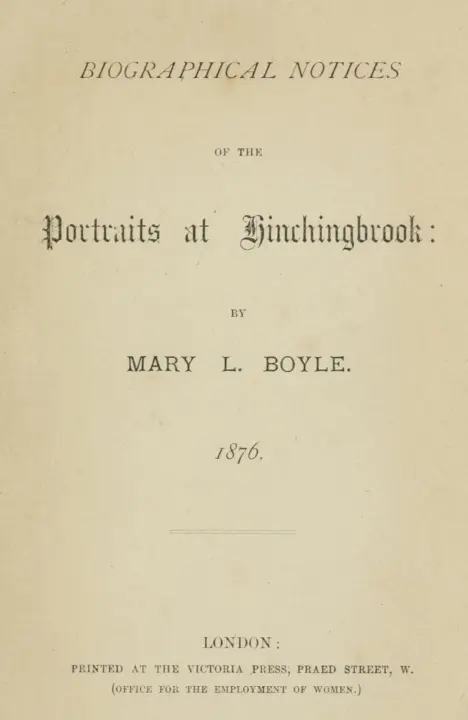
THE CLASSIC COLLECTION · 1876
"Biographical Notices of the Portraits at Hinchingbrook" by Mary Louisa Boyle is a historical account written in the late 19th century. This work provides detailed descriptions and biographical sketches of the portraits located in Hinchingbrook House, focusing particularly on notable figures from English history. Through these descriptions, Boyle aims to highlight both the larger historical impacts of these individuals and the more intimate aspects of their lives. The opening of the work introduces the context of the portraits at Hinchingbrook House, specifically detailing the life and contributions of Edward Montagu, the first Earl of Sandwich. The narrative outlines his political and military career during a tumultuous period in English history, including his loyalty to the crown and involvement in naval engagements. The text employs a rich blend of historical anecdotes and personal reflections from contemporaries, such as Samuel Pepys, illustrating the earl's complex character and the significance of his legacy within the Montagu family's lineage. This section not only paints a vivid picture of Earl Sandwich's life but also sets the tone for the exploration of other characters represented in the portraits found at Hinchingbrook.
Introduction adapted from the source catalogue; source summaries may be automatically generated.
Free to read · English · 44,693 words · No account needed
MAKE TIME FOR A GOOD BOOK
On by default. Untick to stop anonymous reading totals. Each page counts after 10 seconds in view. How this works.
Anonymous counting is on unless you have switched it off.
In the intervals of his employment, Lord Sandwich, who was the fondest of fathers, came up to London frequently to settle the preliminaries of his daughter Jemima’s marriage to the son of Sir George Carteret, an alliance which gave great satisfaction to both families, and the negociations for which were carried on by the indefatigable Pepys. Indeed it was a good thing at that moment to find any cause for rejoicing, as our Diarist’s pages are now full of the record of calamities, caused by the Plague then raging—“no boats on the river, the grass growing up and down Whitehall; all the people panic stricken, and flying from one place to the other for safety”—with innumerable ghastly records of that terrible time.
Lord Sandwich was appointed Ambassador Extraordinary to the Court of Madrid, to mediate a Treaty of Peace between Spain and Portugal. After some conference with the Queen-Regent Mariana, he prevailed with her to acknowledge the King of Portugal, and to agree that the King of England should be Mediator to the Peace. For this purpose he left Madrid and arrived at Lisbon, January 22, 1667. The Peace was concluded in the most satisfactory manner, and the King and the Duke of York wrote Sandwich autograph letters of thanks and commendation. He returned to Spain to take leave of the Queen-Mother, who was most friendly and grateful to the English Envoy, and presented him with full length portraits of herself and her son, the Child-King, painted, says Lord Sandwich, “by her Court painter, Don Sebastian de Herrera, and most excellent likenesses.” The portrait of himself, of which we are now speaking, was also painted during his residence in Spain, and he pronounces that also an excellent resemblance.
Lord Sandwich’s letters show his steady adherence to the Protestant religion, and to the interests of his country: likewise his excellent judgment. He was much opposed to the sale of Dunkirk, and strove to arrest the increasing power of France. In fact, the measures he advocated gained him the good will of the whole fleet and of the disinterested part of the nation, but gave great offence to the Duke of York. In the year 1672, on a new war breaking out with the Dutch, Lord Sandwich served as Vice-Admiral under the man who had become his enemy. On May the 19th, the English fleet, which had been joined by a French squadron, came in sight of the Dutch fleet about eight leagues off Gunfleet, but being separated by hazy weather, the English stood into Southwold Bay, and there anchored till May 28th. Jollity and feasting seem to have been the order of the day on board the English ships, whereupon Lord Sandwich expostulated at such a critical moment, advising that they should stand out to sea, seeing they ran in danger of being surprised by the enemy, as the wind then stood. The Duke of York not only declined to follow this excellent advice, but is said to have returned an insolent and taunting reply. The next day proved the prudence of his wise Admiral’s advice, as the firing of the scout ship’s cannon gave notice of the enemy’s advance. Then the cables were cut and the vessels ranged in as good order as time would permit. Lord Sandwich, in his brave ship the “Royal James,” one hundred guns, sailed almost alone, and was the first to engage the enemy at seven o’clock in the morning: his Royal Highness was the next to fire, his vessel being becalmed; and this sudden calm, combined with the resolution and prompt bravery of Lord Sandwich, saved the fleet, otherwise endangered by the fireships. Interposing between his yet disordered squadron and the “Great Holland,” Captain Brakel, sixty guns, (which was followed by a fireship, and soon seconded by the whole squadron of Van Ghent,) the gallant Englishman defended himself for many hours, disabled several of the enemy’s men-of-war, and sank three of their fireships single handed! while Sir John Jordan, his own Vice-Admiral, and several others, instead of coming to the rescue of the Blue, sailed to the Red to assist the Duke of York. About noon, until which hour he stood at bay like the brave lion that he was, and after giving, as a Dutch historian has it, the utmost proofs of “unfortunate valour,” a fourth fireship, covered by the smoke of the enemy, grappled the “Royal James,” and set her in a blaze. Of one thousand men who formed his crew at the beginning of the action, six hundred were killed on the deck, (among whom was his son-in-law Carteret) many wounded, and only a few escaped. When Lord Sandwich saw it was all over with the “Royal James,” he ordered his first captain, Sir Richard Haddock, the officers, his own servants, etc., into the long-boat, peremptorily declining to leave the ship, in spite of every entreaty: and when the boat pushed off, the noble form of their commander still stood erect on the quarter-deck of the burning vessel. As Sir John Jordan, whose duty it was to relieve him, sailed past in the morning, Lord Sandwich had remarked to the byestanders that if they were not relieved they must fight it out to the last man, and bravely did he keep his word. Thus perished the man whose noble end to a noble life, called forth eulogiums from friend and foe. Bishop Parker, a partisan of the Duke of York, says: “He fell a sacrifice to the service of his country: endued with the virtues of Alcibiades, untainted by his vices; capable of any business; of high birth, full of wisdom, a great commander on sea and land; learned, eloquent, affable, liberal, magnificent.” The Duke of Buckingham, who was in the fleet says: “Lord Sandwich was such a loss, the Dutch might almost have called it a victory.” Gerard Brandt, a Dutchman, says: “He was valiant, intelligent, prudent, civil, obliging in word, and deed, and of great service to his King, not only in war, but in affairs of state and embassies.” We have seen by Pepys’ testimony, how beloved he was in domestic life.
Your reading position is saved on this browser. Take it to another device with a library code. Reading pages adapt to text, rather than matching a printed edition.
BEHIND THE BOOK
This eBook is for the use of anyone anywhere in the United States and most other parts of the world at no cost and with almost no restrictions whatsoever. You may copy it, give it away or re-use it under the terms of the Project Gutenberg License included with this eBook or online at www.gutenberg.org. If you are not located in the United States, you will have to check the laws of the country where you are located before using this eBook. Read the source licence.
The original source file, including credits and licence, is retained by this library. Request an original-format copy at no charge. Please include the book title and Project Gutenberg identifier #63204.
KEEP YOUR CURIOSITY GOING
Cécile Tormay

Moritz Busch
John L. Ransom
Frances Wright
Cécile Tormay

Mabel Potter Daggett