Biographical catalogue of the portraits at Longleat in the county of Wilts, the seat of the Marquis of Bath
Mary Louisa Boyle
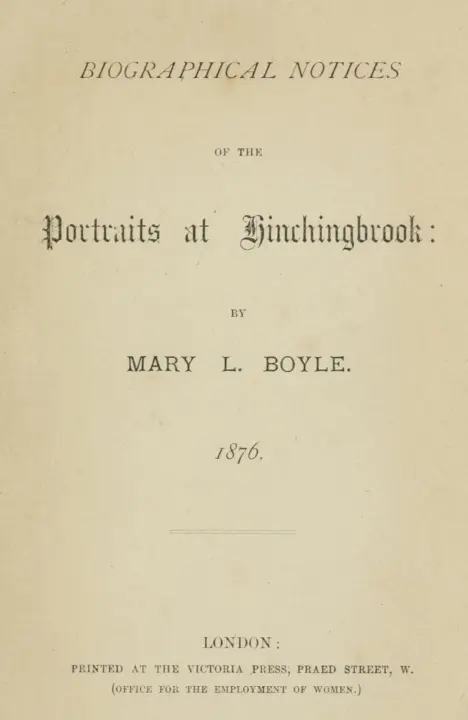
THE CLASSIC COLLECTION · 1876
"Biographical Notices of the Portraits at Hinchingbrook" by Mary Louisa Boyle is a historical account written in the late 19th century. This work provides detailed descriptions and biographical sketches of the portraits located in Hinchingbrook House, focusing particularly on notable figures from English history. Through these descriptions, Boyle aims to highlight both the larger historical impacts of these individuals and the more intimate aspects of their lives. The opening of the work introduces the context of the portraits at Hinchingbrook House, specifically detailing the life and contributions of Edward Montagu, the first Earl of Sandwich. The narrative outlines his political and military career during a tumultuous period in English history, including his loyalty to the crown and involvement in naval engagements. The text employs a rich blend of historical anecdotes and personal reflections from contemporaries, such as Samuel Pepys, illustrating the earl's complex character and the significance of his legacy within the Montagu family's lineage. This section not only paints a vivid picture of Earl Sandwich's life but also sets the tone for the exploration of other characters represented in the portraits found at Hinchingbrook.
Introduction adapted from the source catalogue; source summaries may be automatically generated.
Free to read · English · 44,693 words · No account needed
MAKE TIME FOR A GOOD BOOK
On by default. Untick to stop anonymous reading totals. Each page counts after 10 seconds in view. How this works.
Anonymous counting is on unless you have switched it off.
Lord Anglesey married first in 1795, Lady Caroline Villiers, daughter of the Earl of Jersey, from whom he was divorced. She re-married the Duke of Argyll, and died in 1835. By his first wife he had three sons, of whom the eldest succeeded him, and five daughters. His second wife was the daughter of Earl Cadogan, whose marriage with Lord Cowley had been dissolved. She died in 1853: by whom he had three sons and three daughters, of whom the second, became the Countess of Sandwich.
This portrait was painted by Lord Anglesey’s nephew, the Hon. Henry
Graves.
William, Duke of Cumberland:
(In the Robes of the Garter. Standing by a Table. River, Bridge, and Castle in the Background.)
Born, 1721. Died, 1765.—The third son of George II., King of England, by Carolina Wilhelmina, daughter of the Margrave of Anspach. In 1743, he was wounded by the side of his father, at the Battle of Dettingen; he was unsuccessful at Fontenoy. His name is ever coupled with the discomfiture of Charles Edward’s forces in Scotland, and their entire defeat, at the Battle of Culloden. He gained a name for severity, and cruelty, during this campaign, and is still remembered in the north as “Billy the Butcher.”
This fine portrait was presented by H.R.H., to John, fourth Earl of Sandwich, with whom he formed a friendship, at the time of the Treaty of Aix-la-Chapelle.
Maria Theresa, Queen of France:
Born, 1638. Married, 1660. Died, 1683.—Daughter of Philip IV., King of Spain, by his first wife, Elizabeth of France. Mazarin arranged this marriage to ensure peace. The Duke de Grammont went to Madrid, as Plenipotentiary in 1659, and thus addressed the King of Spain: “Sire, le Roi mon maître vous accorde la paix, et à vous, Madame, il offre son cœur, et sa couronne.” She accepted both, but was compelled to share the first, with innumerable rivals. Gentle, modest, loving, and sensitive, she was constantly insulted by the King’s favourites; yet her devotion to him, never wavered, and a kind word from her royal master, made her happy for the rest of the day. He appointed her Regent, when he went to Holland, but she was not fitted for public life. “To serve God, and honour the King,” was her golden rule. Madame d’Orléans, (the German Princess), one of the other few good women of that age, pays her sister-in-law, this tribute: “Elle étoit d’une extrême simplicité en tout; la femme la plus vertueuse, et la meilleure, du monde. Elle avoit de la grandeur, et elle savoit représenter, et tenir sa cour; elle avoit une foi entière, et sans réserve pour tout ce que le Roi lui disoit. Le Roi l’aimoit à cause de sa vertu, et de l’ardent amour qu’elle lui a constamment conservé, quoiqu’il lui fût infidèle.” On her return from an expedition she had made, with her husband to Alsace and Bourgogne, the Queen fell ill and died. “Voilà,” observed “le Grand Monarque” on that occasion, “le premier chagrin qu’elle m’ait donné.” Had she been the survivor, she could not assuredly have paid Louis a similar tribute.
Your reading position is saved on this browser. Take it to another device with a library code. Reading pages adapt to text, rather than matching a printed edition.
BEHIND THE BOOK
This eBook is for the use of anyone anywhere in the United States and most other parts of the world at no cost and with almost no restrictions whatsoever. You may copy it, give it away or re-use it under the terms of the Project Gutenberg License included with this eBook or online at www.gutenberg.org. If you are not located in the United States, you will have to check the laws of the country where you are located before using this eBook. Read the source licence.
The original source file, including credits and licence, is retained by this library. Request an original-format copy at no charge. Please include the book title and Project Gutenberg identifier #63204.
KEEP YOUR CURIOSITY GOING
Cécile Tormay

Moritz Busch
John L. Ransom
Frances Wright
Cécile Tormay

Mabel Potter Daggett