Biographical catalogue of the portraits at Longleat in the county of Wilts, the seat of the Marquis of Bath
Mary Louisa Boyle
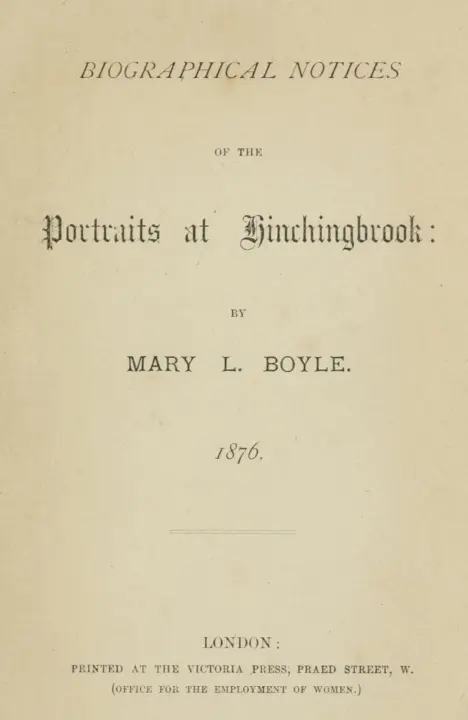
THE CLASSIC COLLECTION · 1876
"Biographical Notices of the Portraits at Hinchingbrook" by Mary Louisa Boyle is a historical account written in the late 19th century. This work provides detailed descriptions and biographical sketches of the portraits located in Hinchingbrook House, focusing particularly on notable figures from English history. Through these descriptions, Boyle aims to highlight both the larger historical impacts of these individuals and the more intimate aspects of their lives. The opening of the work introduces the context of the portraits at Hinchingbrook House, specifically detailing the life and contributions of Edward Montagu, the first Earl of Sandwich. The narrative outlines his political and military career during a tumultuous period in English history, including his loyalty to the crown and involvement in naval engagements. The text employs a rich blend of historical anecdotes and personal reflections from contemporaries, such as Samuel Pepys, illustrating the earl's complex character and the significance of his legacy within the Montagu family's lineage. This section not only paints a vivid picture of Earl Sandwich's life but also sets the tone for the exploration of other characters represented in the portraits found at Hinchingbrook.
Introduction adapted from the source catalogue; source summaries may be automatically generated.
Free to read · English · 44,693 words · No account needed
MAKE TIME FOR A GOOD BOOK
On by default. Untick to stop anonymous reading totals. Each page counts after 10 seconds in view. How this works.
Anonymous counting is on unless you have switched it off.
Miss Ray was remarkable, while under Lord Sandwich’s roof, for her discreet and circumspect conduct, in a most equivocal position; and his lordship appears to have been very strict, lest anyone, as he expressed himself, “should exceed the boundary line,” that he had drawn. For example, at the oratorios where she shone so conspicuously, the society were not expected to notice her, and she herself was sadly embarrassed one evening, when Lady Blake advanced between the scenes to converse with her, the singer well knowing such a step would arouse the noble host’s displeasure; a well grounded suspicion as he went so far as to say “such a trespass might occasion the overthrow of our music meetings.” The Bishop of Lincoln’s wife pays this tribute to Margaret: “She was so assiduous to please, so excellent and unassuming, I felt it cruel to sit directly opposite to her, and yet find it impossible to notice her.”
At these oratorios, the Duke of Manchester’s band generally attended, and Lord Sandwich took the direction of the kettledrums, as, indeed, he sometimes did at public music meetings, at Leicester (and elsewhere), where Mr. Cradock says: “The Earl and the Otaheitan, Omai, (whom he had brought with him) divided public attention.”
Mr. Cradock was with Lord Sandwich, when he first became acquainted with Hackman. My Lord had taken Mr. Cradock to Cambridge, to vote for a candidate for a professorship in whom he was interested, and brought his friend back with him, in his chaise to Hinchingbrook. Under the gateway they met a neighbour, Major Reynolds, with a brother officer, who was presented as Captain Hackman. Lord Sandwich, with his usual hospitality, invited the two officers to a family dinner, and in the evening, he and Miss Ray encountered Major Reynolds, and Mr. Cradock at whist, Captain Hackman preferring to overlook the game. There can be little doubt that Miss Ray inspired the young soldier with love, at first sight. Hackman at that time was on a recruiting party at Huntingdon; he became a constant visitor at Hinchingbrook, and it seems that whenever Miss Ray drove out, he constantly waylaid her, bowing low as she passed. There was evidently a great difference of opinion as to Miss Ray’s feelings, with regard to her new admirer. One account of the transaction affirms that she was not insensible to his devotion, and that the black servant, believing she was false, imparted his suspicions to Lord Sandwich. The same authority states that his Lordship taxed his beautiful companion with her inconstancy, and either through his influence, or that of Major Reynolds, Hackman obtained a recommendation to Sir John Swaine, Adjutant-general in Ireland, where he remained nearly two years. But he never forgot the beautiful Margaret, and leaving the army, he entered the Church, obtained a living in Norfolk, and wrote her a passionate love letter, in which he proposed marriage, and went so far as to promise tenderness, and protection for her children by Lord Sandwich. This offer was refused with decision, whether from fidelity to her protector, anxiety for her children’s welfare, or indifference to her adorer, we cannot say. Her situation was certainly not one of calm enjoyment. One evening at the Admiralty she complained to Mr. Cradock, that she did not believe either Lord Sandwich, or herself was safe to go out, from the fury of the mob, and that coarse ballads, and libels were sung under the windows, which looked upon the Park. Bursting into tears, she besought Mr. Cradock to intercede with Lord Sandwich, to make some settlement on her, not from mercenary motives, but because she wished to relieve my Lord from greater expense, and to go on the stage. Her voice was at its best, Italian music her forte, and she was sure that through her friend Signor Giardini, and Mr. Cradock’s friends Mrs. Brooke and Mrs. Yates, she could secure an advantageous engagement. As might have been supposed, Mr. Cradock declined to interfere, and the matter dropped.
Your reading position is saved on this browser. Take it to another device with a library code. Reading pages adapt to text, rather than matching a printed edition.
BEHIND THE BOOK
This eBook is for the use of anyone anywhere in the United States and most other parts of the world at no cost and with almost no restrictions whatsoever. You may copy it, give it away or re-use it under the terms of the Project Gutenberg License included with this eBook or online at www.gutenberg.org. If you are not located in the United States, you will have to check the laws of the country where you are located before using this eBook. Read the source licence.
The original source file, including credits and licence, is retained by this library. Request an original-format copy at no charge. Please include the book title and Project Gutenberg identifier #63204.
KEEP YOUR CURIOSITY GOING
Cécile Tormay

Moritz Busch
John L. Ransom
Frances Wright
Cécile Tormay

Mabel Potter Daggett