Biographical catalogue of the portraits at Longleat in the county of Wilts, the seat of the Marquis of Bath
Mary Louisa Boyle
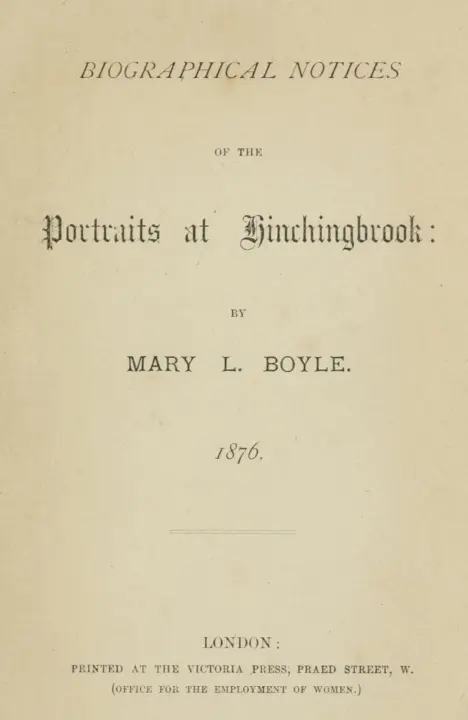
THE CLASSIC COLLECTION · 1876
"Biographical Notices of the Portraits at Hinchingbrook" by Mary Louisa Boyle is a historical account written in the late 19th century. This work provides detailed descriptions and biographical sketches of the portraits located in Hinchingbrook House, focusing particularly on notable figures from English history. Through these descriptions, Boyle aims to highlight both the larger historical impacts of these individuals and the more intimate aspects of their lives. The opening of the work introduces the context of the portraits at Hinchingbrook House, specifically detailing the life and contributions of Edward Montagu, the first Earl of Sandwich. The narrative outlines his political and military career during a tumultuous period in English history, including his loyalty to the crown and involvement in naval engagements. The text employs a rich blend of historical anecdotes and personal reflections from contemporaries, such as Samuel Pepys, illustrating the earl's complex character and the significance of his legacy within the Montagu family's lineage. This section not only paints a vivid picture of Earl Sandwich's life but also sets the tone for the exploration of other characters represented in the portraits found at Hinchingbrook.
Introduction adapted from the source catalogue; source summaries may be automatically generated.
Free to read · English · 44,693 words · No account needed
MAKE TIME FOR A GOOD BOOK
On by default. Untick to stop anonymous reading totals. Each page counts after 10 seconds in view. How this works.
Anonymous counting is on unless you have switched it off.
The Duchess of Marlborough was supplanted by her own protégée, Mrs. Masham, and peremptorily dismissed, in spite of prayers, rages and “scenes.” Voltaire says: “Quelques paires de gants qu’elle refusa à la Reine, un verre d’eau qu’elle laissa tomber par une méprise! sur la robe de Madame Masham, changèrent la face de l’Europe,” alluding to the political changes, which ensued on the downfall of Sarah, Duchess of Marlborough. In her latter days, her temper, embittered by these untoward circumstances, became ungovernable; she quarrelled with her husband, her son-in-law, her grandchildren, and gave way to the most violent outbursts of passion. The Duke of Marlborough was a constant, and affectionate husband, and it is related that on one occasion, when he strove to pacify her rage by a compliment to the beauty of her luxuriant hair, she seized the scissors, cut it off, and flung it in his face. When the Duke died, the long fair tresses, were found carefully preserved in a drawer.
Sarah was a widow for twenty-two years; in spite of her age, perhaps on account of her immense fortune, the Duke of Somerset, and Lord Coningsby were both suitors, for her hand. To the latter, she replied, after reminding him that she was sixty-three, “but were I only thirty, and could you lay the world at my feet, I would never bestow on you, the heart and hand, which belonged exclusively to John, Duke of Marlborough.”
John, Second Duke of Montagu:
(Right Hand on a Table, Left on the Back of a Chair, on which a Greyhound is standing. Court Suit, Star, Garter, and Ribbon of the Order.)
Born, 1682. Died, 1749.—The only surviving son of Ralph, first Duke of Montagu, by his first wife, the Countess of Northumberland. In 1705, he married Lady Mary Churchill, youngest daughter, and co-heiress of the Duke of Marlborough, by Sarah Jennings, his wife, by whom he had several sons, who all died in their childhood, as did one of his daughters; but two survived him, Lady Isabella, married to the Duke of Manchester, and Lady Mary, to the Earl of Cardigan. He was Lord High Constable of England, at the coronation of George I., Knight of the Garter, and one of the first Knights of the Bath, as well as Great Master of that new Order, with several other honours. Sarah, Duchess of Marlborough, in her unpublished volume of remarks and axioms, (which does her little honour) is very hard upon her son-in-law. She declares he had no just claim for place, or favour on the Government, on account of services, by sea, or land; but this statement is emphatically contradicted, in a marginal note, stating that Montagu had served under the great Duke of Marlborough himself. He seems by all accounts, to have been a kind hearted, and benevolent man, but undoubtedly whimsical, and eccentric; witness an anecdote told of him in one of the periodicals of the day. In his walks in St. James’s Park, he was attracted by the daily sight of an old gentleman, of military aspect, but shabby, and poverty stricken in his dress, who usually sat, and sunned himself, on one of the benches in the avenue. The Duke sent his servant, one day to the old soldier, and asked him, to come and visit him. Nothing loth, but much bewildered, the stranger followed the lacquey, through the corridors, and well furnished rooms, to the ducal presence. Here he was asked, and had to tell, his sorrowful tale. He had served his country, but had no pension; he had married a wife without a dowry, and she and her children were half starving, down in Wales, while he had come to London on the sad, and hopeless errand, of getting something, to live upon. He had a wretched room, where he slept, and spent most of his time, on a bench, in the Park. The Duke listened, and fed him, gave him a trifling sum, and said he hoped to see him again, ere very long. Accordingly, some time afterwards, the old man received a letter from the Duke, begging him to come to dinner, telling him that he had a most mysterious, and confidential communication, to make. The soldier, to whom his whole acquaintance with Montagu appeared like a fairy tale, brushed up his thread-bare suit, and presented himself to the Duke, who in a most private, and mysterious manner, assured him, that there was a certain lady, who admired him very much, and who had earnestly desired an interview with him; indeed, the Duke went on to say, so entirely was her heart set on the meeting, that he had consented to be the go-between. More bewildered than ever, the soldier pleaded his wrinkled face, his scanty grey hairs, and, above all, his allegiance to the poor wife, far away among the Welsh mountains. The Duke was jocose, treated the matter with levity, and gave his arm to lead the astonished guest to the hospitable board, where the lady would be seated; and there indeed, smiling amid her tears, sate his wife, and her children, and after a sumptuous repast, the happy couple left the ducal roof, with their pockets sufficiently well lined (with the addition of a small pension also promised by their noble friend), to keep the wolf from their humble door. Such whimsical fancies as these, would not have suited the stern and economical Sarah, Duchess of Marlborough.
Your reading position is saved on this browser. Take it to another device with a library code. Reading pages adapt to text, rather than matching a printed edition.
BEHIND THE BOOK
This eBook is for the use of anyone anywhere in the United States and most other parts of the world at no cost and with almost no restrictions whatsoever. You may copy it, give it away or re-use it under the terms of the Project Gutenberg License included with this eBook or online at www.gutenberg.org. If you are not located in the United States, you will have to check the laws of the country where you are located before using this eBook. Read the source licence.
The original source file, including credits and licence, is retained by this library. Request an original-format copy at no charge. Please include the book title and Project Gutenberg identifier #63204.
KEEP YOUR CURIOSITY GOING
Cécile Tormay

Moritz Busch
John L. Ransom
Frances Wright
Cécile Tormay

Mabel Potter Daggett