Biographical catalogue of the portraits at Longleat in the county of Wilts, the seat of the Marquis of Bath
Mary Louisa Boyle
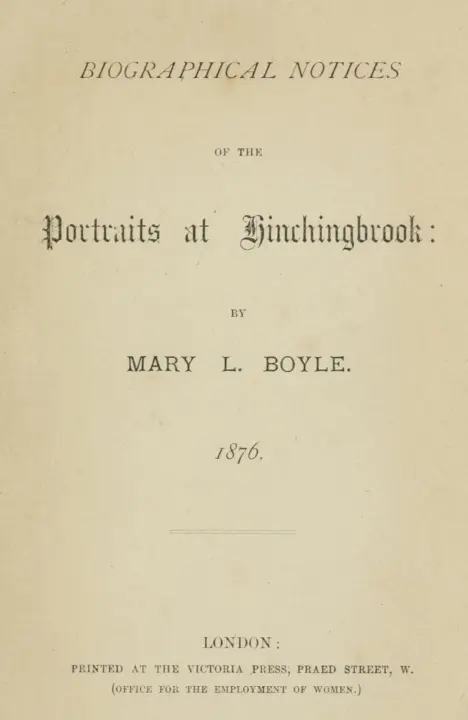
THE CLASSIC COLLECTION · 1876
"Biographical Notices of the Portraits at Hinchingbrook" by Mary Louisa Boyle is a historical account written in the late 19th century. This work provides detailed descriptions and biographical sketches of the portraits located in Hinchingbrook House, focusing particularly on notable figures from English history. Through these descriptions, Boyle aims to highlight both the larger historical impacts of these individuals and the more intimate aspects of their lives. The opening of the work introduces the context of the portraits at Hinchingbrook House, specifically detailing the life and contributions of Edward Montagu, the first Earl of Sandwich. The narrative outlines his political and military career during a tumultuous period in English history, including his loyalty to the crown and involvement in naval engagements. The text employs a rich blend of historical anecdotes and personal reflections from contemporaries, such as Samuel Pepys, illustrating the earl's complex character and the significance of his legacy within the Montagu family's lineage. This section not only paints a vivid picture of Earl Sandwich's life but also sets the tone for the exploration of other characters represented in the portraits found at Hinchingbrook.
Introduction adapted from the source catalogue; source summaries may be automatically generated.
Free to read · English · 44,693 words · No account needed
MAKE TIME FOR A GOOD BOOK
On by default. Untick to stop anonymous reading totals. Each page counts after 10 seconds in view. How this works.
Anonymous counting is on unless you have switched it off.
The second Court under “Madame’s” auspices, with its young beauties, its easy conversation, and pleasant pastimes, was exactly suited to the Monarch’s taste, and he was known to have said, in speaking of the Duchess of Orleans, “qu’il connoissoit en la voyant de plus près, combien il avoit été injuste, à la plus belle personne du monde.” The admiration she excited, and the influence she obtained over her brother-in-law, ended indeed, only with her life. Her small Court was brilliant, in the extreme, and they amused themselves in divers ways. “Madame, montoit à cheval, suivie de toutes ses dames, habillées galamment, avec mille plumes sur leurs têtes, accompagnées du Roi, et de la jeunesse de la Cour.” Monsieur lived a great deal in the Palais Royal, and there she would go to sup with him, taking all her ladies, and chosen friends with her. Mademoiselle de la Vallière was one of her Maids of Honour, and the liaison with the King, began under Henrietta’s roof. She had been very fond of the beautiful girl, but treated her with marked displeasure, in the latter days.
Madame made a second journey to England, for the purpose of concluding a private treaty, between her brother, and the French monarch, and of detaching the former from his alliance with Holland. On this occasion, she was accompanied by the celebrated Mademoiselle de la Quérouaille, afterwards Duchess of Portsmouth, who had also her sealed orders. The mission was successful, though neither advantageous, nor honourable, as far as England was concerned. Madame returned in triumph, took up her abode at the Palace of St. Cloud, and appeared to have reached the zenith of worldly prosperity, always excepting the unhappy difference, with her husband, which commenced so soon after their marriage, and had increased rather than diminished. Her tried friend, and trusty confidant in these trials, was Cosnac, Bishop of Valence, afterwards Archbishop of Aix, a distinguished, but eccentric man. At twenty-four years of age, he preached a sermon, which made such an impression on the mind, of Mazarin, the Cardinal Minister, that on the conclusion of the service, he promised the preacher a bishopric; what he called “faire un maréchal de France sur la brêche.” Cosnac was afterwards appointed almoner to Monsieur, and resided with him, for some time, during which period, he endeavoured to gain an influence for good, over the mind of this fickle, and vacillating Prince, and often expostulated with him, on his conduct to the Duchess. They quarrelled, and separated, but his indignation against Monsieur’s unworthy favourite, the Chevalier de Loraine, so enraged the Duke that he contrived to procure a sentence of exile, against Cosnac. But absence could not sever the bonds of friendship, which bound him to Henrietta, and of which he gave a valuable proof, on the occasion of a libel, that was published against her in Holland, at the time of her negociations between England, and France. The Duchess dreaded lest the scurrilous pamphlet, most damaging to her reputation, should fall into her husband’s hands, and she wrote off in terror to her exiled friend, to ask his assistance. Cosnac immediately despatched an emissary to Holland, who did his work so effectually, that the whole edition was bought up, the publication stopped, and all the extant copies brought over, to be destroyed by this zealous friend. As in duty bound, “Madame” worked hard to obtain the Bishop’s recall, so much so that the King thought her attachment to him, must be of a more tender nature than she confessed. Louis XIV., in all probability, was not a good judge of friendship, or a believer in it, where a woman was concerned.
Your reading position is saved on this browser. Take it to another device with a library code. Reading pages adapt to text, rather than matching a printed edition.
BEHIND THE BOOK
This eBook is for the use of anyone anywhere in the United States and most other parts of the world at no cost and with almost no restrictions whatsoever. You may copy it, give it away or re-use it under the terms of the Project Gutenberg License included with this eBook or online at www.gutenberg.org. If you are not located in the United States, you will have to check the laws of the country where you are located before using this eBook. Read the source licence.
The original source file, including credits and licence, is retained by this library. Request an original-format copy at no charge. Please include the book title and Project Gutenberg identifier #63204.
KEEP YOUR CURIOSITY GOING
Cécile Tormay

Moritz Busch
John L. Ransom
Frances Wright
Cécile Tormay

Mabel Potter Daggett