Biographical catalogue of the portraits at Longleat in the county of Wilts, the seat of the Marquis of Bath
Mary Louisa Boyle
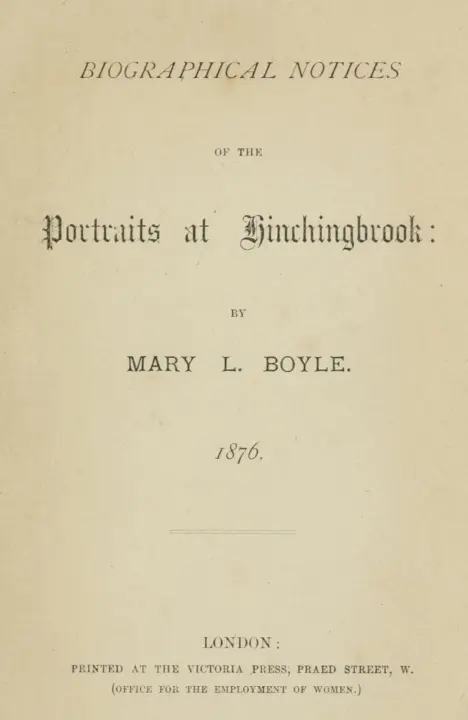
THE CLASSIC COLLECTION · 1876
"Biographical Notices of the Portraits at Hinchingbrook" by Mary Louisa Boyle is a historical account written in the late 19th century. This work provides detailed descriptions and biographical sketches of the portraits located in Hinchingbrook House, focusing particularly on notable figures from English history. Through these descriptions, Boyle aims to highlight both the larger historical impacts of these individuals and the more intimate aspects of their lives. The opening of the work introduces the context of the portraits at Hinchingbrook House, specifically detailing the life and contributions of Edward Montagu, the first Earl of Sandwich. The narrative outlines his political and military career during a tumultuous period in English history, including his loyalty to the crown and involvement in naval engagements. The text employs a rich blend of historical anecdotes and personal reflections from contemporaries, such as Samuel Pepys, illustrating the earl's complex character and the significance of his legacy within the Montagu family's lineage. This section not only paints a vivid picture of Earl Sandwich's life but also sets the tone for the exploration of other characters represented in the portraits found at Hinchingbrook.
Introduction adapted from the source catalogue; source summaries may be automatically generated.
Free to read · English · 44,693 words · No account needed
MAKE TIME FOR A GOOD BOOK
On by default. Untick to stop anonymous reading totals. Each page counts after 10 seconds in view. How this works.
Anonymous counting is on unless you have switched it off.
The marriage proved most unhappy; the husband morose, jealous, exacting; the wife beautiful, brilliant, wayward. In her later correspondence with St. Evremond, she makes many excuses for having left her husband, and not returning to him, in spite of all his solicitations and the action which he brought against her, for separating herself from him. She fled from his roof, in the disguise of a man, and by all accounts not empty handed; “mais tous les chemins mènent à Paris,” and on her return there she received a pension from the King, which, however, she did not consider sufficient to enable her to reside there. She accordingly retired to Chambéri. But in the year 1675 she went to England in the train of Mary of Modena, the youthful Duchess of York. The real object of this journey is believed to have been a mission, with which she was entrusted by the numerous enemies of Mademoiselle de Quérouaille (afterwards Duchess of Portsmouth) to destroy that favourite’s influence by supplanting her, in the affections of Charles II. Nor did such a result appear improbable, as Hortense surpassed her rival, both in wit, and beauty, and it was well known that the King had already admired her so much, as to entertain serious notions of making her his wife. He gave her a most warm reception, and settled a pension on her, the Duke of Mazarin having already found means to possess himself of the pittance, allowed her by Louis XIV. But unfortunately for all these deep-laid schemes, Hortense was so much enamoured of the Prince de Monaco, then in England, as to incur the King’s anger, and cause him for a while even to suspend her pension.
She never left England; persuasions, stratagems, and menaces, all were useless to induce her, to return to France. Her husband sent over Madame de Rutz to try and bring her back to him, or induce her to enter a convent, but she says to St. Evremond: “La liberté ne coute jamais trop chére à qui se délivre de la tyrannie.” She speaks of the alternative of returning to the Duke’s roof, or immuring herself in a convent, as “deux extrémités à éviter, autant l’une que l’autre.” Yet at one time, on the occasion of a lover being killed in a duel in Spain, she seems to have entertained the notion of embracing the latter alternative; but the easy-going St. Evremond advised her strongly against such a step, assuring her the loss of a lover, might soon be repaired. Her enemies in France, founded a scandal on the discovery that she did not reside under the roof of her Royal mistress, at Whitehall, “mais dans un Pavillon tout près du Château de St. James.” She also incurred blame in many quarters, for not sharing Queen Mary’s exile in 1688; but she excuses herself, by saying that if she did so, not only would she place herself once more in the power of her enemies, but that it was impossible for her to leave England. She was deeply in debt; she scarcely dared leave the house, for fear of being arrested. She makes a most pitiful lament, (probably about the time of the escape of James II. to France) over her destitution, always to the same friend, and confidant. “Nul bien de moi, nulle assistance où je suis, nulle espérance d’ailleurs.” Yet she received at different times, pensions from four different monarchs, for William III. continued her allowance. Be this as it may, she contrived to amuse herself, in her house at Chelsea, where St. Evremond was a constant visitor, in spite of his complaints to Lady Anne Hervey, of the occasional cold and discomfort. She assembled round her bassette table, (for in later years she was much addicted to play) a brilliant, aristocratic, literary circle. She gave dinners too, and the St. Evremond correspondence shows us, that presents of meat, wine, and fruit, were as common in those days, as baskets of game in the nineteenth century. Her friends, Lady Sandwich, and the Duke of Montagu in particular, appear to have been very generous, in such contributions, and both the Duchess, and St. Evremond, appreciated to their fullest extent, the pleasures of eating, and drinking, although the latter often expostulates with the former against over-indulgence in stimulants. He warns her against excess in white wine, absynthe or usquebaugh, which are bad for the lungs; her heart, and her head, were given her for better things. There seems every reason to believe the learned man’s precepts, and example, were not always in unison. She occasionally played too high, or too frequently at bassette, to please him. He wrote a poetical scene in which, playing with the handsome “Madame Middleton,” Hortense discusses with her the comparative beauties of “Madame Grafton, Madame Kildare, and Madame Lichfield.” In another letter, an answer no doubt to some lamentations over her pecuniary distresses, he says: “Demandez toujours de l’argent; s’il n’en vient point, c’est vous qui avez sujet de vous plaindre.”
Your reading position is saved on this browser. Take it to another device with a library code. Reading pages adapt to text, rather than matching a printed edition.
BEHIND THE BOOK
This eBook is for the use of anyone anywhere in the United States and most other parts of the world at no cost and with almost no restrictions whatsoever. You may copy it, give it away or re-use it under the terms of the Project Gutenberg License included with this eBook or online at www.gutenberg.org. If you are not located in the United States, you will have to check the laws of the country where you are located before using this eBook. Read the source licence.
The original source file, including credits and licence, is retained by this library. Request an original-format copy at no charge. Please include the book title and Project Gutenberg identifier #63204.
KEEP YOUR CURIOSITY GOING
Cécile Tormay

Moritz Busch
John L. Ransom
Frances Wright
Cécile Tormay

Mabel Potter Daggett