Biographical catalogue of the portraits at Longleat in the county of Wilts, the seat of the Marquis of Bath
Mary Louisa Boyle
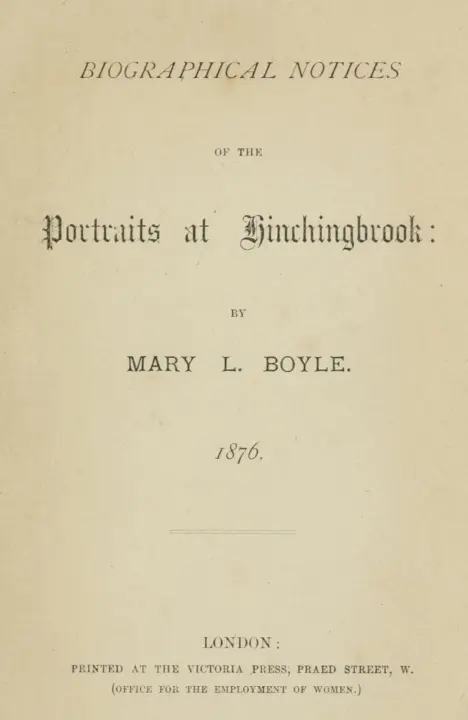
THE CLASSIC COLLECTION · 1876
"Biographical Notices of the Portraits at Hinchingbrook" by Mary Louisa Boyle is a historical account written in the late 19th century. This work provides detailed descriptions and biographical sketches of the portraits located in Hinchingbrook House, focusing particularly on notable figures from English history. Through these descriptions, Boyle aims to highlight both the larger historical impacts of these individuals and the more intimate aspects of their lives. The opening of the work introduces the context of the portraits at Hinchingbrook House, specifically detailing the life and contributions of Edward Montagu, the first Earl of Sandwich. The narrative outlines his political and military career during a tumultuous period in English history, including his loyalty to the crown and involvement in naval engagements. The text employs a rich blend of historical anecdotes and personal reflections from contemporaries, such as Samuel Pepys, illustrating the earl's complex character and the significance of his legacy within the Montagu family's lineage. This section not only paints a vivid picture of Earl Sandwich's life but also sets the tone for the exploration of other characters represented in the portraits found at Hinchingbrook.
Introduction adapted from the source catalogue; source summaries may be automatically generated.
Free to read · English · 44,693 words · No account needed
MAKE TIME FOR A GOOD BOOK
On by default. Untick to stop anonymous reading totals. Each page counts after 10 seconds in view. How this works.
Anonymous counting is on unless you have switched it off.
In some letters of “Madame, veuve de Monsieur,” the first Duke of Orleans, the Princess of Bavaria to whom allusion has already been made, we are told that the Duchesse de Berri at the time of her death was undoubtedly married clandestinely to Captain de Rious, whose portrait Madame paints in the most unflattering terms as remarkable for his ugliness, in spite of which he was a great favourite with the ladies. He was absent on duty with the regiment the Duchess had bought for him at the time of her death. Madame goes on to say: “Pour se tirer de l’embarras que pouvoit lui donner une oraison funêbre, on a pris le parti de n’en point faire du tout.” Apparently a prudent decision. The same authority states that the Duchesse de Berri had grown very large and florid, (and that she often jested on the change in her own appearance), which would account for her looking twice her real age in this picture.
Elizabeth, Countess of Sandwich:
(White Déshabille with Coloured Scarf. Hair en Négligé.)
Born, ——. Died, 1757. She was the second daughter of John, Earl of Rochester, by Elizabeth Mallet. She married Edward, third Earl of Sandwich, in 1691. As we have mentioned in the short notice of his life, the marriage was very unhappy, and Lady Sandwich’s conduct in every respect most reprehensible, in spite of her numerous panegyrists. She was a brilliant member of society, and we are told that at the early age of ten years, she already showed a great taste for reading, and had begun to cultivate several foreign languages. She spoke French, Italian and Spanish; Montaigne was one of her favourite authors. She danced and sang, and played on several instruments, and though learned was in no wise pedantic. Neither did she waste so much time on dress, as was usual with ladies of her time. Lady Sandwich went to Paris not very long after her marriage, and St. Evremond, whose admiration she appears to have shared with the Duchesse de Mazarin and Ninon de l’Enclos, thus speaks of her in a letter (without date) to the latter: “Le Docteur Morelli, mon ami particulier, accompagne Madame la Comtesse de Sandwich qui va en France pour sa santé. Feu Monsieur le Comte de Rochester, Père de Madame Sandwich, avoit plus d’esprit qu’homme en Angleterre. Madame de Sandwich en a plus que n’avoit Monsieur son père; aussi généreuse que spirituelle, aussi aimable que spirituelle et généreuse. Voilà une partie de ses qualités.” According to St. Evremond’s implied wishes, his two friends formed a close intimacy, and Lady Sandwich at Paris seems to have merited Ninon’s report of her when she says: “J’ignore les manières Anglaises, mais elle a été très française.” It must have been during this first visit to Paris that Lady Sandwich made the acquaintance of the French celebrities whose portraits now adorn the Drawing-room at Hinchingbrook, as on her return to the French metropolis in 1729 they were all dead. Mademoiselle de l’Enclos is never tired of praising her English friend; in a letter dated August, 1698, she says to St. Evremond: “Madame Sandwich m’a donné mille plaisirs, par le bonheur que j’ai eu de lui plaire; je ne croyois pas sur mon déclin, pouvoir être propre à une femme de son âge. Elle a plus d’esprit que toutes les femmes de France, et plus de véritable mérite. Elle nous quitte; c’est un regret pour tous qui la connoissent, et pour moi particulièrement. Si vous aviez été ici nous aurions faits des repas dignes du temps du passé. Vous allez revoir Madame Sandwich, que nous voyons partir avec beaucoup de regret.” Again in July, 1699: “Vous allez voir Madame Sandwich, mais je crains qu’elle n’aille à la campagne; elle sait tout ce que vous pensez d’elle; elle vous dira plus de nouvelles de ce pays ci que moi. Elle a tout approfondi et tout pénétré: elle connoit parfaitement tout ce que je hante, et a trouvé le moyen de n’être pas étrangère ici.” In the lengthened correspondence between Mademoiselle de l’Enclos and her faithful Abbé, she constantly reverts to the English lady after her departure from Paris: “Madame Sandwich conservera l’esprit en perdant la jeunesse. Faites la souvenir de moi; je serois bien fâchée d’en être oubliée;” while St. Evremond on his part tells her: “Tout le monde connoit l’esprit de Madame la Comtesse; je vois son bon goût par l’estime extraordinaire qu’elle a pour vous. Elle est admirée à Londres comme elle fut à Paris.”
Your reading position is saved on this browser. Take it to another device with a library code. Reading pages adapt to text, rather than matching a printed edition.
BEHIND THE BOOK
This eBook is for the use of anyone anywhere in the United States and most other parts of the world at no cost and with almost no restrictions whatsoever. You may copy it, give it away or re-use it under the terms of the Project Gutenberg License included with this eBook or online at www.gutenberg.org. If you are not located in the United States, you will have to check the laws of the country where you are located before using this eBook. Read the source licence.
The original source file, including credits and licence, is retained by this library. Request an original-format copy at no charge. Please include the book title and Project Gutenberg identifier #63204.
KEEP YOUR CURIOSITY GOING
Cécile Tormay

Moritz Busch
John L. Ransom
Frances Wright
Cécile Tormay

Mabel Potter Daggett