Biographical catalogue of the portraits at Longleat in the county of Wilts, the seat of the Marquis of Bath
Mary Louisa Boyle
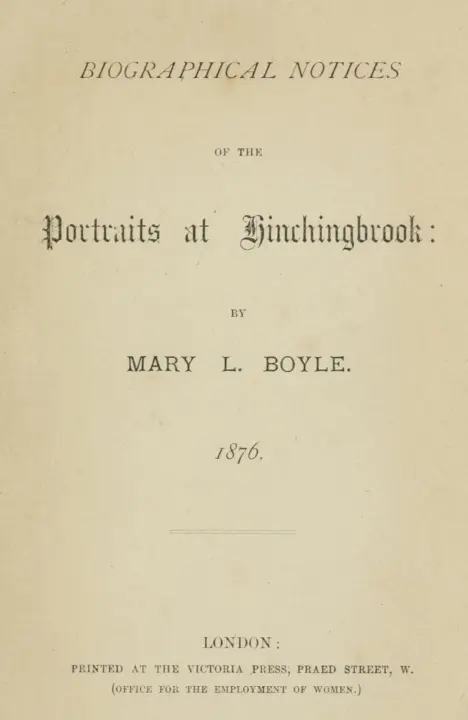
THE CLASSIC COLLECTION · 1876
"Biographical Notices of the Portraits at Hinchingbrook" by Mary Louisa Boyle is a historical account written in the late 19th century. This work provides detailed descriptions and biographical sketches of the portraits located in Hinchingbrook House, focusing particularly on notable figures from English history. Through these descriptions, Boyle aims to highlight both the larger historical impacts of these individuals and the more intimate aspects of their lives. The opening of the work introduces the context of the portraits at Hinchingbrook House, specifically detailing the life and contributions of Edward Montagu, the first Earl of Sandwich. The narrative outlines his political and military career during a tumultuous period in English history, including his loyalty to the crown and involvement in naval engagements. The text employs a rich blend of historical anecdotes and personal reflections from contemporaries, such as Samuel Pepys, illustrating the earl's complex character and the significance of his legacy within the Montagu family's lineage. This section not only paints a vivid picture of Earl Sandwich's life but also sets the tone for the exploration of other characters represented in the portraits found at Hinchingbrook.
Introduction adapted from the source catalogue; source summaries may be automatically generated.
Free to read · English · 44,693 words · No account needed
MAKE TIME FOR A GOOD BOOK
On by default. Untick to stop anonymous reading totals. Each page counts after 10 seconds in view. How this works.
Anonymous counting is on unless you have switched it off.
(Brown Hair and Eyes. Small Moustache.)
Edward, First Earl of Sandwich:
(Purple Vest, Broad Belt, Buckle on Shoulder.)
Elizabeth, Countess of Sandwich:
(Loose Dress. Blue Scarf. Seated on a Bank, putting a Wreath of Flowers round the Neck of a Lamb.)
The Honourable Edward Montagu:
(A Fair Boy in Crimson Coat and Waistcoat, and Frilled Shirt.)
The fourth son of John, fourth Earl of Sandwich. Born, 1745. Died, 1752.
Buried at Barnwell.
The Honourable Elizabeth Montagu:
(Seated, with her Hand on the Neck of a Lamb.)
The second daughter of Edward, Viscount Hinchingbrook, by Elizabeth Popham. Married first to Reginald Courtenay, second son of Sir William Courtenay, of Powderham Castle, Devon, by whom she had one son, Charles, (killed at the battle of Dettingen), and two daughters, co-heiresses: Isabella, wife of William Poyntz, Esq., of Midgham, Berks; and Anne, married to the Earl of Cork and Orrery. Mr. Courtenay died in 1745, and his widow re-married in 1759, William Smith, comedian, better known as “Gentleman Smith.” They lived together at Leiston, near Saxmundham, an estate bequeathed to her by her grandmother, Lady Anne Harvey, where she died. Mr. Smith survived her 57 years. There is a portrait of him by Hoppner, in the National Portrait Gallery. Her brother was very much averse to her marriage with the actor, but the correspondence seems to show they lived happily.
The Duchesse de Berri:
(Hair Dressed High. White and Gold Boddice. Blue Velvet Mantle,
lined with Ermine.)
Born, 1694. Died, 1719. Marie Louise, daughter of Philip, second Duke of Orleans, afterwards Regent, by Mademoiselle de Blois, daughter of Louis XIV. and Madame de Montespan. This marriage, which had been determined on by the King, was not only strongly opposed, by the Duchess of Orleans, his mother, but Philip himself, then Duc de Chartres, was repugnant to the mésalliance. He was at length overruled by the commands of his father, and the King his uncle, and proceeded to break the announcement of his engagement to the proud German Princess his mother, who congratulated the fiancé with a blow. One son and five daughters were born to Philip, the second of whom, Marie Louise, married in 1710 the Duc de Berri, third son to the Dauphin, and consequently grandson to Louis XIV. He was a handsome Prince, full of endearing and sterling qualities, but his education had been shamefully neglected, and on this point he was most sensitive. It made him shy of society, and fearful of speaking in public, and on one occasion he was subjected to terrible mortification. At the general Treaty of Peace, when it was settled that the crowns of France and Spain should never devolve on the same person, the Dukes of Orleans and Berri proceeded to the Parliament House to attend to some necessary formalities, on the occasion of the death of the Duc de Bourgogne, and the Duc de Berri found himself compelled to speak. After stammering and stuttering for some time he entirely broke down, and retired in confusion. Relating the circumstance to a friend, he was said to have shed tears of mortification, bitterly complaining at the same time of the manner in which his education had been neglected for the express purpose of keeping him in the background. “J’avois,” said he, “autant de disposition [for learning] que les autres; on ne m’apprit qu’à chasser, on n’a cherché qu’à m’abattre.” In spite of these disadvantages the Duc de Berri was very popular, and is said to have won all hearts, save that of the ill-conditioned Princess whose outward charms had subjugated him. Even at an early age Marie Louise d’Orléans laid herself open to the tongue of scandal, and had been censured for habits of intemperance. On finding there was a chance of making a brilliant marriage she changed her whole line of conduct, and persuaded every one, including the wary Madame de Maintenon, that she was a reformed character. But no sooner was the marriage consummated than the young Duchess threw off the mask, and returned to all her evil ways. In nowise touched by the kindness and devotion of her husband, she thwarted him on every occasion, and delighted to turn him into ridicule, which was easy in the case of one so diffident and sensitive. But even his forbearance had a limit; her conduct disgraced them both, and one day, maddened by jealousy and the insolence of his wife’s Chamberlain, he sought the advice of his trusty friend, the Duc de St. Simon.
Your reading position is saved on this browser. Take it to another device with a library code. Reading pages adapt to text, rather than matching a printed edition.
BEHIND THE BOOK
This eBook is for the use of anyone anywhere in the United States and most other parts of the world at no cost and with almost no restrictions whatsoever. You may copy it, give it away or re-use it under the terms of the Project Gutenberg License included with this eBook or online at www.gutenberg.org. If you are not located in the United States, you will have to check the laws of the country where you are located before using this eBook. Read the source licence.
The original source file, including credits and licence, is retained by this library. Request an original-format copy at no charge. Please include the book title and Project Gutenberg identifier #63204.
KEEP YOUR CURIOSITY GOING
Cécile Tormay

Moritz Busch
John L. Ransom
Frances Wright
Cécile Tormay

Mabel Potter Daggett