THE CLASSIC COLLECTION✦An outlaw’s diary: the CommuneCLASSIC FREE BOOKS
An outlaw’s diary: the Commune
Cécile Tormay
THE CLASSIC COLLECTION · 1876
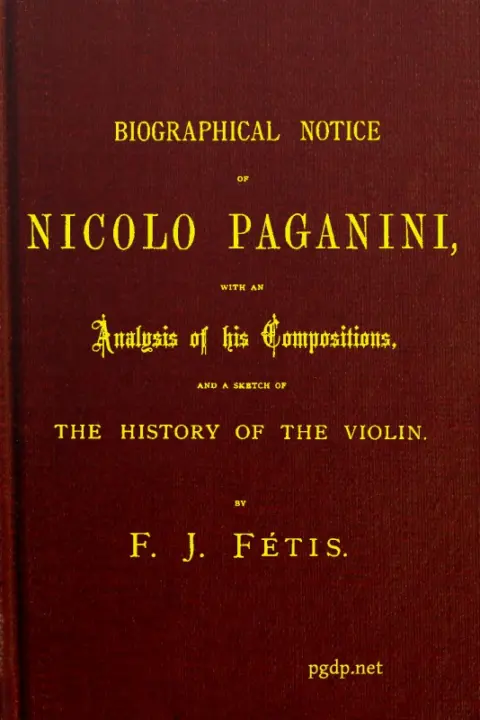
"Biographical Notice of Nicolo Paganini" by François-Joseph Fétis is a biographical account likely written in the mid-19th century. The work delves into the life of Nicolo Paganini, a celebrated violinist of the 19th century, alongside an analysis of his musical compositions and a history of the violin. The book offers a profound exploration of Paganini's extraordinary journey and artistry, positioning him within the broader context of violin history. The opening of the biography provides a detailed examination of Paganini’s early life, touching on his musical upbringing under the strict guidance of his father. It describes his early performances that showcased his prodigious talent, his quest for independence, and pivotal moments that defined his artistic development. The text further highlights the evolution of Paganini's violin playing, his innovation in technique, and the foundational influences that shaped him into one of the most iconic figures in the music world. This initial section sets the stage for a rich narrative about the intersection of genius and adversity in Paganini’s life.
Introduction adapted from the source catalogue; source summaries may be automatically generated.
Free to read · English · 32,504 words · No account needed
MAKE TIME FOR A GOOD BOOK
On by default. Untick to stop anonymous reading totals. Each page counts after 10 seconds in view. How this works.
Anonymous counting is on unless you have switched it off.
By his will, made on the 27th of April, 1837, and opened on the 1st of June, 1840, Paganini left to his son, legitimized by deeds of law, a fortune estimated at two millions (£80,000 sterling), out of which two legacies were to be paid, of fifty and sixty thousand francs, to his two sisters, leaving to the mother of his son Achille an annuity of 1,200 francs. Independently of his wealth, Paganini possessed a collection of valuable instruments, among which was an incomparable Stradiuari, estimated at upwards of 8,000 Austrian florins, a charming Guarnieri of the smaller pattern, an excellent Amati, a Stradiuari Bass, equally prized with his Violin of this master, and his large Guarnieri, the only instrument which accompanied him in his travels, and which he bequeathed to the town of Genoa, not being desirous that any artist should possess it after him.
The frenzied admiration which Paganini’s prodigious talent excited wherever he went, and the wealth he amassed, were painfully compensated for, by the distressing state of his health during the greater part of his life. His biographers attribute this delicate state to the excesses of a stormy youth; but the immoderate use, during more than twenty years, of the quack medicine of Le Roy, exerted an equally fatal influence over his physical constitution. He rarely consulted the faculty, and less frequently followed their advice. His confidence in this favourite panacea was unshaken; he resorted to it on every occasion, convinced that no ill with which humanity is afflicted, could resist its action. The powerful agitation it excited was looked upon as a salutary crisis. Its frequent use subjected the intestinal functions to frequent disturbance, induced irritation, which became chronic, and produced nervous attacks, which often almost deprived him of the power of speech.
It was not only by his almost constant indisposition that Paganini expiated his glory and his success, for the malignity of his enemies pursued him for more than fifteen years with calumnious imputations, which everywhere left their traces, and compromised his honour. Crime was even imputed to him. The versions varied, as regards the deeds laid to his charge; according to one, his liaisons, unworthy of his talent, led him in his youth to the commission of highway robbery; others attributed to him a maddening and vindictive jealousy in love affairs, which frequently brought him to the verge of murder. Now his mistress, now his rival, had fallen victims to his irrepressible fury. It was even said, a long incarceration in prison had expiated his crime. The long intervals which took place between his concerts, either for the re-establishment of his health or for repose and meditation, favoured these calumnious reports. The qualities even of his talent were but weapons for his enemies, and it was said that the solitude of a prison, and the impossibility of replacing the strings of his Violin which had broken, led to his marvellous performance on the fourth, the only one that remained upon his instrument. When Paganini visited Germany, France, and England, envy pursued him, greedy of collecting odious calumny, to oppose his success, as if it were decreed that genius and talent should ever expiate the advantages which nature and study had endowed them with. Paganini was frequently driven to defend himself in the columns of the press; vainly had he appealed to the testimony of the ambassadors of the foreign powers; vainly did he call upon his enemies to cite, with precision, the facts and dates which they had vaguely propagated; but no advantageous results were derived from this. Paris, especially, was hostile to him, although that city contributed principally to his fame. Apart from the real public, who entertain neither hatred nor prejudice, and who yield to the pleasure which talent provides for them, there is, in that city, a hunger-starved population, which exists on the ill it does and the good it prevents. This contemptible world speculated upon the celebrity of the artist, and persuaded itself that he would purchase their silence. Lithographic prints presented him a prisoner; journals attacked his morals, his humanity, his integrity. These reiterated attacks--this pillory to which he saw himself attached, as actor and as spectator--affected him deeply. He confided his sorrows to me, and took counsel from me, satisfying me perfectly of their unjust malice. I requested him to furnish me with some notes to enable me to write a letter, which I published with his signature, and was copied into most of the Paris journals. The facts, related in that letter, possess so much interest for the history of the most extraordinary man of our age, that I deem it important to give it a place here. I conceive it, besides, a duty to omit nothing that may avenge the calumnies which attached to one of the most dazzling glories of the musical art:--
Your reading position is saved on this browser. Take it to another device with a library code. Reading pages adapt to text, rather than matching a printed edition.
BEHIND THE BOOK
This eBook is for the use of anyone anywhere in the United States and most other parts of the world at no cost and with almost no restrictions whatsoever. You may copy it, give it away or re-use it under the terms of the Project Gutenberg License included with this eBook or online at www.gutenberg.org. If you are not located in the United States, you will have to check the laws of the country where you are located before using this eBook. Read the source licence.
The original source file, including credits and licence, is retained by this library. Request an original-format copy at no charge. Please include the book title and Project Gutenberg identifier #58184.
KEEP YOUR CURIOSITY GOING
Cécile Tormay

Moritz Busch
John L. Ransom
Frances Wright
Cécile Tormay

Mabel Potter Daggett