THE CLASSIC COLLECTION✦An outlaw’s diary: the CommuneCLASSIC FREE BOOKS
An outlaw’s diary: the Commune
Cécile Tormay
THE CLASSIC COLLECTION · 1876
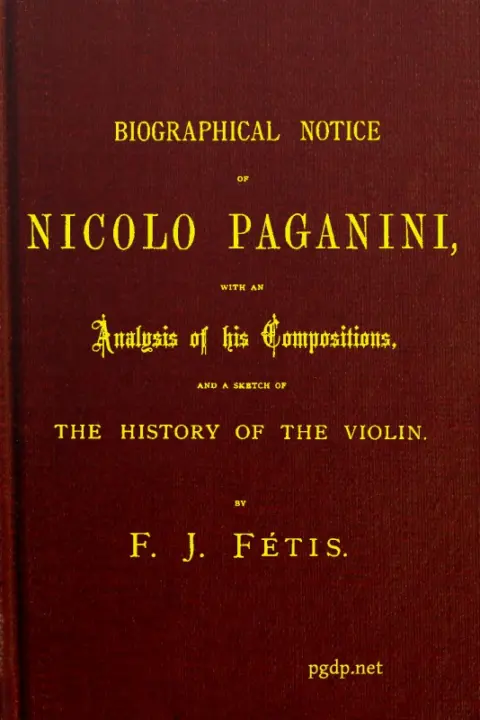
"Biographical Notice of Nicolo Paganini" by François-Joseph Fétis is a biographical account likely written in the mid-19th century. The work delves into the life of Nicolo Paganini, a celebrated violinist of the 19th century, alongside an analysis of his musical compositions and a history of the violin. The book offers a profound exploration of Paganini's extraordinary journey and artistry, positioning him within the broader context of violin history. The opening of the biography provides a detailed examination of Paganini’s early life, touching on his musical upbringing under the strict guidance of his father. It describes his early performances that showcased his prodigious talent, his quest for independence, and pivotal moments that defined his artistic development. The text further highlights the evolution of Paganini's violin playing, his innovation in technique, and the foundational influences that shaped him into one of the most iconic figures in the music world. This initial section sets the stage for a rich narrative about the intersection of genius and adversity in Paganini’s life.
Introduction adapted from the source catalogue; source summaries may be automatically generated.
Free to read · English · 32,504 words · No account needed
MAKE TIME FOR A GOOD BOOK
On by default. Untick to stop anonymous reading totals. Each page counts after 10 seconds in view. How this works.
Anonymous counting is on unless you have switched it off.
Being at Milan in the spring of 1813, he witnessed, at the Theatre La Scala, the ballet of “Il Noce di Benevento” by Virgano, the music of which was by Süssmayer.[J] It was from this ballet that Paganini took the theme of his celebrated variations “le Streghe,” (the Witches), from the air being that to which the witches appeared. While busied with these variations, and making arrangements for his concerts, he was again seized with a return of his former malady, and several months elapsed before he could appear in public. It was only on the 29th of October following he was enabled to give his first concert, when he excited a sensation which the journals of Italy and Germany made known to the whole world.
Paganini always evinced an extraordinary predilection for Milan, to which city he was much attached. Not only did he reside there the greater part of 1813, with the exception of his visit to Genoa, but also, until the month of September, 1814, visiting it three times during five years, residing there for a long period, and giving thirty-seven concerts. In 1813 he gave eleven, some at La Scala, and others at the Theatre Carcano; and, after a repose of some months, another series at the Theatre Rè, in 1814. In the month of October of that year he went to Bologna, where he saw Rossini for the first time, and commenced a friendship which became strengthened at Rome, in 1817, and at Paris in 1831. Rossini produced his “Aureliano in Palmira,” in December, 1813, at Milan, at which period Paganini was at Genoa, so that these artists had never yet met each other until Rossini was about leaving Bologna, to write his “Turco in Italia,” at Milan.
Up to the year 1828, Paganini had made three times the round of Italy. In 1815 he returned to Romagna, and having given some concerts there, stopped at Ancona. Here his malady returned to him for several months, and he then proceeded to Genoa, about the commencement of 1816, while Lafont was giving concerts at Milan. Anxious to hear the French violinist, he repaired thither, where a rivalry ensued, which was much spoken of, and appreciated in various ways, according to the bias of school and nationality. Lafont, who frequently related to me the circumstances of this meeting, was perfectly convinced that he was the victor. It is interesting to hear Paganini’s relation of this circumstance of his life:--“Being at Genoa, in March, 1816, I heard that Lafont was giving concerts at Milan, for which city I immediately started, for the purpose of hearing him. His performance pleased me exceedingly. A week afterwards I gave a concert at the Theatre La Scala, to make myself known to him. The next day Lafont proposed we should both perform on the same evening. I excused myself by saying that such experiments were always impolitic, as the public invariably looked upon such matters as duels, in which there was always a victim, and that it would be so in this case; for as he was acknowledged the best violinist in France, so the public indulgently considered me as the best of Italian violinists. Lafont not looking at it in this light, I was obliged to accept the challenge. I allowed him to regulate the programme, which he did in the following manner:--We each in turn played one of our own compositions, after which we played together the “Symphonie concertante” of Kreutzer, for two Violins. In this I did not deviate in the least from the author’s text, while we both were playing our own parts; but in the solos I yielded to my own imagination, and introduced several novelties, which seemed to annoy my adversary. Then followed a Russian air, with variations, by Lafont, and I finished the concert with my variations on “le Streghe.” Lafont probably surpassed me in tone, but the applause which followed my efforts convinced me I did not suffer by comparison.” Lafont, it cannot be denied, acted imprudently under the circumstances, for although it may be admitted he possessed more purely classical qualities, and was more in accordance with French taste than Paganini, although his tone was fuller, and more equal, yet, in original fancy, poetry of execution, and mastery of difficulties, he could not place himself in juxtaposition with his antagonist. In a concert, at the Conservatory of Paris, in 1816, the palm would have been awarded to him, but, with an Italian public, athirst for novelty and originality, his failure was certain.
Your reading position is saved on this browser. Take it to another device with a library code. Reading pages adapt to text, rather than matching a printed edition.
BEHIND THE BOOK
This eBook is for the use of anyone anywhere in the United States and most other parts of the world at no cost and with almost no restrictions whatsoever. You may copy it, give it away or re-use it under the terms of the Project Gutenberg License included with this eBook or online at www.gutenberg.org. If you are not located in the United States, you will have to check the laws of the country where you are located before using this eBook. Read the source licence.
The original source file, including credits and licence, is retained by this library. Request an original-format copy at no charge. Please include the book title and Project Gutenberg identifier #58184.
KEEP YOUR CURIOSITY GOING
Cécile Tormay

Moritz Busch
John L. Ransom
Frances Wright
Cécile Tormay

Mabel Potter Daggett