THE CLASSIC COLLECTION✦An outlaw’s diary: the CommuneCLASSIC FREE BOOKS
An outlaw’s diary: the Commune
Cécile Tormay
THE CLASSIC COLLECTION · 1876
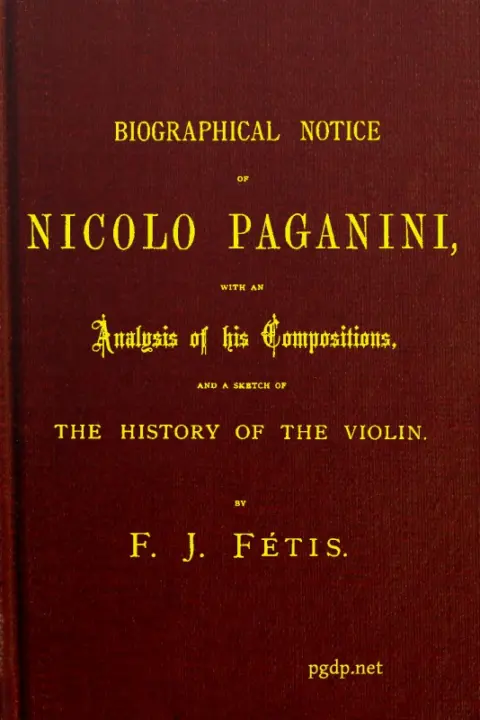
"Biographical Notice of Nicolo Paganini" by François-Joseph Fétis is a biographical account likely written in the mid-19th century. The work delves into the life of Nicolo Paganini, a celebrated violinist of the 19th century, alongside an analysis of his musical compositions and a history of the violin. The book offers a profound exploration of Paganini's extraordinary journey and artistry, positioning him within the broader context of violin history. The opening of the biography provides a detailed examination of Paganini’s early life, touching on his musical upbringing under the strict guidance of his father. It describes his early performances that showcased his prodigious talent, his quest for independence, and pivotal moments that defined his artistic development. The text further highlights the evolution of Paganini's violin playing, his innovation in technique, and the foundational influences that shaped him into one of the most iconic figures in the music world. This initial section sets the stage for a rich narrative about the intersection of genius and adversity in Paganini’s life.
Introduction adapted from the source catalogue; source summaries may be automatically generated.
Free to read · English · 32,504 words · No account needed
MAKE TIME FOR A GOOD BOOK
On by default. Untick to stop anonymous reading totals. Each page counts after 10 seconds in view. How this works.
Anonymous counting is on unless you have switched it off.
In the summer of 1808, Paganini obtained leave to travel, and quitted Lucca, never more to return. As the sister of Napoleon had become Grand Duchess of Tuscany, she fixed her residence at Florence, with all her Court, where the great artist retained his position.[F] He went to Leghorn, where, seven years previously, he had met with so much success. Here he was not received with the warmth extended to him on his former visit; but his talent soon overcame the coldness evinced towards him. He has related, with much humour, a series of tribulations which happened to him upon the occasion of his first concert there. “A nail,” he said, “had run into my heel, and I came on limping, at which the audience laughed. At the moment I was about to commence my concerto, the candles of my desk fell out. (Another laugh.) At the end of the first few bars of the solo, my first string broke, which increased the hilarity of the audience, but I played the piece on the three strings--and the grins quickly changed into acclamations of applause.” The broken string frequently occurred afterwards; and Paganini has been accused of using it as a means of success, having previously practised upon the three strings, pieces which appear to require the use of the first also.
From Leghorn he went to Turin, where the Princess Pauline Borghese, sister of Napoleon, the Prince, her husband, and suite, were sojourning. Blangini, then attached to the service of the Princess as director of music (1808 or 1809), there heard the illustrious violinist at several concerts; and spoke of him to me, on his return to Paris, with unbounded admiration. It was at Turin that Paganini was first attacked with internal inflammation, which subsequently so debilitated his health, as frequently to cause long interruptions to his travels, and his series of concerts. He was nearly convalescent, when he was recalled to the Court of Florence, in the month of October, 1809, for the concerts which were to be given on the occasion of peace between France and Austria. It was at this period that my friend, the celebrated sculptor, Bartolini, executed a bust of Paganini, which I saw in his studio at Florence, in 1841. An excellent work by M. Conestabile, which has just appeared, and which only reached me a few days ago,[G] furnishes me with information as to the manner Paganini was employed in 1810. It will be found (p. 58) that he must have left Florence about December, 1809, to visit Romagna and Lombardy; that he gave concerts at the old theatre of Cesena; that he afterwards produced an extraordinary sensation at a concert given at Rimini, the 22nd of January, 1810. This information was extracted by M. Conestabile, from manuscript memoirs by M. Giangi, an amateur composer, relating to the town of Rimini. It is probable he afterwards visited the other cities of Central Italy, Ravenna, Forli, Imola, and Faenza; but this is not certain. It appears also about the same period he met with an adventure at Ferrara that nearly cost him his life. He had gone to Bologna with a friend, and purposed giving some concerts there. Arrangements were already made with the manager, and rehearsals appointed, when, at the moment the rehearsal was about to commence, Marcolini, who was to sing at the concert, capriciously refused to do so. Disconcerted by this contretemps, Paganini sought the aid of Madame Pallerini, the principal dancer of the theatre, but who possessed a most agreeable voice, which she only cultivated for herself and her friends. Vanquished by the solicitations of the great violinist, she consented to sing at the concert; but when she presented herself to the public, fear overpowered her--she sang with timidity--and when she retired, encouraged by the kind applause which rewarded her efforts, a piercing hiss was heard. Maddened with rage, Paganini vowed to avenge this outrage at the end of the concert. As he was about to commence his last solo, he announced to the public that he purposed imitating the notes and cries of various animals. After having imitated the chirping of certain birds, cock-crowing, the mewing of a cat, and the barking of a dog, he advanced to the footlights, and while imitating the braying of an ass, he called out “This for the men who hissed” (Questo è per quelli che han fischiato!) He was convinced this repartee would excite laughter, and the hissers be hooted; but the pit rose to a man, vociferating, and rushing forward to the orchestra, which they literally scaled. Paganini had only time to escape, by hasty flight, the dangers that menaced him. It was only after he was safely at home, that he learned the cause of this fearful tumult. He was told that the peasantry in the suburbs of Ferrara entertain peculiar ill feelings towards the residents of that town--considering them as a community of idiots, and compare them to asses. Hence, any resident of the suburb, if questioned from whence he came, never admits it is from Ferrara, but vociferates a vigorous hee-haw. The audience present at Paganini’s concert considered this a personal allusion to themselves; the result was, that the authorities withdrew their permission and prohibited the continuation of his concerts. Since then, Paganini was never heard again at Ferrara.
Your reading position is saved on this browser. Take it to another device with a library code. Reading pages adapt to text, rather than matching a printed edition.
BEHIND THE BOOK
This eBook is for the use of anyone anywhere in the United States and most other parts of the world at no cost and with almost no restrictions whatsoever. You may copy it, give it away or re-use it under the terms of the Project Gutenberg License included with this eBook or online at www.gutenberg.org. If you are not located in the United States, you will have to check the laws of the country where you are located before using this eBook. Read the source licence.
The original source file, including credits and licence, is retained by this library. Request an original-format copy at no charge. Please include the book title and Project Gutenberg identifier #58184.
KEEP YOUR CURIOSITY GOING
Cécile Tormay

Moritz Busch
John L. Ransom
Frances Wright
Cécile Tormay

Mabel Potter Daggett