THE CLASSIC COLLECTION✦An outlaw’s diary: the CommuneCLASSIC FREE BOOKS
An outlaw’s diary: the Commune
Cécile Tormay
THE CLASSIC COLLECTION · 1876
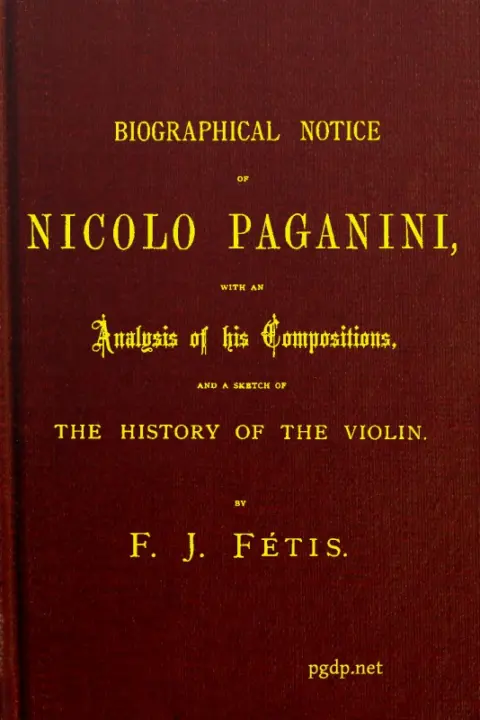
"Biographical Notice of Nicolo Paganini" by François-Joseph Fétis is a biographical account likely written in the mid-19th century. The work delves into the life of Nicolo Paganini, a celebrated violinist of the 19th century, alongside an analysis of his musical compositions and a history of the violin. The book offers a profound exploration of Paganini's extraordinary journey and artistry, positioning him within the broader context of violin history. The opening of the biography provides a detailed examination of Paganini’s early life, touching on his musical upbringing under the strict guidance of his father. It describes his early performances that showcased his prodigious talent, his quest for independence, and pivotal moments that defined his artistic development. The text further highlights the evolution of Paganini's violin playing, his innovation in technique, and the foundational influences that shaped him into one of the most iconic figures in the music world. This initial section sets the stage for a rich narrative about the intersection of genius and adversity in Paganini’s life.
Introduction adapted from the source catalogue; source summaries may be automatically generated.
Free to read · English · 32,504 words · No account needed
MAKE TIME FOR A GOOD BOOK
On by default. Untick to stop anonymous reading totals. Each page counts after 10 seconds in view. How this works.
Anonymous counting is on unless you have switched it off.
The art of playing the Violin, and the composition of music for this instrument, continued during the whole of the eighteenth century to progress rapidly. At the commencement of this century in almost every town of Italy, a distinguished violinist was met with. The genius of Corelli roused that of every artist. At Pisa, Costantino Clari, equally remarkable as composer and executant; at Florence, Francesco Veracini; at Bologna, Geronimo Laurenti; at Modena, Antonio Vitali; at Massa di Carrara, Cosmo Perelli and Francesco Ciampi; at Lucca, Lombardi; at Cremona, Visconti, whose counsels greatly aided Stradiuari in the manufacture of his instruments; at Pistoia, Giacopino; at Naples, Michaele Mascitti. Others, as Matteo Alberti, Tommaso Albinoni, Carlo Tessarini, and Antonio Vivaldi, all pupils of Corelli, were in their day not only virtuosi of the first order, but admirable writers of instrumental music. Vivaldi was one of those predestined artists who impress upon the art of their time a new direction. To him may be attributed the first improvement of the concerto; for the concerto grosso of Corelli is a work in which all the parts agree together, and each in turn partakes of its interest. “L’Estro Armonico” of Vivaldi, composed of twelve concertos for four Violins, two Viols, Violoncello, and Thorough-Bass for the Organ, follows this model; but in his sixth, seventh, eighth, ninth, tenth, eleventh and twelfth work, the genius of the author takes another flight, and although there is no division of solo and tutti, the principal Violin part governs all the rest. The melodies of Vivaldi bear a modern complexion that Somis and Geminiani imitated.
Among the above-mentioned galaxy of distinguished talent, the model violinist of the first half of the eighteenth century was Giuseppe Tartini, born at Pirano, in Istria, on the 12th of April, 1692. His early days were beset with difficulties, but having had the opportunity of hearing the celebrated violinist, Veracini, who happened to be at Venice when he was there, his vocation revealed itself. He withdrew to Ancona to practise uninterruptedly; and he applied himself in solitude more especially to the fundamental principle of bow movements, principles which have since served as the basis of every Violin school of Italy and of France. Settled in Padua in 1721, as principal soloist and chapel master of the celebrated church of St. Anthony, he passed forty-nine years of peace and comfort, solely occupied with the labours of his art, and died there on the 16th of February, 1770. In 1728, he established a school in that city, which became famous throughout Europe, and from which issued a multitude of violinists, among whom the following may be cited: Nardini, Pasqualino Bini, Alberghi, Domenico Ferrari, to whom is attributed the invention of harmonic sounds, Carminati, Capuzzi, Madame de Sirmen, and the French violinists, Pagin and La Houssaye. Tartini not only contributed towards perfecting the art of playing the Violin by his compositions for that instrument, but by the pupils he formed. His style is generally elevated; his ideas varied, and his harmony pure without being dry. The number of his published concertos and manuscripts amounts to nearly one hundred and fifty. There are also nearly fifty sonatas of his, among which is his “Sonata del Diavolo,” the anecdote of which is not dissimilar to that told of Paganini. Tartini thus related it:--“One night in 1713, I dreamt that I had entered into a compact with the devil, who was to be at my service. All succeeded to my utmost desires. My wishes were always anticipated, my desires surpassed, by the services of my new domestic. I thought of giving him my Violin, with the view of discovering whether he would play some fine things upon it; but what was my surprise when I heard a sonata so exquisitely beautiful and original, executed with such consummate skill and intelligence, that my deepest conceptions could not find its parallel. Overcome with surprise and pleasure, I lost my breath, which violent sensation awoke me. I instantly seized my Violin in the hope of remembering some portion of what I had heard, but in vain. The piece which this dream suggested, and which I wrote at the time, is doubtless the best of all my compositions, and I still call it “Sonata del Diavolo,” but it sinks so much into insignificance compared with what I heard, that I would have broken my instrument and abandoned music for ever, had my means permitted me to do so.”
Your reading position is saved on this browser. Take it to another device with a library code. Reading pages adapt to text, rather than matching a printed edition.
BEHIND THE BOOK
This eBook is for the use of anyone anywhere in the United States and most other parts of the world at no cost and with almost no restrictions whatsoever. You may copy it, give it away or re-use it under the terms of the Project Gutenberg License included with this eBook or online at www.gutenberg.org. If you are not located in the United States, you will have to check the laws of the country where you are located before using this eBook. Read the source licence.
The original source file, including credits and licence, is retained by this library. Request an original-format copy at no charge. Please include the book title and Project Gutenberg identifier #58184.
KEEP YOUR CURIOSITY GOING
Cécile Tormay

Moritz Busch
John L. Ransom
Frances Wright
Cécile Tormay

Mabel Potter Daggett