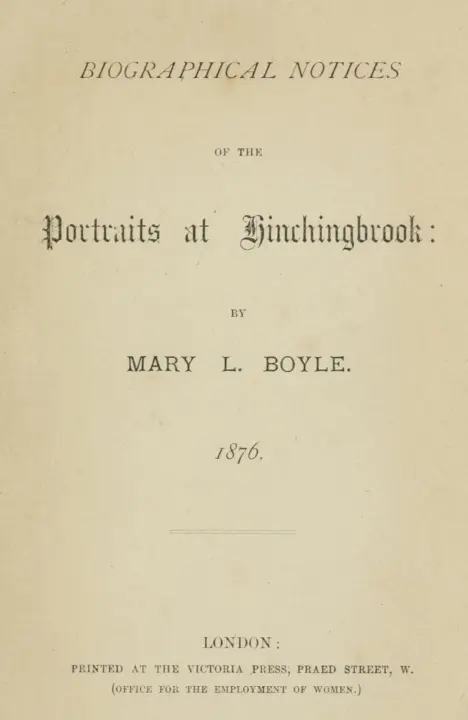
Biographical catalogue of the portraits at Longleat in the county of Wilts, the seat of the Marquis of Bath
Mary Louisa Boyle

THE CLASSIC COLLECTION · 1885
"Biographical Catalogue of the Portraits at Panshanger, the Seat of Earl Cowper" by Mary Louisa Boyle is a historical account written in the late 19th century. The book serves as a catalogue that details the portraits housed at Panshanger, providing biographical sketches of the individuals portrayed, with a particular focus on those connected to the Cowper family. The text is likely rich in historical context, making it a valuable resource for those interested in art history, nobility, and the cultural heritage of the period. The opening of this catalogue introduces the reader to the author's intent and methodology, emphasizing a personal and familial approach to the historical figures represented in the portraits. Boyle notes her preference for portraying her subjects in their private lives rather than through their public personas, aiming to create a more relatable account of their lives. She acknowledges the various sources of information she has used to compile the catalogue and expresses heartfelt gratitude towards those who contributed to her research. This sets the tone for a detailed exploration of the notable portraits and the stories behind them, highlighting the intertwined lives of the Cowper family and their historical significance.
Introduction adapted from the source catalogue; source summaries may be automatically generated.
Free to read · English · 141,121 words · No account needed
MAKE TIME FOR A GOOD BOOK
On by default. Untick to stop anonymous reading totals. Each page counts after 10 seconds in view. How this works.
Anonymous counting is on unless you have switched it off.
The slights put upon him by the Court, and a further offence given him by the Queen, determined Gondi to co-operate with the opposite faction. We have given a full account of the history of the Fronde in the notice of Marshal Turenne, and shall therefore only allude to the personal actions of Gondi, who became, if not at first the nominal leader, assuredly the moving spirit, of the malcontents. He had expressed his opinion some time before, that it required higher qualities to be leader of a party faction than to be emperor of the universe, and he now resolved to show his qualifications for that position. ‘Before noon to-morrow,’ he said, ‘I will be master of Paris.’
Now began that epoch of internal warfare in France, when the men of action and strong will rose to the surface, without reference to the honesty or morality of their characters. ‘Les troubles civils,’ says one of the historians of the Fronde, ‘sont le règne des oiseaux de proie.’ The Regent and her Minister well knew how much they had to fear throughout the wars of the Fronde, throughout the ups and downs of popularity and hatred from such men as Gondi, who became in time both Archbishop of Paris and Cardinal, and maintained for the most part his political ascendency until the conclusion of the civil war in 1652, when the Court returned to Paris. He was offered to go to Rome as Ambassador, but hesitated and demurred and procrastinated, till Anne of Austria’s old hatred broke out afresh, and he was arrested and conveyed, without any resistance on the part of his good Parisians, to the Château de Vincennes. Here he was treated with much severity, and could only gain the favour of being transported to the ancient Castle of Nantes at the price of some concessions in ecclesiastical matters. He contrived to escape, through an ingenious contrivance, and to evade the vigilance of the guards during one of his daily promenades on the ramparts, though he ran great risks while dangling to a rope, which had been thrown over the wall for his descent. Two young pages saw him, and cried loudly to the soldiers above, but as the Cardinal’s good star would have it, there was a great tumult going on below on the banks of the river. A bather was drowning, and people were shouting and calling for help in all directions, so that the boys’ feeble voices were unheard, or confounded with the general uproar. The Cardinal had friends awaiting his descent with horses, and they set forth at a furious pace, intending to make their way to Paris. But the Cardinal’s horse was scared by the report of a pistol which De Retz himself had fired on a supposed pursuer, and the rider fell to the ground, dislocated his shoulder, and had to ride for many leagues in tortures of pain. After passing several nights in misery and apprehension, hiding in barns and outhouses, under piles of hay, half suffocated, the fugitive contrived to reach the Spanish frontier, whence after a short sojourn he repaired to Rome. He had a very good reception, despite the rancour of the French Cardinals, and made himself conspicuous at the Conclave by his eloquence, which was instrumental in securing the election of Alexander VII. This smoothed the way for his return to France, where the King received him well; but the firm spirit of De Retz was not broken, and he withstood to the uttermost the endeavours, both of Louis and Mazarin, to make him resign his Archbishopric. However, he was at length persuaded to exchange it for the Abbey of St. Denis. The rest of his life, we are told by some of his biographers, was passed in retirement, piety, and charitable deeds. By some we are also told that his humility was so great that he offered to resign the Scarlet Hat, of which he was unworthy; but other writers are sceptical enough to doubt his good faith in this transaction, and to whisper that while he tendered his resignation to the King, he sent secret petitions to the Pope to refuse this offer. One thing is certain: the Cardinal became economical, and paid to the uttermost farthing the enormous debts which he had contracted. In his latter days he found amusement in the compilation of his own memoirs, which are characterised by extreme candour; and he found consolation in the society and friendship of Madame de Sévigné. In her charming Letters this admirable writer praises the tired man of the world for his charming conversation, his elevation of character, and his mild and peaceable disposition. Surely it must be acknowledged that our Frondeur had reformed! She speaks of his constant visits. ‘Nous tâchons,’ she says, ‘d’amuser notre bon Cardinal; Corneille lui a lu une pièce qui sera jouée dans quelque temps, et qui fait souvenir des anciennes. Molière lui lira, samedi Trissotin, qui est une fort plaisante chose. Despréaux lui donnera son lutrin, et sa poétique. Voilà tout ce qu’on peut faire pour son service.’ He died in Paris at the Hôtel Lesdiguierés in 1679. Madame de Sévigné, writing on the subject to her daughter, says, ‘Cette mort est encore plus funeste, que tu ne saurais le penser.’ ‘These ambiguous words,’ observes a French writer, ‘were considered very mysterious at the time, but the easy solution appears to be that the Cardinal had, unknown to Madame de Grignan herself, stated or hinted at the fact that he intended to make that lady his heir, a circumstance of which her mother was cognisant.’
Your reading position is saved on this browser. Take it to another device with a library code. Reading pages adapt to text, rather than matching a printed edition.
BEHIND THE BOOK
This eBook is for the use of anyone anywhere in the United States and most other parts of the world at no cost and with almost no restrictions whatsoever. You may copy it, give it away or re-use it under the terms of the Project Gutenberg License included with this eBook or online at www.gutenberg.org. If you are not located in the United States, you will have to check the laws of the country where you are located before using this eBook. Read the source licence.
The original source file, including credits and licence, is retained by this library. Request an original-format copy at no charge. Please include the book title and Project Gutenberg identifier #63698.
KEEP YOUR CURIOSITY GOING
Cécile Tormay

Moritz Busch
John L. Ransom
Frances Wright
Cécile Tormay

Mabel Potter Daggett