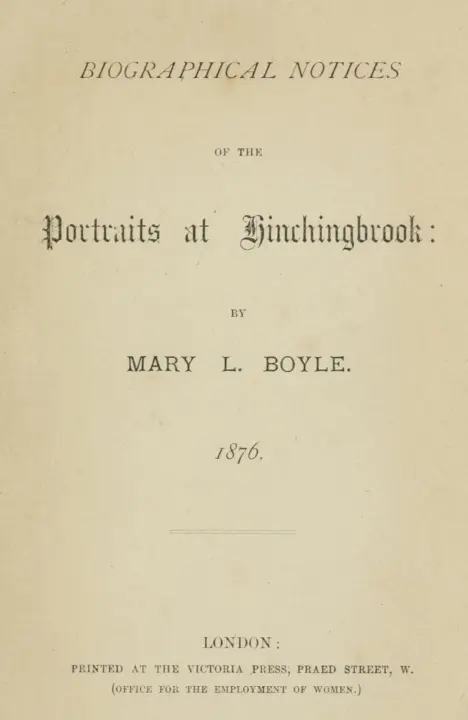
Biographical catalogue of the portraits at Longleat in the county of Wilts, the seat of the Marquis of Bath
Mary Louisa Boyle
THE CLASSIC COLLECTION · 1885
"Biographical Catalogue of the Portraits at Panshanger, the Seat of Earl Cowper" by Mary Louisa Boyle is a historical account written in the late 19th century. The book serves as a catalogue that details the portraits housed at Panshanger, providing biographical sketches of the individuals portrayed, with a particular focus on those connected to the Cowper family. The text is likely rich in historical context, making it a valuable resource for those interested in art history, nobility, and the cultural heritage of the period. The opening of this catalogue introduces the reader to the author's intent and methodology, emphasizing a personal and familial approach to the historical figures represented in the portraits. Boyle notes her preference for portraying her subjects in their private lives rather than through their public personas, aiming to create a more relatable account of their lives. She acknowledges the various sources of information she has used to compile the catalogue and expresses heartfelt gratitude towards those who contributed to her research. This sets the tone for a detailed exploration of the notable portraits and the stories behind them, highlighting the intertwined lives of the Cowper family and their historical significance.
Introduction adapted from the source catalogue; source summaries may be automatically generated.
Free to read · English · 141,121 words · No account needed
MAKE TIME FOR A GOOD BOOK
On by default. Untick to stop anonymous reading totals. Each page counts after 10 seconds in view. How this works.
Anonymous counting is on unless you have switched it off.
In 1769 he became the possessor of The Gregories, in the parishes of Penn and Beaconsfield, in Buckinghamshire. He thus speaks of it to Shackleton: ‘I have made a push with all I could collect, and the aid of my friends, to cast a little root in this country. I have bought a house, with an estate of about 600 acres, twenty-four miles from London: it is very pleasant, and I propose, God willing, to become a farmer in good earnest.’ He is sure his friend will approve of the acquisition, when he knows it was once the property of Waller the poet. There is always a large portion of the community who consider it incumbent on them to inquire into, and animadvert upon, their neighbours’ affairs, more especially their finances. The world was much exercised over the chances of Burke’s ability to defray such an expense as the purchase of an estate; but there seems little doubt that Lord Rockingham assisted him materially, and at his death that kind friend desired that all Edmund Burke’s bonds should be destroyed.
The Irishman did not belie his nationality with regard to money; it must be confessed he was lavish, and it is said that from the day, in 1769, when he applied to Garrick for the loan of £1000, till 1794, when he received a pension from the Crown, he was never out of debt. But Burke’s extravagance was far removed from selfishness; he never closed his ear or his purse against the appeals of struggling talent or deserving poverty, and was generous and compassionate in every relation of life. In 1773, his only child, his ‘darling Dick,’ having left Westminster, was entered student at Christchurch, Oxford, but he being considered too young for College life, his father determined to send him to Auxerre to study the French language. The youth was lodged in the house of the Bishop of the diocese, a good prelate, who treated him with the utmost kindness, which Richard’s father amply repaid, when, in after years, the Bishop visited England as an exile and a pauper. Edmund Burke went to Paris at the same time, not merely for the pleasure of making acquaintance with the agreeable and distinguished members of society, but for the purpose of investigating the causes of the revolutionary movement, which was beginning by degrees to convulse the French nation. He was presented to the Duchesse de Luxembourg, and to Madame du Deffand, who laments that ‘the Englishman speaks French so badly, in spite of which everybody likes him, and thinks he would be most agreeable, if he could make himself understood’! What a strange position for Edmund Burke; he was able, however, to follow French perfectly as a listener, and was much delighted with hearing La Harpe’s tragedy of Les Barmecides read at the Duchess’s house. He became acquainted with the Count de Broglie, one of the King’s confidential Ministers, and Caraccioli, the Neapolitan Envoy, and many members of the haute noblesse. Bent on weighing the balance of political opinion in Paris, Burke did not confine his visits to the salons of one faction or another; he was a frequent guest at the house of Mademoiselle d’Espinasse, the well-known writer of love-letters so ardent, that it was feared they would consume the paper on which they were written! And here he saw the man who inspired those tender epistles,—one Guibert, a colonel in the Corsican Legion, who had lately written a book, which had made a great noise in Paris, all the more that it had been suppressed by the Government. Burke studied the men and their works, and drew his own conclusions; he also, in common with all foreigners, went to Versailles, and saw the old King, Louis Quinze, at Mass, in a pew, just above Madame du Barry, and the Dauphin and his young bride dine in public with great pomp: Marie Antoinette, who, ‘glittering like the morning star, full of life, and joy, and splendour,’—that vision of beauty, indelibly stamped on his memory, which suggested many ‘words that burn,’ and inspired many an enthusiastic and eloquent appeal in behalf of the unfortunate French Sovereigns. Madame du Deffand flattered herself that Burke had gone home enamoured with the nation at large, but she was mistaken; he was never blinded, as were so many of his countrymen, especially his own party, by theoretical benefits of the French Revolution, but foresaw, in all their terrible distinctness, the horrors and excesses of the impending Reign of Terror. On his return to London, he renewed his acquaintance with all the eminent men of the day. His friendship with Johnson and Reynolds lasted till the death of both those loved companions; and Johnson, whose opinions, especially on politics, were usually opposed to those of Burke, used to say he did not grudge Edmund being the first man in the House of Commons, for was not Edmund the first man everywhere? ‘Indeed, he is a man, sir, that if you met him, for the first time, in the street, when, overtaken by a drove of oxen, you both stepped aside for five minutes’ shelter, from whom you could not part without saying, “What an extraordinary man!”’
Your reading position is saved on this browser. Take it to another device with a library code. Reading pages adapt to text, rather than matching a printed edition.
BEHIND THE BOOK
This eBook is for the use of anyone anywhere in the United States and most other parts of the world at no cost and with almost no restrictions whatsoever. You may copy it, give it away or re-use it under the terms of the Project Gutenberg License included with this eBook or online at www.gutenberg.org. If you are not located in the United States, you will have to check the laws of the country where you are located before using this eBook. Read the source licence.
The original source file, including credits and licence, is retained by this library. Request an original-format copy at no charge. Please include the book title and Project Gutenberg identifier #63698.
KEEP YOUR CURIOSITY GOING
Cécile Tormay

Moritz Busch
John L. Ransom
Frances Wright
Cécile Tormay

Mabel Potter Daggett