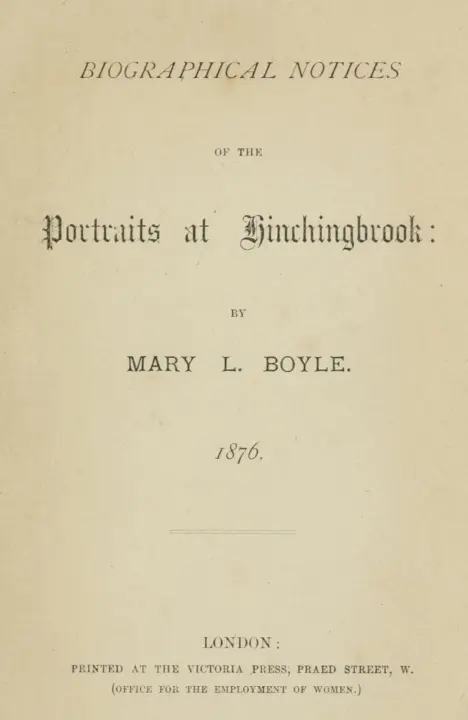
Biographical catalogue of the portraits at Longleat in the county of Wilts, the seat of the Marquis of Bath
Mary Louisa Boyle
THE CLASSIC COLLECTION · 1885
"Biographical Catalogue of the Portraits at Panshanger, the Seat of Earl Cowper" by Mary Louisa Boyle is a historical account written in the late 19th century. The book serves as a catalogue that details the portraits housed at Panshanger, providing biographical sketches of the individuals portrayed, with a particular focus on those connected to the Cowper family. The text is likely rich in historical context, making it a valuable resource for those interested in art history, nobility, and the cultural heritage of the period. The opening of this catalogue introduces the reader to the author's intent and methodology, emphasizing a personal and familial approach to the historical figures represented in the portraits. Boyle notes her preference for portraying her subjects in their private lives rather than through their public personas, aiming to create a more relatable account of their lives. She acknowledges the various sources of information she has used to compile the catalogue and expresses heartfelt gratitude towards those who contributed to her research. This sets the tone for a detailed exploration of the notable portraits and the stories behind them, highlighting the intertwined lives of the Cowper family and their historical significance.
Introduction adapted from the source catalogue; source summaries may be automatically generated.
Free to read · English · 141,121 words · No account needed
MAKE TIME FOR A GOOD BOOK
On by default. Untick to stop anonymous reading totals. Each page counts after 10 seconds in view. How this works.
Anonymous counting is on unless you have switched it off.
Many and strange were the vicissitudes which befell the body of this great man. It was placed (as we have said) in the Royal Chapel of St. Denis, by order of Louis XIV., and when the tombs of the royal family were desecrated in the Revolution of 1793, Turenne’s embalmed body was so well preserved as to be an object of desire to the owner of a Museum of Natural History. He gained permission to place it there, and it was exhibited among the skeletons and fossils of animals for some time, and then removed to an antiquarian museum for the edification of its members. Buonaparte, who had a profound admiration for the memory of the great soldier, caused the remains to be carried with much solemnity to the Church of the Invalides, and there deposited, while the Marshal’s heart, which had been placed in the Abbey of Cluny, was restored to his family.
This splendid picture is said to be the only equestrian portrait extant by Rembrandt. Its date has been given 1649-1650, when it is said in a Life of the painter that Turenne passed a month in Holland, and this picture was most probably painted. It was bought in 1740 by the Earl of Grantham (father-in-law to the second Earl Cowper) from a private collection at Amsterdam.
No. 2.
White quilted frocks. One child holds a bird. One is in a cradle with a
blue coverlet.
No. 3.
Seated writing at a table, with striped cover. Black dress and cap.
HE was the son of a tailor in Florence; and this trade, which is so often (for one reason or another) spoken of derisively in England, has surely gained to Italian ears a species of glorification, from the sobriquet attached to this illustrious painter. When only seven years old, the little Andrea was taken from the school where he received instruction in reading and writing, and placed with a goldsmith in the city. Even at that tender age his predilection for drawing, and even designing, showed itself, and, in like manner, his aversion to handling the mechanical instruments used in the handicraft. Indeed, the boy’s drawings were so clever as to attract the attention of one Gian Barile, a Florentine painter; so much so, that he did not rest until he had secured Andrea for his own studio; and as old Vasari quaintly says, ‘No sooner did the boy begin to exercise himself in the art of painting than he acknowledged that Nature had created him for that employment.’ In a very short space of time, Andrea, or Del Sarto, as he was called, produced such excellent pieces of colour as to excite the admiration of his master and all the artists in Florence, more especially Piero Cosimo, whose works were much esteemed in the city, and who proceeded to engage Andrea as his pupil. Nothing could be more diligent than the young man proved himself, studying and copying the cartoons of Michel Angelo, Leonardo da Vinci, etc., which were allotted the scholars as models; and he surpassed all his fellow-workers in the studio and academy, with one of whom, Francia Bigio, he soon formed an intimate friendship. One day, working, as was their custom, side by side, the two young men began to compare notes, with respect to the manner in which they were treated by their respective masters; they had each complaints to make; they were each discontented with their lot. After some little discussion, they resolved to set up house, or rather to take a room, together, which they accordingly did, in the Piazza del Grano. Here they laboured diligently, painting chiefly sacred subjects for galleries, churches, etc., both in oil and in fresco. There was at that time a confraternity, ‘Detto del Scalzo,’ whose meetings were held in the Via Larga. They were formed for the most part of the artificers of the city, but included men of all classes, who met for charitable and religious purposes; although not essentially a religious order, they took the name of The Scalzo, from the fact that when they met in prayer, or to walk in procession, they went barefoot. This company was most desirous that Andrea del Sarto should adorn the walls of their court with paintings from the life of their patron saint, St. John the Baptist. The company was not very wealthy, neither was our painter grasping, whatever may have been said of him later on, when subjected to a bad influence. He cheerfully undertook the work for a small remuneration, and reaped his reward, for these frescoes added so considerably to his fame that innumerable orders came in from all sides. He now moved to better quarters (in company with Francia Bigio), from the Piazza del Grano to a house situated in the neighbourhood of the Annunziata, where he made acquaintance with Jacopo Tatti, better known as the celebrated Sansovino, in whose society and conversation Andrea took so much delight that the two young enthusiasts in art became almost inseparable. Del Sarto was now gaining a good income, and might have been happy in the company of his friends, and the pursuit of his beloved art, but for a false step which involved his whole life in ruin and disaster. In the Via San Gallo lived a certain hatter, who had married Lucrezia Bartolommeo de Fede, the daughter of indigent and ill-conditioned parents. She was a young woman of exceeding beauty, violent and arrogant by nature, exercising a tyrannical influence over her many admirers, of whom Andrea was one of the most infatuated. Unfortunately for our painter, the husband died suddenly, and nothing would content Del Sarto but he would immediately espouse his inamorata. From the very beginning of their married life she possessed such a mastery over him that he was her slave in everything, and spent all his time and money on her and her relations, neglecting, in consequence, his own aged parents, whom he had hitherto supported. His friends shunned his society, his servants quitted his service, so ungenial and unamiable was the behaviour of Lucrezia.
Your reading position is saved on this browser. Take it to another device with a library code. Reading pages adapt to text, rather than matching a printed edition.
BEHIND THE BOOK
This eBook is for the use of anyone anywhere in the United States and most other parts of the world at no cost and with almost no restrictions whatsoever. You may copy it, give it away or re-use it under the terms of the Project Gutenberg License included with this eBook or online at www.gutenberg.org. If you are not located in the United States, you will have to check the laws of the country where you are located before using this eBook. Read the source licence.
The original source file, including credits and licence, is retained by this library. Request an original-format copy at no charge. Please include the book title and Project Gutenberg identifier #63698.
KEEP YOUR CURIOSITY GOING
Cécile Tormay

Moritz Busch
John L. Ransom
Frances Wright
Cécile Tormay

Mabel Potter Daggett