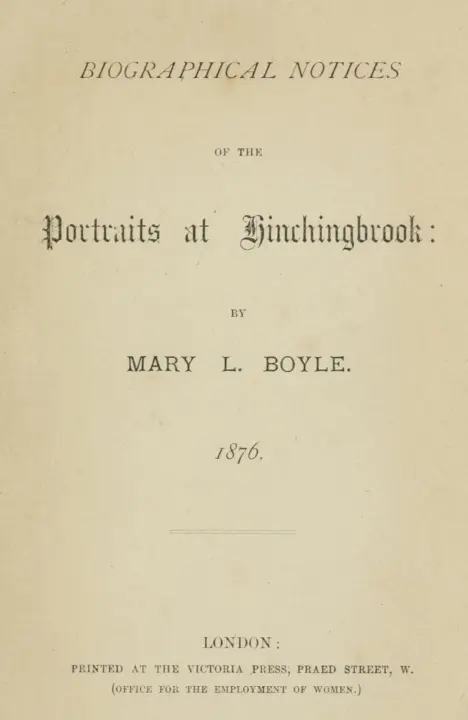
Biographical catalogue of the portraits at Longleat in the county of Wilts, the seat of the Marquis of Bath
Mary Louisa Boyle
THE CLASSIC COLLECTION · 1885
"Biographical Catalogue of the Portraits at Panshanger, the Seat of Earl Cowper" by Mary Louisa Boyle is a historical account written in the late 19th century. The book serves as a catalogue that details the portraits housed at Panshanger, providing biographical sketches of the individuals portrayed, with a particular focus on those connected to the Cowper family. The text is likely rich in historical context, making it a valuable resource for those interested in art history, nobility, and the cultural heritage of the period. The opening of this catalogue introduces the reader to the author's intent and methodology, emphasizing a personal and familial approach to the historical figures represented in the portraits. Boyle notes her preference for portraying her subjects in their private lives rather than through their public personas, aiming to create a more relatable account of their lives. She acknowledges the various sources of information she has used to compile the catalogue and expresses heartfelt gratitude towards those who contributed to her research. This sets the tone for a detailed exploration of the notable portraits and the stories behind them, highlighting the intertwined lives of the Cowper family and their historical significance.
Introduction adapted from the source catalogue; source summaries may be automatically generated.
Free to read · English · 141,121 words · No account needed
MAKE TIME FOR A GOOD BOOK
On by default. Untick to stop anonymous reading totals. Each page counts after 10 seconds in view. How this works.
Anonymous counting is on unless you have switched it off.
No. 9.
She is seated in the clouds, habited in blue floating drapery. In her right hand she holds a wand; her left rests on a sphere. A skull lies at her feet.
HER father, the Marquis de Ruvigny, came of a noble Huguenot family in France, and her brother was at one time head of the Protestant party in that country. But in spite of his religious opinions, he was much in favour, not only with Louis XIV., but also with Cardinal Mazarin. He eventually went to England on a diplomatic mission, where he settled with his family. One of his sons was killed at the battle of the Boyne, the other was created Earl of Galway by William III. We do not know the date of Rachel de Ruvigny’s marriage, but take it for granted that young Wriothesley made her acquaintance on his first visit to France. His elder brother dying of fever, Thomas, the second son, succeeded to the earldom of Southampton on the death of his father. His wife bore him two sons, who both died v. p., and three daughters, the second being Rachel, the faithful and devoted wife of William, Lord Russel, who was beheaded.
No. 1.
Violet coat. Wig.
HE was born at Marlborough, in Wiltshire, but went to London, where his father resided, when quite young; and, being of a delicate constitution, received his education at private schools. He showed an early predilection for the gentle arts of poetry, music, and drawing, yet, when he came to man’s estate, these tastes, which never left him, did not prevent his filling the posts he held under Government with credit, and proving himself a good man of business. He had an appointment in the Ordnance Office, and was secretary to several Commissions for the purchase of lands for the better securing of the Royal Docks and Yards of Portsmouth, Chatham, and Harwich. He found leisure in the midst of his public duties to devote a considerable time to the acquisition of modern languages, with which he supplemented his previous knowledge of Greek and Latin. His first poetic effusion was inspired by the Treaty of Ryswick, and was very popular. He wrote many translations and imitations of classical authors, together with such productions as ‘The Court of Neptune,’—an ode on the return of King William from Holland; and many monodies, elegies, and panegyrics, chiefly in honour of royal personages, which would now be considered but dreary reading. For all that he was much esteemed by the literati of the time, being intimate with Addison, Pope, Rowe, etc.; and Johnson tells us that Addison consulted with him, and even at one time asked his co-operation, in the matter of his tragedy of Cato, which, it appears, was finished, and put on the stage at the instigation of John Hughes. He was also much favoured by men of high standing and position, and when Lord Wharton was made Lord-Lieutenant of Ireland, he offered our author an appointment in the sister country. Hughes declined, although at the time in very poor circumstances; but he had another true friend and patron,—the Lord Chancellor Cowper, in whose family he had been tutor. Lord Cowper not only made Hughes secretary for the Commission of the Peace, but, on his own removal from office, recommended him to the notice of his successor. Hughes was now in comparatively affluent circumstances, but his failing health prevented his enjoyment of life. He had consumptive tendencies, and grew gradually weaker. His last work was a drama entitled ‘The Siege of Damascus,’ which set the fashion of sieges innumerable. He completed it a short time before his death, with a dedication to Lord Cowper; but he had no strength to attend the rehearsals, or energy to resist the emendations, alterations, and innovations thrust upon him by the worshipful company of players. The first night of his tragedy’s representation was the last of the author’s life; they brought him word that ‘The Siege’ was progressing satisfactorily; but by that time his thoughts were fixed on the new life which was opening before him, and he made no remark, but passed silently away. Many of his works were published during his life; many more after his death. He was a constant contributor to the Spectator, the Guardian, and similar periodicals; and Steele wrote an eulogistic paper on his death. Two letters which passed between Swift and Pope may perhaps help to enable us (if we accept their testimony) in assigning Hughes a place as an author. The Dean writes: ‘A month ago a friend sent me over the works of John Hughes in prose and verse. I never heard of the man in my life, yet I find your name as a subscriber. He is far too grave a poet for me, and I think among the mediocrists in prose, as well as verse.’ Pope replies: ‘To answer your question about Hughes: what he wanted in genius he made up in honesty; but he was of the class you think him.’
Your reading position is saved on this browser. Take it to another device with a library code. Reading pages adapt to text, rather than matching a printed edition.
BEHIND THE BOOK
This eBook is for the use of anyone anywhere in the United States and most other parts of the world at no cost and with almost no restrictions whatsoever. You may copy it, give it away or re-use it under the terms of the Project Gutenberg License included with this eBook or online at www.gutenberg.org. If you are not located in the United States, you will have to check the laws of the country where you are located before using this eBook. Read the source licence.
The original source file, including credits and licence, is retained by this library. Request an original-format copy at no charge. Please include the book title and Project Gutenberg identifier #63698.
KEEP YOUR CURIOSITY GOING
Cécile Tormay

Moritz Busch
John L. Ransom
Frances Wright
Cécile Tormay

Mabel Potter Daggett