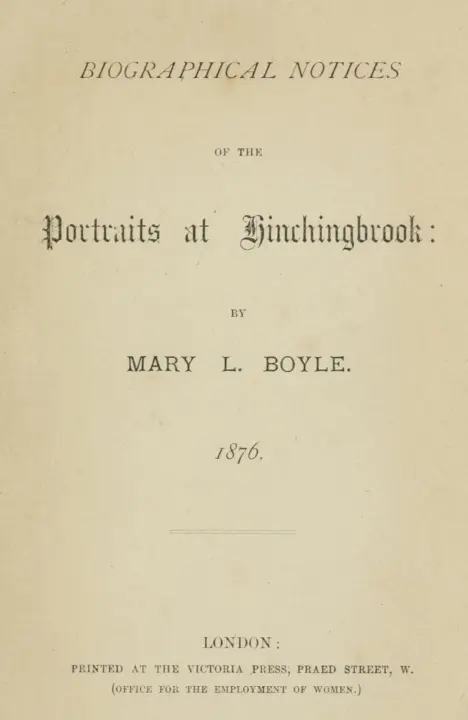
Biographical catalogue of the portraits at Longleat in the county of Wilts, the seat of the Marquis of Bath
Mary Louisa Boyle
THE CLASSIC COLLECTION · 1885
"Biographical Catalogue of the Portraits at Panshanger, the Seat of Earl Cowper" by Mary Louisa Boyle is a historical account written in the late 19th century. The book serves as a catalogue that details the portraits housed at Panshanger, providing biographical sketches of the individuals portrayed, with a particular focus on those connected to the Cowper family. The text is likely rich in historical context, making it a valuable resource for those interested in art history, nobility, and the cultural heritage of the period. The opening of this catalogue introduces the reader to the author's intent and methodology, emphasizing a personal and familial approach to the historical figures represented in the portraits. Boyle notes her preference for portraying her subjects in their private lives rather than through their public personas, aiming to create a more relatable account of their lives. She acknowledges the various sources of information she has used to compile the catalogue and expresses heartfelt gratitude towards those who contributed to her research. This sets the tone for a detailed exploration of the notable portraits and the stories behind them, highlighting the intertwined lives of the Cowper family and their historical significance.
Introduction adapted from the source catalogue; source summaries may be automatically generated.
Free to read · English · 141,121 words · No account needed
MAKE TIME FOR A GOOD BOOK
On by default. Untick to stop anonymous reading totals. Each page counts after 10 seconds in view. How this works.
Anonymous counting is on unless you have switched it off.
Mrs. Delany, in her amusing diaries and letters, published of late years by Lady Llanover, to whom many thanks are due for the same, speaks constantly of her cousin Georgiana Granville, with an obvious pride in the relationship. She says, in writing to her sister, ‘You will expect to hear some account of our cousin Spencer. The marriage took place between eight and nine o’clock at night. The guests were very distinguished,—the Dukes and Duchesses of Marlborough and Bedford, Sir Robert and Lady Worsley, the bride’s grandparents, and numerous members of their family, Lord Morpeth, Colonel Montagu, etc. etc. After they were married, they played a pool of commerce, then retired between twelve and one, and went next day to Windsor Lodge. They are to return on Monday, to what was Mr. Percival’s lodging in Conduit Street. Georgiana was dressed in white satin, embroidered in silver, her laces very fine, and the jewels the Duchess of Marlborough gave her, magnificent. Frequent allusions are made by the writers of the day to these famous jewels in which Mrs. Spencer ‘sparkled.’ Then follows a catalogue of the bride’s wedding bravery, of laces and linen very fine, and flowered silks, such as would rouse the envy of many a lover of old brocade in modern times; a pink and silver poudesoy, a blue damask night-gown, and rich brocades, all stiff with embroidery.
John Spencer dying, his widow contracted a second marriage with Lord Cowper, and Mrs. Delany speaks of the union as being a very happy one, for ‘Georgiana is much attached to her new Lord and his children, and it is warmly reciprocated.’ Horace Walpole, in describing the gorgeous sight which the coronation of George III. and his Queen presented, gives an amusing account of the preparations for the same among the ladies: how several were dressed overnight, and reposed in armchairs, with watchers beside them to wake up the sleepers when in danger of ruffling their garments or tumbling their headdresses. Walpole conveyed Ladies Townshend, Hervey, Hertford, and Anne Conolly, with Mrs. Clive, to see the show in his deputy’s house at the gate of Westminster Hall. Says Lady Townshend, ‘I should like to go to a coronation, for I have never seen one.’ ‘Why,’ remarked Horace, ‘you walked at the last.’ ‘Yes, child,’ was the candid reply, ‘but I saw nothing; I only looked to see who was looking at me.’ There seemed to have been a great stir among the Countesses, who all objected to associate with Lady Macclesfield. Horace again: ‘My heraldry was much more offended with the ladies who did walk, than with those who walked out of place, but I was not so furiously angry as my Lady Cowper. She flatly refused at first to set a foot with my Lady Macclesfield, and when at last compelled to do so she set out at a round trot’ (to distance her companion?), ‘as if she designed to prove the antiquity of her family by walking as lustily as a maid of honour of Queen Guinevere.’ Mrs. Delany writes later on, ‘Lady Cowper is very much pleased at her son being made an Earl, and all the more as the honour was entirely unsolicited.’ Lord Spencer was a generous and dutiful son, and when his mother once more became a widow, he gave her a charming house at Richmond, fully furnished, where she was very hospitable to Mrs. Delany and that branch of her family, as well as to the relations and connections of both her husbands. Here her ‘cousin’ frequently mentions meeting Lady Spencer and her mother, Mrs. Poyntz, Anne Maria Mordaunt, who had been maid of honour to Queen Caroline, and governess to the Duke of Cumberland. Lady Cowper’s letters are lively and genial. In one, dated New Year’s Day, she says, ‘Last evening came Lord Montagu (only son of the Earl of Cardigan, created Baron Montagu). He spent most of the evening alone with me, and I played on the guitar, and sang to him. I hope we may not be talked about, for he is quite alive, I assure you, although he is fourscore struck, as the Duchess of Marlborough used to say.’ Georgiana retained her good looks to a very advanced age, for Mrs. Delany says, not long before her death, ‘I saw Lady Cowper yesterday. She is still the Glastonbury Rose.’ During her last illness, which was of some duration, her daughter-in-law, Lady Spencer, was unremitting in her attentions, driving over daily from her home at Wimbledon to Richmond, sometimes twice in the twenty-four hours, and often passing the night by the sufferer’s bedside.
Your reading position is saved on this browser. Take it to another device with a library code. Reading pages adapt to text, rather than matching a printed edition.
BEHIND THE BOOK
This eBook is for the use of anyone anywhere in the United States and most other parts of the world at no cost and with almost no restrictions whatsoever. You may copy it, give it away or re-use it under the terms of the Project Gutenberg License included with this eBook or online at www.gutenberg.org. If you are not located in the United States, you will have to check the laws of the country where you are located before using this eBook. Read the source licence.
The original source file, including credits and licence, is retained by this library. Request an original-format copy at no charge. Please include the book title and Project Gutenberg identifier #63698.
KEEP YOUR CURIOSITY GOING
Cécile Tormay

Moritz Busch
John L. Ransom
Frances Wright
Cécile Tormay

Mabel Potter Daggett