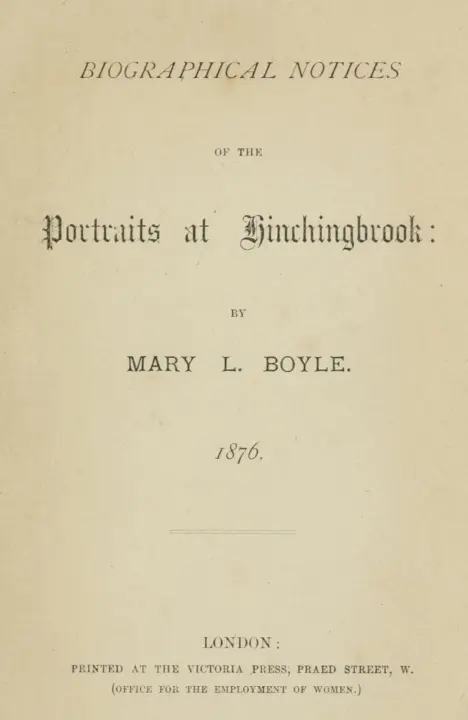
Biographical catalogue of the portraits at Longleat in the county of Wilts, the seat of the Marquis of Bath
Mary Louisa Boyle
THE CLASSIC COLLECTION · 1885
"Biographical Catalogue of the Portraits at Panshanger, the Seat of Earl Cowper" by Mary Louisa Boyle is a historical account written in the late 19th century. The book serves as a catalogue that details the portraits housed at Panshanger, providing biographical sketches of the individuals portrayed, with a particular focus on those connected to the Cowper family. The text is likely rich in historical context, making it a valuable resource for those interested in art history, nobility, and the cultural heritage of the period. The opening of this catalogue introduces the reader to the author's intent and methodology, emphasizing a personal and familial approach to the historical figures represented in the portraits. Boyle notes her preference for portraying her subjects in their private lives rather than through their public personas, aiming to create a more relatable account of their lives. She acknowledges the various sources of information she has used to compile the catalogue and expresses heartfelt gratitude towards those who contributed to her research. This sets the tone for a detailed exploration of the notable portraits and the stories behind them, highlighting the intertwined lives of the Cowper family and their historical significance.
Introduction adapted from the source catalogue; source summaries may be automatically generated.
Free to read · English · 141,121 words · No account needed
MAKE TIME FOR A GOOD BOOK
On by default. Untick to stop anonymous reading totals. Each page counts after 10 seconds in view. How this works.
Anonymous counting is on unless you have switched it off.
The travellers reached Eartham at last, Hayley’s home, about six miles from Chichester, and five from Arundel. ‘Here,’ writes Cowper on his arrival, ‘we are as happy as it is possible for terrestrial good to make us.’ He looked from the library window on a fine landscape, bounded by the sea, a deep-wooded valley, and hills which we should call mountains in Buckinghamshire. Hayley and Cowper were both very busy with their several works in the morning, and Johnny, as usual, was his cousin’s transcriber. The kind host, thinking to do honour to his guest, invited the ex-Chancellor Thurlow to meet his old acquaintance, but his Lordship would not come. There were, however, pleasant visitors at Eartham, with whom Cowper fraternised,—Charlotte Smith the novelist, and Romney the admirable painter. ‘Hayley has given me a picture of himself by this charming artist, who is making an excellent portrait of me in pastel.’
‘Mrs. Unwin,’ he says, ‘has benefited much by the change, and has many young friends, who all volunteer to drag her chair round the pretty grounds.’ In spite of all these pleasant surroundings, the two friends became home-sick, and returned to Weston, where they found (after the manner of less gifted mortals) that chaos had reigned in their absence. Cowper resumed his Miltonic labours, and began preparing Homer for a new edition. ‘I play at push-pin with Homer every morning before breakfast, furbishing and polishing, as Paris did his armour.’ Speaking of his assurance in having undertaken works of such importance, he quotes Ranger’s observation in the Suspicious Husband: ‘There is a degree of assurance in your modest men, which we impudent fellows never arrive at.’
Poor Cowper! He was again gradually sinking back into despondency, though he combated the advances of the enemy as far as in him lay. ‘I am cheerful on paper sometimes when I am actually the most dejected of creatures. I keep melancholy out of my letters as much as I can, that I may, if possible, by assuming a less gloomy air, deceive myself, and improve fiction into reality.’ He is to sit for his portrait once more to Lawrence, and he only wishes his face were moveable, to take off and on at pleasure, so that he might pack it in a box, and send it to the artist. On Hayley’s second visit to Weston, he found Cowper tolerably well in appearance. Young Mr. Rose was there, the bearer of an invitation from Lord Spencer, who wished Cowper to meet Gibbon. ‘We did all we could to make him accept, urging the benefit he would derive from such genial society, and the delight he would experience from revelling in the treasures of the magnificent library. But our arguments were all in vain; Cowper was unequal to the exertion.’ So Rose and Hayley were his ambassadors to Althorp, laden with his excuses. It is our intention to dwell as briefly as is consistent with the narrative on the sad scenes now enacting at Weston. A fearful relapse had befallen Cowper; Mrs. Unwin’s state bordered on imbecility; and Lady Hesketh, who had lately taken up her abode with her two afflicted friends, seemed powerless to cheer them, and Hayley, whom she summoned to their aid, was shocked to find that Cowper scarcely recognised him, and manifested no pleasure in his society. It was with the greatest difficulty that he could now be induced to taste food, and this system of course increased his malady, by reducing his strength. One morning a letter arrived from Lord Spencer, announcing that the long-looked-for pension had at length been granted,—a circumstance which was a great relief to his friends, but, alas! brought no satisfaction to the sufferer’s bewildered mind. Change of air and scene were recommended. Lady Hesketh, whose own health was greatly impaired, went to London, and Cowper and Mrs. Unwin were conveyed into Norfolk under the kind charge of ‘Johnny’ Johnson. They went first to a village called Tuddenham, and afterwards to Mundsley, on the coast. Johnson accompanied Cowper in all his rambles, and one day, calling on Mrs. Bodham, their cousin, to whom we have already alluded, Cowper saw the portrait of himself painted by Abbot; he looked at it for some time, and then, wringing his hands, uttered a vehement wish that he were now as happy as when he sat for that picture.
Your reading position is saved on this browser. Take it to another device with a library code. Reading pages adapt to text, rather than matching a printed edition.
BEHIND THE BOOK
This eBook is for the use of anyone anywhere in the United States and most other parts of the world at no cost and with almost no restrictions whatsoever. You may copy it, give it away or re-use it under the terms of the Project Gutenberg License included with this eBook or online at www.gutenberg.org. If you are not located in the United States, you will have to check the laws of the country where you are located before using this eBook. Read the source licence.
The original source file, including credits and licence, is retained by this library. Request an original-format copy at no charge. Please include the book title and Project Gutenberg identifier #63698.
KEEP YOUR CURIOSITY GOING
Cécile Tormay

Moritz Busch
John L. Ransom
Frances Wright
Cécile Tormay

Mabel Potter Daggett