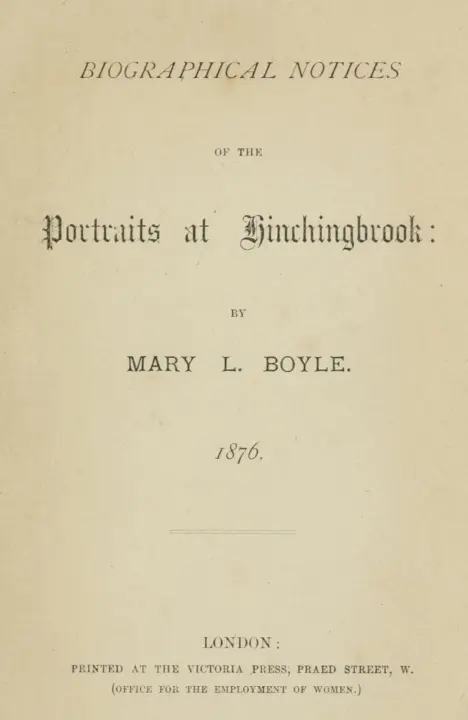
Biographical catalogue of the portraits at Longleat in the county of Wilts, the seat of the Marquis of Bath
Mary Louisa Boyle
THE CLASSIC COLLECTION · 1885
"Biographical Catalogue of the Portraits at Panshanger, the Seat of Earl Cowper" by Mary Louisa Boyle is a historical account written in the late 19th century. The book serves as a catalogue that details the portraits housed at Panshanger, providing biographical sketches of the individuals portrayed, with a particular focus on those connected to the Cowper family. The text is likely rich in historical context, making it a valuable resource for those interested in art history, nobility, and the cultural heritage of the period. The opening of this catalogue introduces the reader to the author's intent and methodology, emphasizing a personal and familial approach to the historical figures represented in the portraits. Boyle notes her preference for portraying her subjects in their private lives rather than through their public personas, aiming to create a more relatable account of their lives. She acknowledges the various sources of information she has used to compile the catalogue and expresses heartfelt gratitude towards those who contributed to her research. This sets the tone for a detailed exploration of the notable portraits and the stories behind them, highlighting the intertwined lives of the Cowper family and their historical significance.
Introduction adapted from the source catalogue; source summaries may be automatically generated.
Free to read · English · 141,121 words · No account needed
MAKE TIME FOR A GOOD BOOK
On by default. Untick to stop anonymous reading totals. Each page counts after 10 seconds in view. How this works.
Anonymous counting is on unless you have switched it off.
Several of his friends, unacquainted with these sad circumstances, called upon him on the day appointed for his appearance at the House of Lords, but one and all acquiesced in the sad decision that he must be placed under restraint. The asylum chosen was that of Dr. Cotton, a religious and well-educated man, who was of much service to the sufferer by his judicious treatment. William laboured under terrible despondency, fear of eternal punishment, and the deepest feelings of remorse. By the gentle, friendly care of Dr. Cotton, the patient gradually regained his health, both mental and bodily, and took much comfort in reading the Bible,—the very book which, in his fits of madness, he would dash to the ground. One morning, studying the third chapter of Romans, he experienced ‘comfort and strength to believe, feeling the full beams of the Sun of Righteousness shining on me, and relying on the full justification by faith in the blood of Jesus. In a moment I believed, and received the Gospel.’
The seeds of religion, which bore fruit in Cowper’s after life, had been in some measure sown by the hand of the good physician Dr. Cotton, and, after eleven months’ sojourn at St. Albans, William Cowper went forth in his right mind.
After much consultation between the brothers, an abode was fixed upon for William Cowper at what one of his biographers designates as ‘dull, fenny Huntingdon,’ which appeared an Elysium to one who had just recovered his senses and his liberty. He had not been there long before an incident occurred which changed the whole tenor of his after life. Leaving church one morning, he began pacing up and down under the shade of the trees, before returning to his solitary lodging, when he was accosted by a young man of prepossessing appearance, who craved pardon for addressing ‘a perfect stranger,’ and asked leave to accompany him in his walk. Such an unconventional proceeding was doubtless calculated to please a man of so imaginative a turn of mind, and Cowper warmly responded. The young man announced himself as William Unwin, a student of Cambridge, the son of the Rev. Mr. Unwin, who lived in the town, and boarded pupils for the Huntingdon school. Young Unwin went on to confess that, for some time past, he had been attracted by Cowper’s appearance, and longed to speak to him, but to-day he could no longer resist doing so. He ended by requesting his new friend to accompany him home, that he might make acquaintance with his parents. No time was lost, the visit was paid; the liking proved reciprocal, and it was not long before William Cowper left his lonely apartments to occupy a room, lately vacated, under the roof of the Rev. Mr. Unwin. Thus began that lifelong friendship, the annals of which are indissolubly connected with the poet’s history. ‘Verily there is One who setteth the solitary in families.’ Writing to his dear cousin and constant correspondent, Lady Hesketh (the sister of Theodora), he described ‘the most comfortable and sociable folk he had ever met,—the son, destined for the Church, most frank and unreserved; the girl pretty, bashful, taciturn; the father a kind of Parson Adams, and the mother.’ Mrs. Unwin was some years younger than her husband, comely in appearance, strongly imbued with evangelical views in religion, well read, particularly in the English poets, with a vein of cheerfulness and humour tempering the strictness of her religious tenets, and an invaluable critic. Cowper describes a two hours’ walk and conversation with her, which did him ‘more good than an audience with a prince could have done. Her society is a real blessing to me.’ The manner of life in the Unwin establishment proved most congenial to Cowper’s tastes, for he both contemned and condemned ‘the frivolous gaieties, the balls, routs, and card-parties of the Huntingdon beau monde.’ ‘After early breakfast,’ he says, ‘we occupy ourselves in reading passages from Scripture, or the works of some favourite preacher; at eleven, Divine service, which is performed twice a day; a solitary ride, walk, or reading; and after dinner a sociable walk in the garden with mother or son, the conversation usually of a religious character.’ Mrs. Unwin was a good walker, and the friends often rambled beyond the home precincts, and did not return till tea-time; at night, reading or singing hymns till supper; family prayers concluded the order of the day. This was the description by William Cowper of a day of perfect cheerfulness. With all our admiration for the man who was thus spiritually minded, it is almost a relief to find him confessing to some slight shade of human weakness in a letter to his cousin, Mrs. Cowper. He had given young Unwin an introduction to ‘the Park,’ and—after a lengthened rhapsody of self-accusation, not without a spice of humour, as of one who is laughing at himself,—he allows that ‘it was not alone friendship for the youth which prompted the introduction, but a desire that Unwin should receive some convincing proof of “my sponsibility,” by visiting one of my most splendid connections, so that, when next he hears me called “that fellow Cowper” (which has happened before now), he may be able to bear witness to my gentlemanhood.’
Your reading position is saved on this browser. Take it to another device with a library code. Reading pages adapt to text, rather than matching a printed edition.
BEHIND THE BOOK
This eBook is for the use of anyone anywhere in the United States and most other parts of the world at no cost and with almost no restrictions whatsoever. You may copy it, give it away or re-use it under the terms of the Project Gutenberg License included with this eBook or online at www.gutenberg.org. If you are not located in the United States, you will have to check the laws of the country where you are located before using this eBook. Read the source licence.
The original source file, including credits and licence, is retained by this library. Request an original-format copy at no charge. Please include the book title and Project Gutenberg identifier #63698.
KEEP YOUR CURIOSITY GOING
Cécile Tormay

Moritz Busch
John L. Ransom
Frances Wright
Cécile Tormay

Mabel Potter Daggett