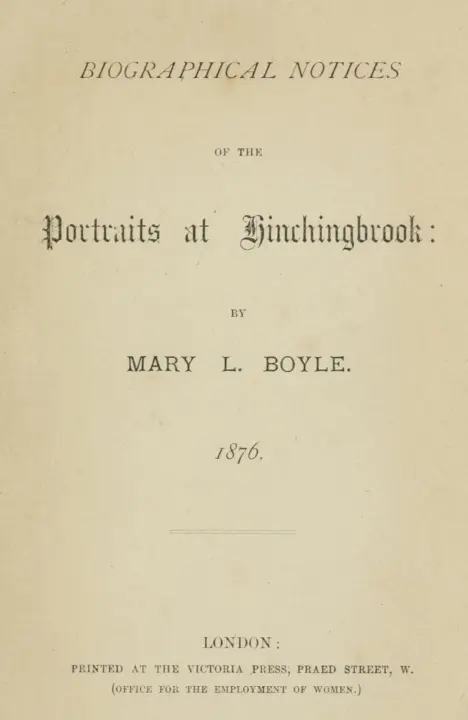
Biographical catalogue of the portraits at Longleat in the county of Wilts, the seat of the Marquis of Bath
Mary Louisa Boyle
THE CLASSIC COLLECTION · 1885
"Biographical Catalogue of the Portraits at Panshanger, the Seat of Earl Cowper" by Mary Louisa Boyle is a historical account written in the late 19th century. The book serves as a catalogue that details the portraits housed at Panshanger, providing biographical sketches of the individuals portrayed, with a particular focus on those connected to the Cowper family. The text is likely rich in historical context, making it a valuable resource for those interested in art history, nobility, and the cultural heritage of the period. The opening of this catalogue introduces the reader to the author's intent and methodology, emphasizing a personal and familial approach to the historical figures represented in the portraits. Boyle notes her preference for portraying her subjects in their private lives rather than through their public personas, aiming to create a more relatable account of their lives. She acknowledges the various sources of information she has used to compile the catalogue and expresses heartfelt gratitude towards those who contributed to her research. This sets the tone for a detailed exploration of the notable portraits and the stories behind them, highlighting the intertwined lives of the Cowper family and their historical significance.
Introduction adapted from the source catalogue; source summaries may be automatically generated.
Free to read · English · 141,121 words · No account needed
MAKE TIME FOR A GOOD BOOK
On by default. Untick to stop anonymous reading totals. Each page counts after 10 seconds in view. How this works.
Anonymous counting is on unless you have switched it off.
After many fluctuations on one part and the other, the Prince de Condé’s army was hemmed in, and must have been cut to pieces had not the Parisians, seeing his danger, opened the gates, and received the rebels within their walls, while the cannon began playing on the Royal army, by command of the King’s own cousin, Mademoiselle de Montpensier. So hot was the fire, and so close the quarters, that Turenne was obliged to abandon his desire of pursuing the enemy within the walls. Disorder and tumult reigned in Paris, and a terrible massacre took place at the Hôtel de Ville.
The Court, by the Marshal’s advice, repaired to Pontoise, and he himself to Compiègne; and it was chiefly through his instrumentality that the Spanish troops were at length obliged to evacuate France, and retreat to Flanders. A sad affliction was in store for the hero about this time, in the death of his brother, the Duc de Bouillon, to whom he was fondly attached. But he was not a man to allow sorrow to interfere with duty. The ill feeling that was still rife against the Cardinal Minister continued to be used as a pretext for revolt and rebellion of all kinds. Turenne went in person one day, and had a long and confidential conversation with Mazarin, in which he pointed out, in the most emphatic manner, that it was incumbent upon him (the Minister) to make at least a temporary sacrifice for the good of the King, his master, and the country in general. This, urged the Marshal, would be effected by his absenting himself, for a time at least. His arguments prevailed. Mazarin consented to leave France, but in so doing he made his own conditions. The King (who was directed to say he ‘only gave in to the plan of dismissing his faithful Minister in order to pacify his people’) received a paper from the Cardinal, in which directions were drawn up for his own conduct; and His Majesty was further instructed to place two of his Eminence’s most devoted adherents at the head of affairs. After this was done, Mazarin, strong in the conviction that the Queen would soon recall him, took his way to Bouillon. But Condé and the Duc de Lorraine still continued to harass the kingdom, and peace seemed still far off; it was again by Turenne’s advice that the Court was induced to proceed once more to Paris, where the Marshal assured Louis that the Parisians, being wearied by the unsettled state of affairs, would gladly welcome him. Accordingly the Court set out; but as the cortége approached the Bois de Boulogne, they were met by a deputation, the members of which pointed out in the most formidable colours the danger which his Majesty would incur in entering Paris, where those arch-rebels, the Duke of Orleans, and Mademoiselle de Montpensier, his daughter, were caballing to incite the people against him. The royal coach came to a stand-still, and Anne of Austria, with her accustomed energy and promptness, made the ladies who were inside alight, and summoning the Vicomte de Turenne, the Marshals De Villeroi, Du Plessis, and others, she held an open-air council. Every one, with the exception of Turenne, was of opinion that they had better retrace their steps. The noble soldier spoke, as he always did, with firmness and judgment. He did not believe, he said, in the friendship of men who could give such pusillanimous advice; that the return of the Court would make them despicable in the eyes of all, and would discourage the loyal, and give fresh impetus to the plans of the disaffected. The Queen approved and seconded him on every point, and the procession moved on once more. The young King, at the head of his guards, rode in amid loud cries of ‘Vive le Roi!’ and the acclamations of a huge concourse that accompanied him to the gates of the Louvre. The next day the Duke of Orleans and his daughter thought it advisable to leave Paris, and amicable relations were entered into between the King and his Parliament. ‘L’ordre fût bientôt rétabli dans la ville, et le calme qui succeda fit oublier les troubles de la Fronde.’ The Prince de Condé alone refused to comply with the conditions of the amnesty which was proclaimed, preferring, he said, to suffer any loss rather than live in the same country with the Cardinal, whose return was, of course, a matter of certainty; and he chose the alternative of making a league with the Spaniards. Turenne remained in Paris until he considered Louis to be safely reinstated on the throne, and then he went again into the field at a time of year when troops generally go into winter quarters. On parting from the King, he promised to drive Condé and his allies out of France before the expiration of the winter; and he redeemed his pledge.
Your reading position is saved on this browser. Take it to another device with a library code. Reading pages adapt to text, rather than matching a printed edition.
BEHIND THE BOOK
This eBook is for the use of anyone anywhere in the United States and most other parts of the world at no cost and with almost no restrictions whatsoever. You may copy it, give it away or re-use it under the terms of the Project Gutenberg License included with this eBook or online at www.gutenberg.org. If you are not located in the United States, you will have to check the laws of the country where you are located before using this eBook. Read the source licence.
The original source file, including credits and licence, is retained by this library. Request an original-format copy at no charge. Please include the book title and Project Gutenberg identifier #63698.
KEEP YOUR CURIOSITY GOING
Cécile Tormay

Moritz Busch
John L. Ransom
Frances Wright
Cécile Tormay

Mabel Potter Daggett