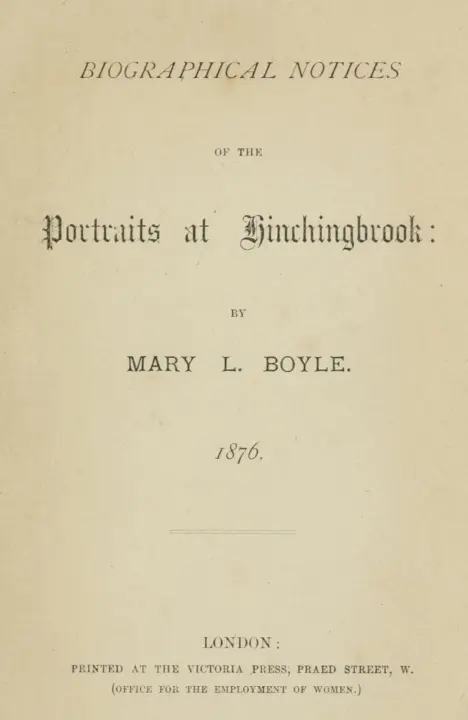
Biographical catalogue of the portraits at Longleat in the county of Wilts, the seat of the Marquis of Bath
Mary Louisa Boyle
THE CLASSIC COLLECTION · 1885
"Biographical Catalogue of the Portraits at Panshanger, the Seat of Earl Cowper" by Mary Louisa Boyle is a historical account written in the late 19th century. The book serves as a catalogue that details the portraits housed at Panshanger, providing biographical sketches of the individuals portrayed, with a particular focus on those connected to the Cowper family. The text is likely rich in historical context, making it a valuable resource for those interested in art history, nobility, and the cultural heritage of the period. The opening of this catalogue introduces the reader to the author's intent and methodology, emphasizing a personal and familial approach to the historical figures represented in the portraits. Boyle notes her preference for portraying her subjects in their private lives rather than through their public personas, aiming to create a more relatable account of their lives. She acknowledges the various sources of information she has used to compile the catalogue and expresses heartfelt gratitude towards those who contributed to her research. This sets the tone for a detailed exploration of the notable portraits and the stories behind them, highlighting the intertwined lives of the Cowper family and their historical significance.
Introduction adapted from the source catalogue; source summaries may be automatically generated.
Free to read · English · 141,121 words · No account needed
MAKE TIME FOR A GOOD BOOK
On by default. Untick to stop anonymous reading totals. Each page counts after 10 seconds in view. How this works.
Anonymous counting is on unless you have switched it off.
Martin’s father before him had also been killed on the deck of his own vessel, in an engagement with the English, and Cornelius proved himself worthy of his brave progenitors. At the age of twenty-one he had attained the rank of post-captain, and was employed against the Emperor of Morocco, whom he compelled to make advantageous terms with the Dutch. In 1652 he fought the English at Porto Longone, and captured one of their finest vessels, the Sampson, which he boarded, his own ship being disabled; but, to the great mortification of Van Tromp, the Sampson was recaptured by the enemy. The following year, in a fresh encounter with the English, he made a violent effort to regain possession of his former prize, but the Sampson was blown up. The Dutch were victorious on this occasion, but they lost their Admiral, and Van Tromp was promoted to the vacant post. In 1656, in connection with Oldham and De Ruyter, he distinguished himself on the high seas, and then retired for a while from public life, and did not go afloat till 1662, when he fought the Algerine pirates in the Mediterranean. He also performed an arduous task in convoying several richly freighted Dutch merchantmen from the East Indies safely into port, in spite of numerous enemies who were on the look-out for such valuable prizes. Van Tromp was constantly opposed to the English, and in one engagement he gained universal praise for the manner in which he defended his disabled and shattered ship, when the Dutch were defeated, and sad havoc made in their fleet. New ships had to be constructed in all haste, and the States-General were placed in a dilemma as to the appointment of the command of the naval forces. Popular De Ruyter was absent, battling with other foes, and although Van Tromp’s knowledge and skill were almost universally acknowledged, there was a very powerful faction against him, led by the brothers De Witt, then in the plenitude of their power. The head and front of the gallant seaman’s offending seemed to consist in his unswerving loyalty to the House of Orange. There was, however, no alternative, and the command of the fleet was grudgingly bestowed on Cornelius Van Tromp, who had many hard conditions, to which his patriotism alone induced him to submit. He had not the sole command, but was joined therein by De Witt and others, who received instructions to watch over and supervise all his movements. Worse treatment was in store for him; no sooner had he hoisted his flag, than the sudden return of De Ruyter changed the whole aspect of affairs; Van Tromp’s appointments were cancelled, and De Ruyter ordered to supersede him. We can imagine with what feelings of wrathful indignation Van Tromp went on shore, proudly refusing to serve under the man who had supplanted him. In the ensuing year, spite of much bitterness of feeling, he who had been so unjustly treated was induced (partly by the bribe, perhaps, of a splendid ship) to join De Ruyter in an attack on the English, when, after a fierce struggle, of several days’ duration, the Dutch were victorious. Hostilities continuing between the two nations, in another engagement Van Tromp defeated the British Admiral Smith, but De Ruyter was worsted; and on their return violent recriminations passed between them. De Ruyter complained that his colleague had acted quite independently, had afforded him no support whatsoever, and, in fact, had left him and his portion of the fleet completely in the lurch, while Van Tromp retaliated with counter-charges. The States-General, as usual, espoused the cause of De Ruyter, deprived Van Tromp of his commission, forbade him to hold any communication with the fleet, and placed him under provisory arrest at the Hague. It was at this moment, while smarting beneath the ingratitude and injustice of the country which he had so nobly served, that tempting offers were made to the gallant seaman to enter the service of France, but these overtures were answered with becoming indignation. He now gained permission to leave the Hague, and repair to a country house which he possessed near Gravensand, called Trompenburg, and built in the fanciful form of a man-of-war. But being in the Hague at the time of the murder of the De Witt brothers, there were slanderous rumours set abroad that he encouraged the assassins. This arose doubtless from the fact that some voices in the crowd on the day of the murder called out, ‘Down with the De Witts! Long live Van Tromp!’
Your reading position is saved on this browser. Take it to another device with a library code. Reading pages adapt to text, rather than matching a printed edition.
BEHIND THE BOOK
This eBook is for the use of anyone anywhere in the United States and most other parts of the world at no cost and with almost no restrictions whatsoever. You may copy it, give it away or re-use it under the terms of the Project Gutenberg License included with this eBook or online at www.gutenberg.org. If you are not located in the United States, you will have to check the laws of the country where you are located before using this eBook. Read the source licence.
The original source file, including credits and licence, is retained by this library. Request an original-format copy at no charge. Please include the book title and Project Gutenberg identifier #63698.
KEEP YOUR CURIOSITY GOING
Cécile Tormay

Moritz Busch
John L. Ransom
Frances Wright
Cécile Tormay

Mabel Potter Daggett