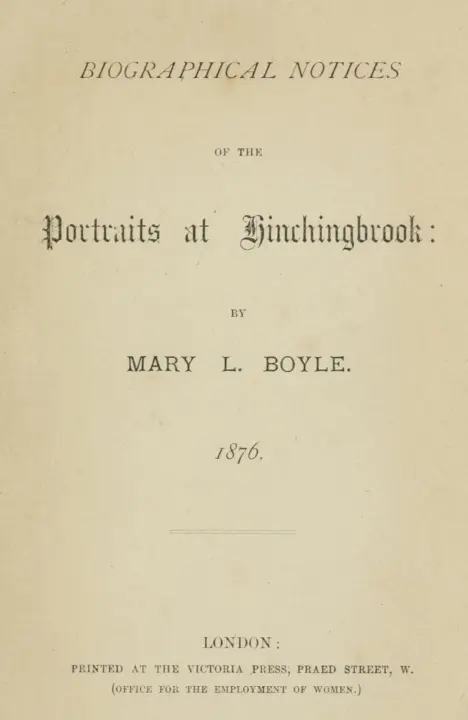
Biographical Catalogue of the Portraits at Panshanger, the Seat of Earl Cowper, K.G.
Mary Louisa Boyle
THE CLASSIC COLLECTION · 1881
"Biographical Catalogue of the Portraits at Longleat in the County of Wilts" by Mary Louisa Boyle is a historical account written in the late 19th century. This work serves as a detailed record of the portraits housed at Longleat, which is the seat of the Marquis of Bath, providing insights into the lives of individuals connected to this notable estate. The catalogue not only lists the portraits and their subjects but also intertwines personal accounts and historical context, contributing to a richer understanding of its lineage. The opening of the book features a dedication to the owners of Longleat and an apology from the author for any shortcomings in the work, which she attributes to various challenges she faced during her research. Boyle emphasizes the family nature of the record, focusing primarily on individuals associated with Longleat rather than just famous historical figures. She elucidates key figures, including Thomas Ken, a famous Bishop, whose life and contributions are explored in detail, alongside others such as Anthony Ashley Cooper and the Duke of Somerset. This introductory section sets the stage for a comprehensive exploration of the portraits, linking biography with art history in a way that highlights Longleat's significance.
Introduction adapted from the source catalogue; source summaries may be automatically generated.
Free to read · English · 92,099 words · No account needed
MAKE TIME FOR A GOOD BOOK
On by default. Untick to stop anonymous reading totals. Each page counts after 10 seconds in view. How this works.
Anonymous counting is on unless you have switched it off.
He was buried, by his own desire, in the nearest parish within his diocese; and there, in Frome churchyard, under the east window of the chancel of St. John’s, a quaint tomb covers the mortal remains of Thomas Ken. Many are the pilgrims who still visit that stone coffin, surmounted by a mitre and pastoral staff.
Some years after his death, four volumes of miscellaneous works were published—theological, devotional, secular, in prose and verse. In consequence of the rumours which had been circulated of a leaning towards Roman Catholicism, an extract from his will was made public:—‘I die in the Holy Catholic and Apostolic faith; more particularly, I die in the communion of the Church of England, as it stands distinguished from all Papal and Puritanical denominations, as it adheres to the doctrines of the Cross.’
Professor Keble, in speaking of his forerunner in sacred lyrical composition, pays a graceful tribute to Thomas Ken when he says:—‘We shall scarcely find in all ecclesiastical history a greener spot than the latter years of this courageous and affectionate pastor, persecuted alternately by both parties, and driven from his station in his declining age, yet singing on with unabated cheerfulness to the last.’
From all we hear and read indeed of Ken, it would seem as if he had reached nearer his own ideal than is the lot of most men. In his description of what a poet should be, he says—
‘Prophets and poets were of old Made in the same celestial mould; True poets are a saint-like race, And with the gift receive the grace, Of their own songs the virtue feel, etc.
A poet should have heat and light,
Of all things a capacious sight,
Serenity with rapture joined,
Aims noble, eloquence refined,
Strong, modest, sweetness to endear,
Expressions lively, lofty, clear.
Such graces can nowhere be found
Except on consecrated ground,
Where poets fix on God their thought,
By sacred inspiration taught,
Where each poetic votary sings
In heavenly tones of heavenly things.’
No. 3.
In coloured Chancellor’s robes.
SON of Sir John Cooper of Rockbourne, county Hants, by Anne, daughter and sole heir of Sir Anthony Ashley, Bart., of Wimborne St. Giles, county Dorset, where the future Chancellor was born.
In his autobiography, he describes his mother of ‘low stature,’ as was also the aforesaid Sir Anthony, ‘a large mind but his person of the lowest,’ while his own father was ‘lovely and graceful in mind and person, neither too high nor too low,’ therefore the pigmy body of which Dryden speaks must have been inherited from the maternal side.
Your reading position is saved on this browser. Take it to another device with a library code. Reading pages adapt to text, rather than matching a printed edition.
BEHIND THE BOOK
This eBook is for the use of anyone anywhere in the United States and most other parts of the world at no cost and with almost no restrictions whatsoever. You may copy it, give it away or re-use it under the terms of the Project Gutenberg License included with this eBook or online at www.gutenberg.org. If you are not located in the United States, you will have to check the laws of the country where you are located before using this eBook. Read the source licence.
The original source file, including credits and licence, is retained by this library. Request an original-format copy at no charge. Please include the book title and Project Gutenberg identifier #64653.
KEEP YOUR CURIOSITY GOING
Cécile Tormay

Moritz Busch
John L. Ransom
Frances Wright
Cécile Tormay

Mabel Potter Daggett