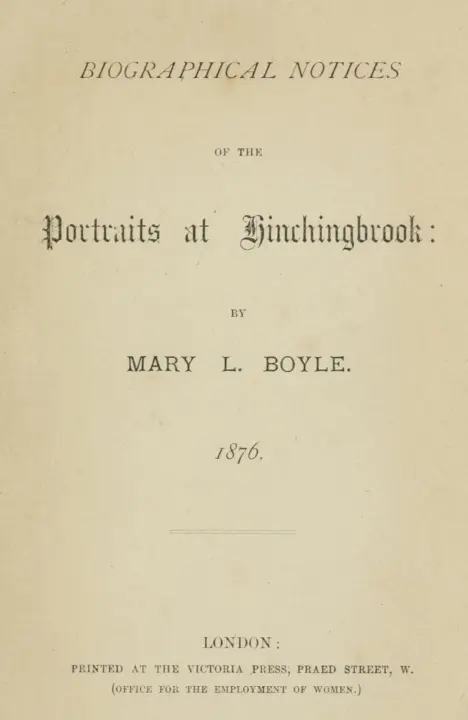
Biographical Catalogue of the Portraits at Panshanger, the Seat of Earl Cowper, K.G.
Mary Louisa Boyle
THE CLASSIC COLLECTION · 1881
"Biographical Catalogue of the Portraits at Longleat in the County of Wilts" by Mary Louisa Boyle is a historical account written in the late 19th century. This work serves as a detailed record of the portraits housed at Longleat, which is the seat of the Marquis of Bath, providing insights into the lives of individuals connected to this notable estate. The catalogue not only lists the portraits and their subjects but also intertwines personal accounts and historical context, contributing to a richer understanding of its lineage. The opening of the book features a dedication to the owners of Longleat and an apology from the author for any shortcomings in the work, which she attributes to various challenges she faced during her research. Boyle emphasizes the family nature of the record, focusing primarily on individuals associated with Longleat rather than just famous historical figures. She elucidates key figures, including Thomas Ken, a famous Bishop, whose life and contributions are explored in detail, alongside others such as Anthony Ashley Cooper and the Duke of Somerset. This introductory section sets the stage for a comprehensive exploration of the portraits, linking biography with art history in a way that highlights Longleat's significance.
Introduction adapted from the source catalogue; source summaries may be automatically generated.
Free to read · English · 92,099 words · No account needed
MAKE TIME FOR A GOOD BOOK
On by default. Untick to stop anonymous reading totals. Each page counts after 10 seconds in view. How this works.
Anonymous counting is on unless you have switched it off.
The description which Sir Charles Cornwallis gives us of Henry’s appearance is as follows: ‘He was of a comely stature, about five feet eight inches high, strong, straight, and well made, as if Nature in him had showed all her cunning; with somewhat broad shoulders and a small waist, of an amiable and majestic countenance; his hair auburn, long-faced, and broad forehead, piercing grave eye, a most gracious smile, with a terrible frown.’
The beautiful house at Bramshill, Hants, now the property of Sir William Cope, was said to have been built as a residence for the Prince of Wales, likewise the picturesque old house of Charlton, in Kent.
No. 133.
Head oval. Brown dress. White scarf, fastened in front with a jewel. Ringlets.
SHE was the daughter of Lord Keeper Coventry, and the wife of Sir Henry
Frederick Thynne.
No. 134.
Light brown hair. Clean shaven. Embroidered vest. Band of pearls over the shoulder. Dark cloak. Right arm akimbo.
THOMAS Cavendish was the son of a gentleman of fortune in Suffolk. He had an early fancy for the sea, which was strengthened by circumstances. At the age of twenty-one he had already dissipated the chief part of the property left him by his father, through gambling and other pleasures.
England was at this time at war with Spain, and it was considered fair play for ‘amateur buccaneers’ on the high seas to attack any vessel, or take possession of any settlement, in any part of the world, belonging to that nation.
In this manner Cavendish thought to retrieve his fortunes, and he accordingly, in 1585, equipped a stout bark at his own expense, and accompanied Sir Richard Grenville on his voyage to Virginia, Florida, the West Indies, etc. etc. The expedition was very successful on the whole, though naturally the English met with some reverses. Cavendish returned with his income much replenished; but he went to the Court of ‘the maiden Queen,’ where he lived in splendour, and indulged in great extravagance, so that the dollars did not remain long in his purse. He determined to go afloat once more, but he had to sell or mortgage the remainder of his estates to enable him to fit out three vessels, and, fired by the example of Sir Francis Drake, he resolved to visit some of the spots where that famous sailor had been so successful. He first steered for Sierra Leone, where he landed, and pillaged and burned the town, ostensibly as reprisals for a wound inflicted on one of his crew by a native. Proceeding to South America, he touched at many points as he coasted along, giving English names to the places which took his fancy. One beautiful bay, glistening with golden sands, he called ‘Elizabeth,’ after his royal mistress, although it did not enjoy a good reputation, being inhabited by cannibals who had feasted largely on the unfortunate Spaniards. He landed frequently whenever there was a prospect of gain, and attacked the Spaniards in their settlements, burning, destroying, and plundering, often with considerable loss on his own side; but he was never daunted, and his success outweighed his reverses. He took many Spanish barks, but his chief prize was the ‘St. Anna’ galleon laden with rich merchandise, specie, jewels, etc. etc. He marked her for his own, lay in wait for her, and in spite of fearful odds as to numbers of the respective crews, he boarded and took possession, with all the invaluable freight. He then proceeded on his voyage round the world, which he performed most successfully, and returned to Plymouth, being the second Englishman who had circumnavigated the globe, and the first who had achieved the voyage in so short a time.
Your reading position is saved on this browser. Take it to another device with a library code. Reading pages adapt to text, rather than matching a printed edition.
BEHIND THE BOOK
This eBook is for the use of anyone anywhere in the United States and most other parts of the world at no cost and with almost no restrictions whatsoever. You may copy it, give it away or re-use it under the terms of the Project Gutenberg License included with this eBook or online at www.gutenberg.org. If you are not located in the United States, you will have to check the laws of the country where you are located before using this eBook. Read the source licence.
The original source file, including credits and licence, is retained by this library. Request an original-format copy at no charge. Please include the book title and Project Gutenberg identifier #64653.
KEEP YOUR CURIOSITY GOING
Cécile Tormay

Moritz Busch
John L. Ransom
Frances Wright
Cécile Tormay

Mabel Potter Daggett