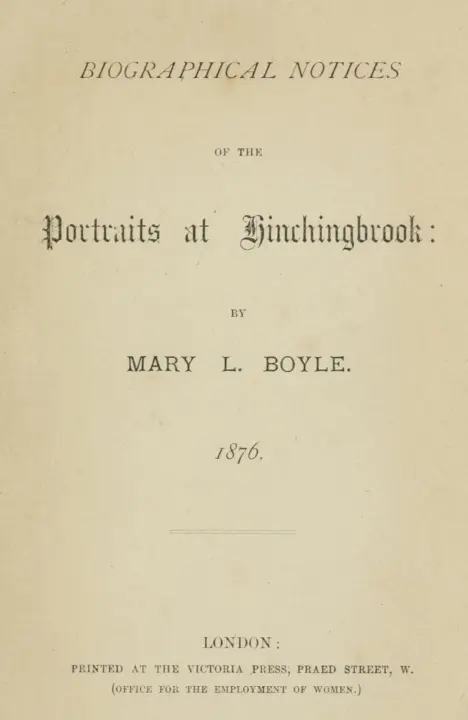
Biographical Catalogue of the Portraits at Panshanger, the Seat of Earl Cowper, K.G.
Mary Louisa Boyle
THE CLASSIC COLLECTION · 1881
"Biographical Catalogue of the Portraits at Longleat in the County of Wilts" by Mary Louisa Boyle is a historical account written in the late 19th century. This work serves as a detailed record of the portraits housed at Longleat, which is the seat of the Marquis of Bath, providing insights into the lives of individuals connected to this notable estate. The catalogue not only lists the portraits and their subjects but also intertwines personal accounts and historical context, contributing to a richer understanding of its lineage. The opening of the book features a dedication to the owners of Longleat and an apology from the author for any shortcomings in the work, which she attributes to various challenges she faced during her research. Boyle emphasizes the family nature of the record, focusing primarily on individuals associated with Longleat rather than just famous historical figures. She elucidates key figures, including Thomas Ken, a famous Bishop, whose life and contributions are explored in detail, alongside others such as Anthony Ashley Cooper and the Duke of Somerset. This introductory section sets the stage for a comprehensive exploration of the portraits, linking biography with art history in a way that highlights Longleat's significance.
Introduction adapted from the source catalogue; source summaries may be automatically generated.
Free to read · English · 92,099 words · No account needed
MAKE TIME FOR A GOOD BOOK
On by default. Untick to stop anonymous reading totals. Each page counts after 10 seconds in view. How this works.
Anonymous counting is on unless you have switched it off.
On reaching the platform, he kneeled on both knees, and fervently commended his soul to God, then, rising, ‘with great alacrity, and cheerfulness,’ he addressed the people in quiet, measured terms. He declared his innocence, his loyalty to the King, his love of his country, and of the reformed religion, to which he admonished his hearers to be faithful. Here he was interrupted by a strange kind of tumult, and Sir Anthony Browne appearing on horseback in the crowd, the people cried aloud, ‘A pardon! a pardon! God save the King!’ But he told them there was no hope, and all the time his arch-enemy, Lord Warwick (or rather Northumberland, as he then was), stood untouched, shaking his cap, and making signs to the people to be quiet.
The Duke of Somerset resumed his discourse, exhorting his hearers to be loyal to the King, and submissive to the laws, concluding with, ‘I wish you all to bear witness that I die in the faith of Jesus Christ, desiring you to help me with your prayers.’
We have not space to make more extracts from a dying speech which for manliness, forbearance, and piety could scarcely be surpassed. Unbuckling his sword, he presented it to the Lieutenant of the Tower, gave the executioner money and rings, bade all near him graciously farewell, then, kneeling down, arranged his collar, and covered his face, which showed ‘no signs of trouble,’ with his handkerchief.
He was required to rise up, once more, to remove his doublet, and again laying his head on the block, and calling thrice, ‘Lord Jesu save me!’ received the death-stroke.
The head and body were both interred in the north side of St. Peter’s
Church in the Tower.
There is a story told of a fair enthusiast, who dipped her handkerchief in the ‘martyr’s’ blood, and afterwards flourished it in the face of the Duke of Northumberland, when he, two years later, was led captive through the City, for his opposition to Queen Mary. Varying as have been the verdicts on the character of the Protector Somerset, surely no one can deny him the attributes of courage, energy, and piety. He had enthusiastic friends, and bitter enemies, among the last his own brother. Edward, first Duke of Somerset, was remarkably handsome, majestic, and naturally of a melancholy aspect, ‘every inch a gentleman.’ His extravagance, both in public and private matters, was undeniable, and he affected great splendour in dress, not only on State occasions. During his imprisonment he employed himself in works of a religious character. He was twice married—first to Catherine, daughter and co-heir of Sir William Fillol of Woodlands, county Dorset. Respecting this lady there exists a mystery: there were rumours of misconduct, and certain it is her son was disinherited.
Your reading position is saved on this browser. Take it to another device with a library code. Reading pages adapt to text, rather than matching a printed edition.
BEHIND THE BOOK
This eBook is for the use of anyone anywhere in the United States and most other parts of the world at no cost and with almost no restrictions whatsoever. You may copy it, give it away or re-use it under the terms of the Project Gutenberg License included with this eBook or online at www.gutenberg.org. If you are not located in the United States, you will have to check the laws of the country where you are located before using this eBook. Read the source licence.
The original source file, including credits and licence, is retained by this library. Request an original-format copy at no charge. Please include the book title and Project Gutenberg identifier #64653.
KEEP YOUR CURIOSITY GOING
Cécile Tormay

Moritz Busch
John L. Ransom
Frances Wright
Cécile Tormay

Mabel Potter Daggett