THE CLASSIC COLLECTION✦A dead man’s diaryCLASSIC FREE BOOKS
A dead man’s diary
Coulson Kernahan
THE CLASSIC COLLECTION · 1918
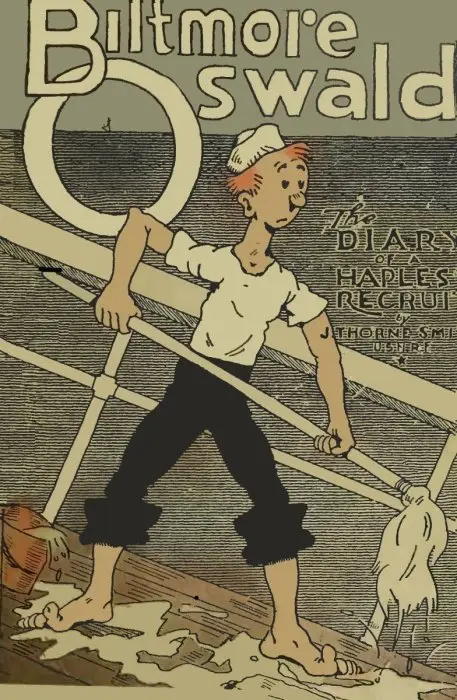
"Biltmore Oswald: The Diary of a Hapless Recruit" by J. Thorne Smith, Jr. is a comedic novel written in the early 20th century. The book presents a humorous narrative of Oswald, an inexperienced recruit in the Navy, as he goes through rigorous training and encounters various absurd situations and colorful characters. The story likely explores themes of camaraderie, the challenges of military life, and the humorous absurdities of boot camp. At the start of the diary, the protagonist, Oswald, humorously details his enlistment process, showcasing his overwhelming inexperience and the bemusement of the officers around him. His attempts to impress the enlistment officer backfire as he realizes that his lack of genuine sailing experience paints him as a stereotypical hapless recruit. Following this, Oswald's physical examination and subsequent experiences provide a comedic commentary on the various eccentricities of military life, as he navigates interactions with fellow recruits, medical personnel, and his own mother, who expresses exaggerated concern for his well-being. The tone is light-hearted and satirical, laying the groundwork for a comical exploration of his journey in the Navy.
Introduction adapted from the source catalogue; source summaries may be automatically generated.
Free to read · English · 33,084 words · No account needed
MAKE TIME FOR A GOOD BOOK
On by default. Untick to stop anonymous reading totals. Each page counts after 10 seconds in view. How this works.
Anonymous counting is on unless you have switched it off.
Most of the time I passed pleasantly on the soft, fresh flank of a hill where for a while I slept until a cow breathed heavily in my face and reminded me that it was war after all. My instructions were to keep away from the guns, and get killed as soon as possible. As these instructions were not difficult to follow, I carried them out to the letter. I stayed away from the guns and I permitted myself to be killed several times in order to make sure it would take. After that I became a sort of composite camp follower, deserter and straggler.
In my wandering I chanced upon an ancient enemy of many past
encounters.
"Are you Red or Blue?" I asked, preparing to die for the fifth time.
"No," he answered, sarcastically, "I'm what you might call elephant
ear gray."
"Are you the guy the reporter for the camp paper was referring to in his last story?" I asked him.
"Yes," he replied, "the slandering blackguard."
"You hit me on the nose with a push-ball," said I.
"I'll do it again," said he.
"That reporter, evidently a man of some observation, said you didn't wash your neck and that you had the habits of a camel."
"But I do wash my neck," he said, stubbornly, "and I don't know anything about the habits of a camel, but whatever they might happen to be, I haven't got 'em."
"Yes," I replied, as if to myself, "you certainly should wash your neck. That's the very least you could do."
"But I tell you," he cried, desperately, "I keep telling you that I do wash my neck. Why do you go on talking about it as if I didn't! I tell you now, once for all time, that I do wash my neck, and that ends it. Don't talk any more. I want to think."
We sat in silence for a space, then I remarked casually, almost inaudibly, "and you certainly shouldn't have the habits of a camel."
The depraved creature stirred uneasily. "I ain't got 'em," he said.
"Good," I cried heartily. "We understand each other perfectly. In the future you will try to wash your neck and cease from having the habits of a camel. No compromise is necessary. I know you will keep your word."
"Go away quickly," he gasped, searching around for a stone to hurl at me, and discarding several because of their small size. "Go away to somewhere else. I'm telling you now, go away or else a special detail will find your lifeless body here in the bushes some time to-morrow."
Your reading position is saved on this browser. Take it to another device with a library code. Reading pages adapt to text, rather than matching a printed edition.
BEHIND THE BOOK
This eBook is for the use of anyone anywhere in the United States and most other parts of the world at no cost and with almost no restrictions whatsoever. You may copy it, give it away or re-use it under the terms of the Project Gutenberg License included with this eBook or online at www.gutenberg.org. If you are not located in the United States, you will have to check the laws of the country where you are located before using this eBook. Read the source licence.
The original source file, including credits and licence, is retained by this library. Request an original-format copy at no charge. Please include the book title and Project Gutenberg identifier #16634.
KEEP YOUR CURIOSITY GOING
Coulson Kernahan

Maurice Baring
Frances Wright
Cécile Tormay

Frederic Jesup Stimson

W. H. P. (William Henry Pope) Jarvis