THE CLASSIC COLLECTION✦A dead man’s diaryCLASSIC FREE BOOKS
A dead man’s diary
Coulson Kernahan
THE CLASSIC COLLECTION · 1918
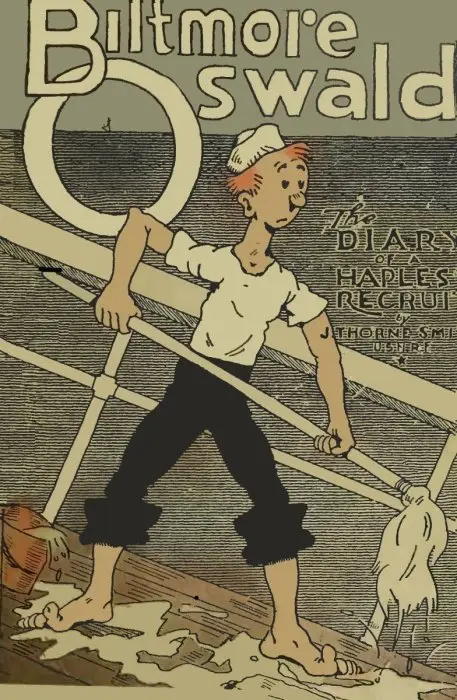
"Biltmore Oswald: The Diary of a Hapless Recruit" by J. Thorne Smith, Jr. is a comedic novel written in the early 20th century. The book presents a humorous narrative of Oswald, an inexperienced recruit in the Navy, as he goes through rigorous training and encounters various absurd situations and colorful characters. The story likely explores themes of camaraderie, the challenges of military life, and the humorous absurdities of boot camp. At the start of the diary, the protagonist, Oswald, humorously details his enlistment process, showcasing his overwhelming inexperience and the bemusement of the officers around him. His attempts to impress the enlistment officer backfire as he realizes that his lack of genuine sailing experience paints him as a stereotypical hapless recruit. Following this, Oswald's physical examination and subsequent experiences provide a comedic commentary on the various eccentricities of military life, as he navigates interactions with fellow recruits, medical personnel, and his own mother, who expresses exaggerated concern for his well-being. The tone is light-hearted and satirical, laying the groundwork for a comical exploration of his journey in the Navy.
Introduction adapted from the source catalogue; source summaries may be automatically generated.
Free to read · English · 33,084 words · No account needed
MAKE TIME FOR A GOOD BOOK
On by default. Untick to stop anonymous reading totals. Each page counts after 10 seconds in view. How this works.
Anonymous counting is on unless you have switched it off.
One man whispered to me at muster this morning that all he could remember of his liberty was checking out and checking in. He looked unwell. My old pal, "Spike" Kelly, I hear was also out of luck. His girl was the skipper of a Fourteenth Street crosstown car, so he was forced to spend most of his time riding, between the two rivers. He nickeled himself to death in doing it. He said if Mr. Shonts plays golf, as no doubt he does, he has "Spike" Kelly to thank for a nice, new box of golf balls. And while on the subject, "Spike" observes that one of those engaging car signs should read:
"Is it Gallantry, or the Advent of Woman Suffrage, or the Presence of the Conductorette that Causes So Many Sailors to Wear Out Their Seats Riding Back and Forth, and So Many Unnecessary Fares to Be Rung Up in So Doing?"
His conversation with "Mame," his light-o'-love, was conducted along
this line:
"Say, Mame."
"Yes, George, dear (fare, please, madam). What does tweetums want?"
"You look swell in your new uniform."
"Oh, Georgie, do you think it fits? (Yes, madam, positively, the car was brushed this morning, your baby will be perfectly safe inside.)"
"Mame."
"George! (Step forward, please.) Go on, dear."
"Mame, it's doggon hard to talk to you here." "Isn't it just! (What is it lady? Cabbage? Oh, baggage! No, no, you can't check baggage here; this isn't a regular train.) George, stop holding my hand! I can't make change!"
"Aw, Mame, who do you love?"
"Why, tweetums, I love--(plenty of room up forward! Don't jam up the door) you, of course. (Fare, please! Fare, please! Have your change ready!)"
"Can't we get a moment alone, Mame?"
"Yes, dear; wait until twelve-thirty, and we'll drive to the car barn then. (Transfers! Transfers!)"
"Spike" says that his liberty was his first actual touch with the
horrors of war.
Another bird that lived in some remote corner of New York State told me in pitiful tones that all he had time to do was to walk down the street of his home town, shake hands with the Postmaster, lean over the fence and kiss his girl (it had to go two ways, Hello and Good-by), take a package of clean underwear from his mother as he passed by and catch the outbound train on the dead run. All he could do was to wave to the seven other inhabitants. He thought the Grand Central Terminal was a swell dump, though. He said: "There was quite a lot of it," which is true.
Your reading position is saved on this browser. Take it to another device with a library code. Reading pages adapt to text, rather than matching a printed edition.
BEHIND THE BOOK
This eBook is for the use of anyone anywhere in the United States and most other parts of the world at no cost and with almost no restrictions whatsoever. You may copy it, give it away or re-use it under the terms of the Project Gutenberg License included with this eBook or online at www.gutenberg.org. If you are not located in the United States, you will have to check the laws of the country where you are located before using this eBook. Read the source licence.
The original source file, including credits and licence, is retained by this library. Request an original-format copy at no charge. Please include the book title and Project Gutenberg identifier #16634.
KEEP YOUR CURIOSITY GOING
Coulson Kernahan

Maurice Baring
Frances Wright
Cécile Tormay

Frederic Jesup Stimson

W. H. P. (William Henry Pope) Jarvis