
Last letters from the living dead man
David Patterson (Spirit) Hatch
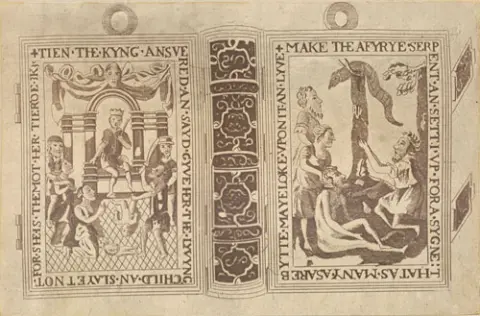
THE CLASSIC COLLECTION · 1809
"Bibliomania; or Book-Madness" by Thomas Frognall Dibdin is a satirical work first published in 1809. Written as fictional dialogues among book collectors, it playfully diagnoses a supposed disease afflicting wealthy bibliophiles of the Romantic era. Through mock-heroic conversations, Dibdin catalogs obsessive symptoms: coveting uncut copies, first editions, banned books, and rare bindings. This eccentric work gently mocks aristocratic collectors while simultaneously fueling the very collecting mania it pretends to cure, becoming Dibdin's bestselling production and inspiring legendary auction battles.
Introduction adapted from the source catalogue; source summaries may be automatically generated.
Free to read · English · 289,632 words · No account needed
MAKE TIME FOR A GOOD BOOK
On by default. Untick to stop anonymous reading totals. Each page counts after 10 seconds in view. How this works.
Anonymous counting is on unless you have switched it off.
275. Hawys's Compendions Story, or Exemple of Vertue, B.L.--C.R. wood-cuts, ib. Wynkyn de Worde, 1533.
276. ---- Passe-Tyme of Pleasure, B.L. wood-cuts ib. by W.
de Worde, 1517, 4to.
306. Spenser's Shephearde's Calendar. C.T.--F.D., wood-cuts: first edition, ib. Singleton, 1579, 4to.
308. Taylor, the water poet (fifteen different pieces by) all of posterior date to the collection of his works. Among them is the Life of Old Par, with Par's head, and 31 plates of curious needle-work. The volume also contains some replies to Taylor. A written list of all the contents is prefixed. Lond. and Oxford, 4to.
330. Tulle of Old Age (translated by William Botoner, or of Worcester) pr. by Caxton, 1481. folio.
---- of Friendship, translated by Tiptoft, Earl of Worcester; to which is added another tract written by the same Earl, C.R.--F.D.--L.R. Explicit per Caxton, folio.]
How shall I talk of thee, and of thy wonderful collection, O RARE RICHARD FARMER?[408]--and of thy scholarship, acuteness, pleasantry, singularities, varied learning, and colloquial powers! Thy name will live long among scholars in general; and in the bosoms of virtuous and learned bibliomaniacs thy memory shall ever be enshrined! The walls of Emanuel College now cease to convey the sounds of thy festive wit--thy volumes are no longer seen, like Richard Smith's "bundles of sticht books," strewn upon the floor; and thou hast ceased, in the cause of thy beloved Shakspeare, to delve into the fruitful ore of black-letter literature. Peace to thy honest spirit; for thou wert wise without vanity, learned without pedantry, and joyous without vulgarity!
[Footnote 408: There is but a scanty memorial of this extraordinary and ever respectable bibliomaniac, in the Gentleman's Magazine; vol. lxvii. pt. ii. p. 805: 888: nor is it noticed, among Farmer's theologico-literary labours, that he was author of an ingenious essay upon the Demoniacs mentioned in scripture; in which essay he took up the idea of Mede, that these Demoniacs were madmen. Dr. Farmer's essay upon the Learning of Shakespeare is, in respect to the materials, arguments, and conclusions--what the late Bishop of Salisbury's [Douglas] was upon Miracles--original, powerful, and incontrovertible. Never was there an octavo volume, like Farmer's upon Shakespeare--which embraced so many, and such curious, points, and which displayed such research, ingenuity, and acuteness--put forth with so little pomp, parade, or pedantry. Its popularity was remarkable; for it delighted both the superficial and deeply-versed reader in black-letter lore. Dr. Parr's well applied Ciceronian phrase, in lauding the "ingenious and joy-inspiring language" of Farmer, gives us some notion of the colloquial powers of this acute bibliomaniac; whose books were generally scattered upon the floor, as Lysander above observes, like old Richard Smith's "stitched bundles." Farmer had his foragers; his jackalls: and his avant-couriers: for it was well known how dearly he loved every thing that was interesting and rare in the literature of former ages. As he walked the streets of London--careless of his dress--and whether his wig was full-bottomed or narrow-bottomed--he would talk and "mutter strange speeches" to himself; thinking all the time, I ween, of some curious discovery he had recently made in the aforesaid precious black-letter tomes. But the reader is impatient for the Bibliotheca Farmeriana: the title to the catalogue whereof is as follows. "Bibl. Farm. A Catalogue of the curious, valuable, and extensive Library in print and manuscript, of the late REV. RICHARD FARMER, D.D., Canon Residentiary of St. Paul's; Master of Emanuel College: Librarian to the University of Cambridge; and Fellow of the Royal & Antiquary Societies (deceased, &c.) Sold by Auction by Mr. King; May, 1798," 8vo. [8199 articles]. The collection is justly said, in the title page, to contain the "most rare and copious assemblage of Old English Poetry that, perhaps, was ever exhibited at one view; together with a great variety of Old Plays, and early printed books, English and Foreign, in the black-letter." The reader has already (p. 324 ante) had some intimation of the source to which Dr. Farmer was chiefly indebted for these poetical and dramatical treasures; of some of which, "hereafter followeth" an imperfect specimen:
Your reading position is saved on this browser. Take it to another device with a library code. Reading pages adapt to text, rather than matching a printed edition.
BEHIND THE BOOK
This eBook is for the use of anyone anywhere in the United States and most other parts of the world at no cost and with almost no restrictions whatsoever. You may copy it, give it away or re-use it under the terms of the Project Gutenberg License included with this eBook or online at www.gutenberg.org. If you are not located in the United States, you will have to check the laws of the country where you are located before using this eBook. Read the source licence.
The original source file, including credits and licence, is retained by this library. Request an original-format copy at no charge. Please include the book title and Project Gutenberg identifier #28540.
KEEP YOUR CURIOSITY GOING
David Patterson (Spirit) Hatch

David Patterson (Spirit) Hatch

David Patterson (Spirit) Hatch
Cécile Tormay

Moritz Busch
John L. Ransom