THE CLASSIC COLLECTION✦The Homosexual NeurosisCLASSIC FREE BOOKS
The Homosexual Neurosis
Wilhelm Stekel
THE CLASSIC COLLECTION · 1922
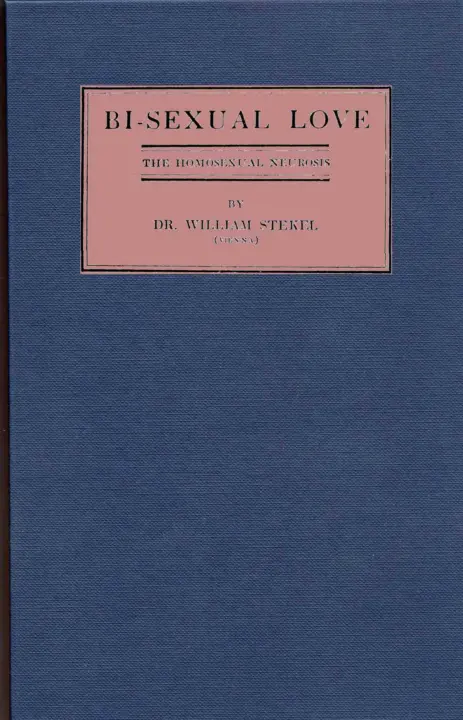
"Bi-sexual Love; the Homosexual Neurosis" by Wilhelm Stekel is a scientific publication written in the early 20th century. This work serves as a significant contribution to the understanding of sexuality, specifically focusing on bisexuality and the psychological aspects of homosexuality. Through clinical studies and psychoanalytical insights, the book seeks to unravel the complexities surrounding human sexual desire and the interplay of various psychological elements. At the start of the book, the author introduces the common misconceptions about the causes of homosexuality, particularly the erroneous belief that masturbation leads to such inclinations. Stekel references various notable figures in psychoanalysis, such as Krafft-Ebing and Moll, while critiquing their perspectives on hereditary versus acquired homosexuality. He emphasizes that all individuals are inherently bisexual and discusses the psychological factors that influence sexual orientation, asserting that repression of one’s desires contributes to neurosis. This opening sets the stage for a deeper exploration into the intricate relationships between sexuality, neurosis, and individual psychological development throughout the rest of the text.
Introduction adapted from the source catalogue; source summaries may be automatically generated.
Free to read · English · 80,811 words · No account needed
MAKE TIME FOR A GOOD BOOK
On by default. Untick to stop anonymous reading totals. Each page counts after 10 seconds in view. How this works.
Anonymous counting is on unless you have switched it off.
Reproach, 207
Research, sexual, 12
Resistance, 145, 153, 238, 245
Retif de la Bretonne, 99, 100, 111
Retrogression, 41, 45, 331
Retrospective tendency, 334
Revenge, 154, 168, 207
Reversed love, 152
Right and Left (symbolism), 130
Roemer, V., 32
Rôle of family, 172
Rousseau, 95
Sade, Marquis de, 283
Sadger, 245, 314, 337, 346
Sadism, 49, 131, 263, 272, 274
Satyriasis, 131 passim, 152, 154, 160, 250
Schmitz, O. A. H., 98, 100, 124
Schopenhauer, 283
Scorn, 218, 319
Secret pride, 213
Seduction, 99, 101, 160, 167, 253, 268, 285, 312
Sensuality, 165
Sexual object, 98, 103
Shakespeare, 46
Shyness, 177, 302, 310
Sister, attitude towards, 169
Imago, 223
Situs Inversus, 82, 84, 284
Starvation, 215
Stekel, 48
Stier, 12
Strindberg, 283
Struggle, 236
Sublimation, 39, 40, 49, 130, 271
Substitution, 187, 211
Succubus, 71, 161
Suicide, 105
Suppressed instincts, 96
Suspicion, 149
Symbol, 60, 81, 91, 129, 145, 211, 323
Symptomatic acts, 129
Syphilidophobia, vid. Fear of syphilis
Tarnovsky, 246, 247
Taste, 97
Temptation, 147, 164, 196
Tendency, 55, 89, 176
prospective, 222
Tension, sexual, 32
Therapy, 244
“Third” sex, 24
Timidity, 345
Touch, 252
Traits, male and female, 73, 94, 124
neurotic, 96
Transference, 88, 111, 153, 211
Transitional types, 103, 175
Transvestite, 69, 70, 336
Trauma, 23, 42, 119, 172, 196, 236, 238, 293, 297, 302, 305, 309, 320,
326, 327
Ulrichs, 36
Unconscious, 35
wish, 209
Undifferentiated, 31
Ungratified libido, 129
Urlind, 30, 78, 284, 297, 333, 341
Urning, 81, 333, 339, 341, 345
Urolagnia, 312
Van Teslaar, 44, 46
Variation, biologic, 20
Virchow, 20
Virgo intacta, 154
Virility, 100, 125
Vita Sexualis, 73, 145, 178, 270, 287, 300, 321
Vomiting, symptomatic, 199, 230
Warning, 260
Weininger, 283, 346
Westphal, 19
Whip (sadism), 265
“Will to power,” 337
Wish, 35, 38, 292, 325, 336
fulfillment, 214
Witches, fear of, 221
Woman, aggressive, 30, 350
“Womanly” men, 24
“World pain,” 334
Worry, 181
Ziemcke, 286
Zwischenstuffen, 25
-theorie, 245
[1] Hans Blüher: Studien ueber den perversen Charakter. Ztrbl. f.
Psychoanalyse, Oct., 1913.
[2] Neue Studien auf dem Gebiete der Homosexualitaet. Jahrb. f. Sexuelle Zwischenstuffen, vol. III, Leipzig.
[3] This view of Krafft-Ebing is by no means “antiquated.” It is still maintained by Stier (Zur Aetiologie des kontraeren Sexualgefuehls. Monatschrf. f. Psych, u. Neurol., vol. XXXII, 1914) and very energetically criticised (ibid.) by Hirschfeld and Burchard. “It is inconceivable,” state the above named authors, “how Stier can ascribe an etiologic significance to onanism in connection with homosexuality. Its distribution, ubiquitous—in the opinion of most specialists, would permit one to hold masturbation responsible for any other sexual development as well.” According to Stier, early and long-continued onanism (especially mutual) is harmful because “it does away with the feeling of shame in connection with one’s sexual organs and makes for readier handling even by the uncorrupted adult.” Fleischmann also finds 33 excessive onanists among 60 inverts and concludes (Beitr. zur Lehre der kontraeren Sexualempfindung, Zeitschr. f. d. ges. Neur. u. Psychol., vol. VII, 1911) that “like alcoholism, masturbation must influence the development of the perversion.” Many of his patients mentioned the habit in a casual relation. We know well that the sense of guilt is attached to the habit of masturbation. But Fleischmann sees in that a proof. “Onanism plays a role in the development of the sexual perversion,” he argues, “because it rouses an increased sexual excitability while the will power is weakened by it at the same time and there follows a progressive wandering of the sexual instinct away from the normal sexual aim and object.”
Your reading position is saved on this browser. Take it to another device with a library code. Reading pages adapt to text, rather than matching a printed edition.
BEHIND THE BOOK
This eBook is for the use of anyone anywhere in the United States and most other parts of the world at no cost and with almost no restrictions whatsoever. You may copy it, give it away or re-use it under the terms of the Project Gutenberg License included with this eBook or online at www.gutenberg.org. If you are not located in the United States, you will have to check the laws of the country where you are located before using this eBook. Read the source licence.
The original source file, including credits and licence, is retained by this library. Request an original-format copy at no charge. Please include the book title and Project Gutenberg identifier #66693.
KEEP YOUR CURIOSITY GOING

Charles G. (Charles Griffith) Ross
Hannah Webster Foster

Emily Lawless
Edwin Hamlin Carr

Charles De Lano Hine
Andrew Ure