THE CLASSIC COLLECTION✦The Homosexual NeurosisCLASSIC FREE BOOKS
The Homosexual Neurosis
Wilhelm Stekel
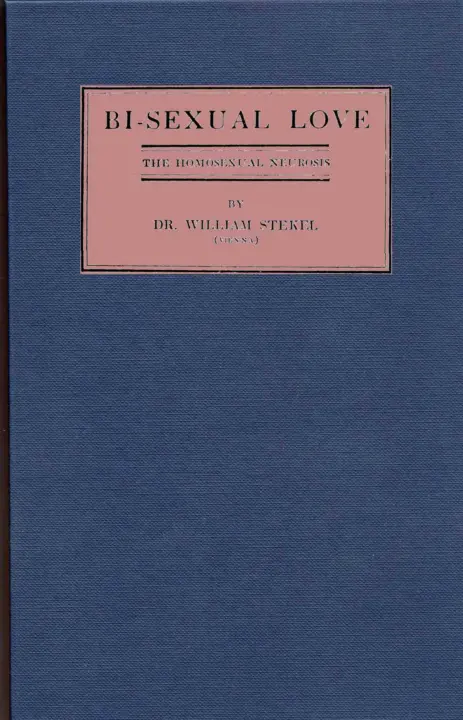
THE CLASSIC COLLECTION · 1922
"Bi-sexual Love; the Homosexual Neurosis" by Wilhelm Stekel is a scientific publication written in the early 20th century. This work serves as a significant contribution to the understanding of sexuality, specifically focusing on bisexuality and the psychological aspects of homosexuality. Through clinical studies and psychoanalytical insights, the book seeks to unravel the complexities surrounding human sexual desire and the interplay of various psychological elements. At the start of the book, the author introduces the common misconceptions about the causes of homosexuality, particularly the erroneous belief that masturbation leads to such inclinations. Stekel references various notable figures in psychoanalysis, such as Krafft-Ebing and Moll, while critiquing their perspectives on hereditary versus acquired homosexuality. He emphasizes that all individuals are inherently bisexual and discusses the psychological factors that influence sexual orientation, asserting that repression of one’s desires contributes to neurosis. This opening sets the stage for a deeper exploration into the intricate relationships between sexuality, neurosis, and individual psychological development throughout the rest of the text.
Introduction adapted from the source catalogue; source summaries may be automatically generated.
Free to read · English · 80,811 words · No account needed
MAKE TIME FOR A GOOD BOOK
On by default. Untick to stop anonymous reading totals. Each page counts after 10 seconds in view. How this works.
Anonymous counting is on unless you have switched it off.
Count X., 25 years old; a very energetic mother. His gait and movements are exceedingly feminine, he is careless and has been mixed up already in a number of unpleasant affairs from which the writer successfully helped him extricate himself. Two of his three brothers are also homosexual, and of his family circle in the wider sense, two uncles.
Karl W., 28 years of age, bank clerk. For the past six years has maintained relations with his older colleagues. He is very strikingly feminine and anxiety appears to lend zest to life in his case. He is continually living in dread lest some one in his family should find out about his peculiar inclination, although he is a stranger here and has no relative living nearby. But if he has no reason to fear anything on this score he finds some other reason to keep his mind in torment. For instance, he fears he will be run over by an automobile, even when he strolls along the safe side of a side walk, etc. As he is otherwise mentally normal I conclude that he has a strong masochistic tendency which he satisfies thus by conjuring up absurd fears. There is no expression of the masochistic tendency in any overt acts. On the other hand K. has relations only with persons belonging to the lowest social stratum (plasterers, drivers, etc.) and it is probable that the greater danger in that connection serves as a stimulant for him.
His mother is normal, but a very energetic woman, always taking care of her own affairs and when a couple of thieves once broke in at her home she grappled with them, threw them to the ground and held them. She has married a second time, has a slight downy beard growth, and in her house often puts on male clothing.
We need not be surprised that the expert emphasizes the fact that in many instances homosexuality occurs in groups in the same family. The same conditions bring about similar effects. Even the fact that 65% of homosexuals have a very energetic mother need not be in itself of any particular significance as typical of the psychogenesis of homosexuality. The expert really means that these are mannish women so that they naturally bring into the world womanly boys.
Abstinence, 249
Abuse, 322
Act, specific, 334
Acquired, 245
Adler, 273, 335
Adspectu sanguinis currentis, 295
Affect, 274
Aggression, 59, 73, 85, 150, 176, 250
Ahasuerus type, 163, 164
Alcoholism, 248 passim, 255, 261, 269, 271, 274, 285, 288
“All gone” feeling, 136
Allerotism, 53 passim, 277
Ambition, 344
Amnesia, 143
Anal irritation, 189
Analysis, vid. Psychoanalysis
“Analytic scotoma,” 248
Androgyny, 24
Anesthesia, sexual, 76, 163
Anger, 133
Antifetichism, 102, 118
Anxiety, 23, 40, 68, 96, 121, 140, 153, 196, 201, 213, 242, 283
Aphrodisiac, 261
Ascetic ideal, 176
Asceticism, 226
Attitude (neurotic), 146, 148, 188, 209, 212, 217, 337 passim, 342
Attraction (sexual), 345
Autoerotism, vid. Masturbation
Aversion, 201, 253, 304
Azoospermia, 24
Bashfulness, 342
Belief in devil, 220
Bestiality, 295, 304
Binet, 41, 42, 305
Bipolar attitude, 208, 221
Bipolarity, 272
Birthplace symbolism, 207
Bisexuality, 27, 28, 34, 40, 41, 49, 54, 68, 69, 79, 120, 161, 185, 213, 255, 261, 268, 289, 312, 317
Bloch, 22, 26, 30, 33, 34, 99, 100, 273, 280, 281, 283, 291, 306,
309
Blüher, H., 26, 28, 79
Boy love, 331
Brain, 31
Your reading position is saved on this browser. Take it to another device with a library code. Reading pages adapt to text, rather than matching a printed edition.
BEHIND THE BOOK
This eBook is for the use of anyone anywhere in the United States and most other parts of the world at no cost and with almost no restrictions whatsoever. You may copy it, give it away or re-use it under the terms of the Project Gutenberg License included with this eBook or online at www.gutenberg.org. If you are not located in the United States, you will have to check the laws of the country where you are located before using this eBook. Read the source licence.
The original source file, including credits and licence, is retained by this library. Request an original-format copy at no charge. Please include the book title and Project Gutenberg identifier #66693.
KEEP YOUR CURIOSITY GOING

Charles G. (Charles Griffith) Ross
Hannah Webster Foster

Emily Lawless
Edwin Hamlin Carr

Charles De Lano Hine
Andrew Ure