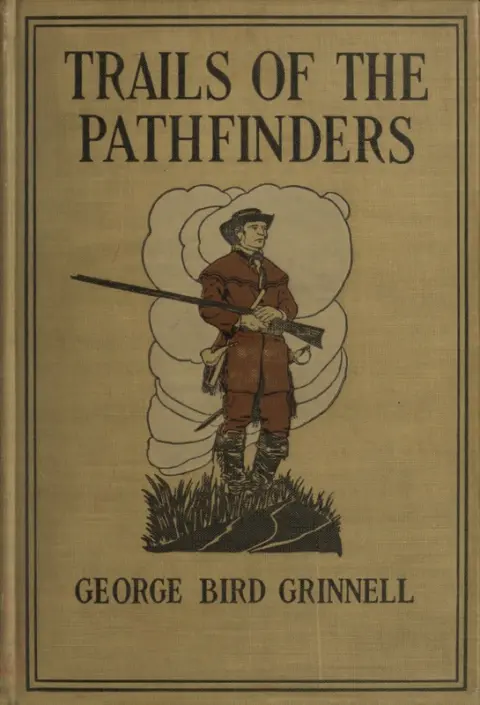
Trails of the Pathfinders
George Bird Grinnell
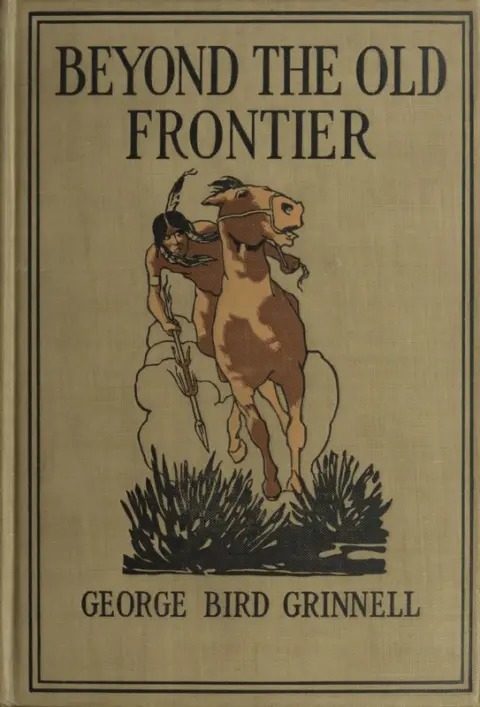
THE CLASSIC COLLECTION · 1913
"Beyond the Old Frontier: Adventures of Indian-Fighters, Hunters, and Fur Traders" by George Bird Grinnell is a historical account written in the early 20th century. The book delves into the tumultuous period of western expansion in the United States, focusing on the lives and experiences of early fur traders and their encounters with Native American tribes. It offers a vivid portrayal of exploration, survival, and the transformative conflicts of the era. The opening of the narrative sets the stage for the adventures that will unfold as it paints a picture of the American West before settlement. It describes the dangerous trek into largely uncharted territories, where traders and explorers faced not only the harshness of nature but also the threats posed by Native tribes defending their lands. As settlers began their arduous journeys westward in search of wealth and opportunity, Grinnell introduces key figures, such as fur trader Alexander Ross, whose firsthand accounts and experiences will serve as a lens through which readers can understand the complexities of the fur trade and the rich yet perilous tapestry of life "beyond the old frontier."
Introduction adapted from the source catalogue; source summaries may be automatically generated.
Free to read · English · 93,392 words · No account needed
MAKE TIME FOR A GOOD BOOK
On by default. Untick to stop anonymous reading totals. Each page counts after 10 seconds in view. How this works.
Anonymous counting is on unless you have switched it off.
The country through which they were passing had been thoroughly hunted by Indians, and the camp was out of meat, and had no food except beans. However, the fall migration of the wild fowl was on; at least the lakes and streams were occupied by plenty of ducks. Palliser set out with two of the hunters to try to kill some of these, but found that neither of the men could shoot on the wing. “It was amusing to see how astounded they were at my knocking over a fine mallard, that came wheeling over our heads; they insisted on its being a chance shot, and would not be persuaded to the contrary, until I brought down several successively; and at last, with a most satisfactory right and left, silenced their scepticism completely. They were greatly delighted; ‘Mais comment diable, monsieur, faites-vous cela?’ said one hardy old veteran to me. I offered to instruct him, but could not get him to fire rapidly enough, as he was afraid of wasting his ammunition, which was very expensive.”
On this journey they saw the approach of a prairie fire--a splendid and terrible sight--but succeeded in cutting it off by back-firing. The old French voyageurs declare that the Indians were travelling about. This experience suggested to Palliser a description given him by a brother sportsman of a fire which he had witnessed. “We had seen, during the latter part of our day’s journey, a remarkable appearance in the eastern horizon; and during supper observed a smell of burning, and a few light cinders fell about the camp, and presently we remarked that the luminous appearance in the east had very much augmented. There being a little hill in front of us, we could not see distinctly what caused it; but having consulted together, we agreed that it proceeded from a prairie on fire, which, however, was a long way off. About eight o’clock the smell of burning and the glare having materially increased, we walked up to the top of the hill, when a spectacle presented itself to us the most grand that can well be conceived. The whole horizon, from north to south, was one wall of fire, blazing up in some places to a great height, at others merely smouldering in the grass. It was, however, at least, eight miles off; but the wind seemed to set in our direction, so we instantly returned, and took measures to preserve the camp. We were in a corner, as it were, on the bank of the stream, with a good deal of brushwood running up on our left, and the ground sloping up gradually from the creek to the top of the hill. Our guides, on looking at the fire, said that it would not harm us--‘Ce n’est rien--le vent change.’ In short, they would do nothing. In about twenty minutes, however, it approached so near that there was no time to be lost, and all hands were immediately employed in burning a road across the face of the hill, so as to stop the fire at that part. A more picturesque scene could hardly be imagined. The night was very dark, but as far as the eye could reach, all across the horizon, about four miles in front of us, was a broad, bright, lurid glare of fire, with a thick canopy of smoke hanging over it, whose fantastic wreaths, as they curled in the breeze, were tinged with the red reflection of the flames. Even at that distance we could hear the crackling and rushing of the fire, which, as it advanced, caused a strong wind, and every now and then a brighter flame would shoot high up into the black cloud of smoke over the top of the hill, illuminating for an instant our tents and waggons in the dark hollow, and giving a momentary glimpse of the horses which were picketed on the side of the rise, on the crest of which the figures of the men engaged in lighting the opposition fire (which, as it became too extended, they beat down with blankets, only suffering it to burn a space about twelve feet broad, right across the line of the advancing conflagration), stood out in strong relief against the glowing wall of light beyond them; and as they ran about, tossing their arms, and waving the blankets and little torches of lighted grass, they looked in the distance like demons rather than men. We had no time to look at the picturesque, however, for every moment (owing to their previous obstinacy in neglecting to take precaution in time) became more pregnant with danger, and by the time they had burned as much as would only about half cover the camp, the fire was raging in the bottom at the other side of the hill. I ran up for an instant to the top, and shall never forget the scene. Although still half a mile off, the fire seemed close to me, and the heat and smoke were almost intolerable, while the dazzling brightness of the flames made it painful to look at them; they were in three lines nearly parallel, the first of which was just below me, burning with a rushing noise, and crackling as it caught the dry grass, that gave an idea of total destruction which it is impossible to convey, and stretching away over hill and dale for twelve or fourteen miles on each side of me, lighting up the sides of the hills and the little groves of wood far away. The two lines in the rear were not so much connected, and seemed rather licking up any little spots of grass which had escaped at first. Every now and then a prairie hen would flirr past, flying in a wild uncertain manner, as if fear had almost deprived it of the use of its wings; while all the songsters of the grove were wheeling about among the trees, uttering the most expressive cries of alarm, and the melancholy hooting of several owls, and wailing yells of the wolves, together with the shouts and cries of the men, almost drowned occasionally by the roaring of the flames, added to the savage grandeur of the scene, and one could have fancied the end of all things was at hand. On returning to the camp, I found all hands cutting the lassoes and halters of the mules, some of which galloped off instantly into the river, where they remained standing till the hurricane of flame had passed over; the others, seemingly trusting themselves instinctively more to man than to their own energies in such an emergency, followed us up the space which we had burned, and remained quietly there, trembling indeed, but without an effort to escape. By the time the animals were collected in this spot, the fire was blazing on the top of the hill, and we all rushed away with blankets to arrest its progress, if possible, at the part which we had left unguarded; all our efforts would have been in vain, however, and our tents and everything else must have been consumed, but that, just at that weak point, the grass suddenly became thin and scanty, with much stony ground, and we had the satisfaction of seeing the flames stopped there and turned off to the northward along the edge of the brushwood. It was really terrific to be, as we were, trying to break it down in the very middle of the blaze (which, after all, was so narrow that where the flames were not high, you could jump across it); we were, indeed, nearly suffocated by the smoke and heat. As soon as we perceived the fire turned off, we returned to the camp and horses, and all danger was over; but the sight of the three lines of fire stretching up the rising grounds behind the camp, just like the advance of a vast army, was magnificent; and it was still more extraordinary to watch the manner in which the fire passed itself on, as it were, over the tops of the highest trees, to the height of at least forty or fifty feet. The whole scene lasted altogether about two hours, and nothing could be conceived more awfully grand. The extraordinary rushing and crackling sound of the flames was one of the most terrific parts of it, and when one considers that the grass is nowhere more than five or six feet high, it is difficult to imagine how the flame blazes up to such a vast height as it did. The contrast presented, two hours afterwards, was most striking. Instead of the brilliant glare of the fire, and lurid appearance of the sky, there reigned an impenetrable darkness, earth and sky being alike shrouded in a black gloom, which could almost be felt; not a star was to be seen, and the air retained a suffocating, sulphureous smell, as if Satan himself had passed over the earth. We could not distinguish objects at ten paces’ distance, and were right glad when a fresh breeze came gently breathing over the prairie, dissipating the murky vapors still hanging in the atmosphere; and a fine starlit sky, with a sharpish frost, at length relieved us from the close, choking feeling we had experienced for hours before. This prairie fire had travelled at the rate of five miles an hour, bringing with it a strong gale of wind; for, otherwise, the night was quite calm, both before and after it had passed over.”
Your reading position is saved on this browser. Take it to another device with a library code. Reading pages adapt to text, rather than matching a printed edition.
George Bird Grinnell

Caspar Whitney & George Bird Grinnell & Owen Wister
George Bird Grinnell
George Bird Grinnell
BEHIND THE BOOK
This eBook is for the use of anyone anywhere in the United States and most other parts of the world at no cost and with almost no restrictions whatsoever. You may copy it, give it away or re-use it under the terms of the Project Gutenberg License included with this eBook or online at www.gutenberg.org. If you are not located in the United States, you will have to check the laws of the country where you are located before using this eBook. Read the source licence.
The original source file, including credits and licence, is retained by this library. Request an original-format copy at no charge. Please include the book title and Project Gutenberg identifier #54125.
KEEP YOUR CURIOSITY GOING
Cécile Tormay

Moritz Busch
John L. Ransom
Frances Wright
Cécile Tormay

Mabel Potter Daggett