THE CLASSIC COLLECTION✦An outlaw’s diary: the CommuneCLASSIC FREE BOOKS
An outlaw’s diary: the Commune
Cécile Tormay
THE CLASSIC COLLECTION · 1864
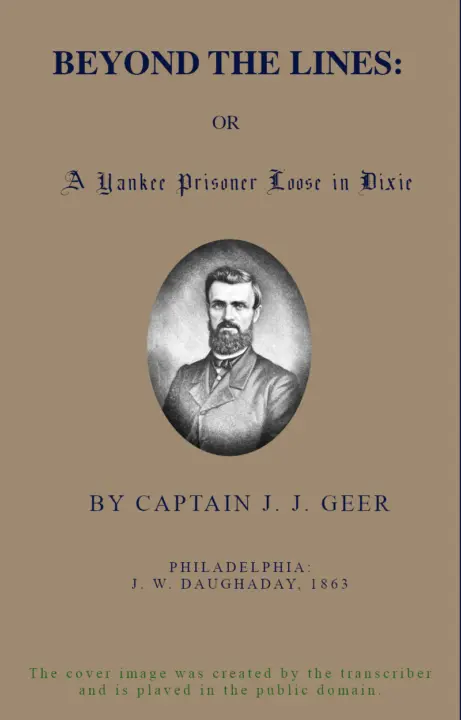
"Beyond the Lines; Or, A Yankee Prisoner Loose in Dixie" by John James Geer is a historical account written in the mid-19th century. The narrative details the experiences of Geer, a Union officer captured during the Civil War, as he recounts his struggles, sufferings, and eventual escape from Confederate captivity. The book offers a vivid insight into the realities faced by Union soldiers in the South, highlighting themes of bravery, survival, and the horrors of war. The opening of the narrative introduces us to Captain John J. Geer, who has recently left Camp Dennison with his regiment and is quickly thrust into battle at Shiloh, where he is captured. The tension of the battlefield is palpable as Geer describes witnessing the conflict and the suffering of civilians caught in the crossfire. Captured by rebel forces, he details the initial reactions of both the rebels, who are astonished to encounter a Union officer, and his own set of hardships as he faces threats from his captors. The early chapters set a dark tone, hinting at further trials ahead while establishing a framework for Geer's resilience and determination to escape.
Introduction adapted from the source catalogue; source summaries may be automatically generated.
Free to read · English · 57,584 words · No account needed
MAKE TIME FOR A GOOD BOOK
On by default. Untick to stop anonymous reading totals. Each page counts after 10 seconds in view. How this works.
Anonymous counting is on unless you have switched it off.
These miserable creatures despatched one of their number on a jenny, who shortly after returned, bringing with him the “squire,” a long, lanky, knock-kneed man, with hollow eyes and lantern jaws. He had a law-book tucked under his arm, to give weight, I suppose, to his appearance. This dignitary (?) stepped to me, and began questioning me with much official haughtiness, in fact so offensively, that I became enraged at last, and throwing off my assumed character of an idiot, exclaimed:
“Who are you?”
“I’m the squiah, sir, the squiah!” he replied, in his half negro dialect, and in exceedingly pompous tones.
“Well,” said I, “the people who made a squire of you must have been very short of material. But, sir squire, what is your business here?”
“To hold a trial over you; that thar’s my bis’nis here.”
I looked the ignoramus sternly in the face, as I rejoined:
“Well, sir, if you undertake to ‘hold a trial’ over Pulaski county citizens, we’ll make you smoke for it.”
My determined manner nonplussed him considerably, and turning to a companion, who seemed to be a conscripting officer, he said:
“I don’t want nuthin’ to do with these yer tarnal fellers, fur they know ’emselves, I golly!”
The conscripting officer, however, was not so easily turned aside, for failing to induce the “squire to hold a trial on us,” he sent a message to the deputy sheriff, and that high functionary came promptly to the rescue of the “Confederacy,” and arrested us. The squire having thus shifted this responsibility, regained his courage, and said to us, fiercely:
“Now, then, you’re arrested, and you’ve got ter tell us who you are,
and whar from.”
“Ah! we’re prisoners now, and you may find out all you want to know if you can,” was our reply.
We were forthwith searched, the result of which was the finding of a slip of paper in one of my pockets with “Mess No. 44” written on it. Not one of our captors could read; and when I asked for a written copy of the charges against us, they were completely dumbfounded. The “squire,” with a kind of glorification in his tones, said:
“A bill, you tarnal fool! I can’t write, I golly!”
My comrade was asked if he could read and write, and on his saying yes, the card was handed to him to decipher. The crowd clustered around, and when he assisted them in spelling out the word upon it, one cute fellow exclaimed:
“Meeser! Meeser! that’s it!”
Your reading position is saved on this browser. Take it to another device with a library code. Reading pages adapt to text, rather than matching a printed edition.
BEHIND THE BOOK
This eBook is for the use of anyone anywhere in the United States and most other parts of the world at no cost and with almost no restrictions whatsoever. You may copy it, give it away or re-use it under the terms of the Project Gutenberg License included with this eBook or online at www.gutenberg.org. If you are not located in the United States, you will have to check the laws of the country where you are located before using this eBook. Read the source licence.
The original source file, including credits and licence, is retained by this library. Request an original-format copy at no charge. Please include the book title and Project Gutenberg identifier #63120.
KEEP YOUR CURIOSITY GOING
Cécile Tormay

Moritz Busch
John L. Ransom
Frances Wright
Cécile Tormay

Mabel Potter Daggett