THE CLASSIC COLLECTION✦An outlaw’s diary: the CommuneCLASSIC FREE BOOKS
An outlaw’s diary: the Commune
Cécile Tormay
THE CLASSIC COLLECTION · 1864
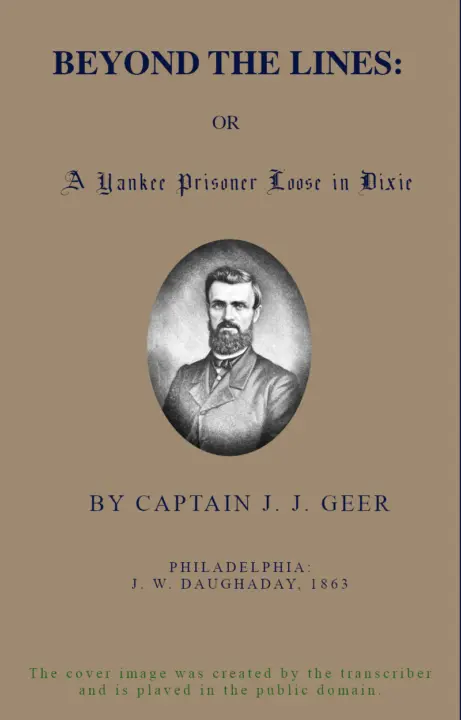
"Beyond the Lines; Or, A Yankee Prisoner Loose in Dixie" by John James Geer is a historical account written in the mid-19th century. The narrative details the experiences of Geer, a Union officer captured during the Civil War, as he recounts his struggles, sufferings, and eventual escape from Confederate captivity. The book offers a vivid insight into the realities faced by Union soldiers in the South, highlighting themes of bravery, survival, and the horrors of war. The opening of the narrative introduces us to Captain John J. Geer, who has recently left Camp Dennison with his regiment and is quickly thrust into battle at Shiloh, where he is captured. The tension of the battlefield is palpable as Geer describes witnessing the conflict and the suffering of civilians caught in the crossfire. Captured by rebel forces, he details the initial reactions of both the rebels, who are astonished to encounter a Union officer, and his own set of hardships as he faces threats from his captors. The early chapters set a dark tone, hinting at further trials ahead while establishing a framework for Geer's resilience and determination to escape.
Introduction adapted from the source catalogue; source summaries may be automatically generated.
Free to read · English · 57,584 words · No account needed
MAKE TIME FOR A GOOD BOOK
On by default. Untick to stop anonymous reading totals. Each page counts after 10 seconds in view. How this works.
Anonymous counting is on unless you have switched it off.
On my way from Bragg’s to Hardee’s quarters, my mind was busied with singular fancies. I thought of rebel treachery and oppression; I thought of the arch-conspirators at Montgomery, the disgraceful bombardment of Sumpter, the murder of United States troops in the streets of Baltimore, the enslavement of four millions of Adam’s race, all by the hateful power that now had me in its clutches. These atrocities made me the more willing to suffer in the defense of the Government that I had volunteered to serve.
Hardee is a noble-looking man, and on this occasion was dressed in full
uniform of blue cloth.
“General,” said my conductor, “here is a Yankee officer, referred to you by General Bragg.”
“For what purpose?” asked the General.
“For examination, sir.”
The General, with a look of surprise and indignation, replied:
“I shall ask the young man no questions that I would not answer myself under similar circumstances. But,” added he, after a moment’s consideration, “I shall send you to General Beauregard.”
I could hardly repress a smile at this decision, for now, thought I, I shall see the chiefest rebel of them all.
We passed through motley crowds of long-haired “butternuts,” to a place called Monterey. The General-in-Chief’s headquarters were in a dilapidated cabin. I was immediately arraigned before a bony-faced old man with a gray moustache, not at all prepossessing in personal appearance. Yet, on closer observation, I could detect a cunning shrewdness and a penetrating forethought in his tones and manner.
Beauregard. “You have been rather unfortunate to-day, sir.”
Geer. “Yes, sir, a little so to-day, but not so much on other days.” (I referred to the four days’ skirmishing prior to the Shiloh fight, in which we had seriously worsted the rebels.)
B. “Sir, they tell me you have not surrendered.”
G. “No, sir; but you have me in your power.”
B. “What are your reasons for not surrendering?”
G. “I decline telling you, sir.”
B. “But you shall tell me!”
G. “If you press me, I will tell you. I surrender to no foe that can not look me in the face nationally.”
When I had uttered these words, great excitement prevailed. In the din and confusion, I could discover the cry, “Cut his head off!” But in the midst of the melee, General Beauregard ordered silence, and said he would refer me to General Johnson.
As I was leaving Beauregard’s quarters, I heard that gentleman say:
“We intend to go on from victory to victory, till we drive you invaders
from our soil.”
“Yes,” replied I, for I felt his remarks keenly, “just as you did at
Fort Donelson.”
Your reading position is saved on this browser. Take it to another device with a library code. Reading pages adapt to text, rather than matching a printed edition.
BEHIND THE BOOK
This eBook is for the use of anyone anywhere in the United States and most other parts of the world at no cost and with almost no restrictions whatsoever. You may copy it, give it away or re-use it under the terms of the Project Gutenberg License included with this eBook or online at www.gutenberg.org. If you are not located in the United States, you will have to check the laws of the country where you are located before using this eBook. Read the source licence.
The original source file, including credits and licence, is retained by this library. Request an original-format copy at no charge. Please include the book title and Project Gutenberg identifier #63120.
KEEP YOUR CURIOSITY GOING
Cécile Tormay

Moritz Busch
John L. Ransom
Frances Wright
Cécile Tormay

Mabel Potter Daggett