THE CLASSIC COLLECTION✦An outlaw’s diary: the CommuneCLASSIC FREE BOOKS
An outlaw’s diary: the Commune
Cécile Tormay
THE CLASSIC COLLECTION · 1864
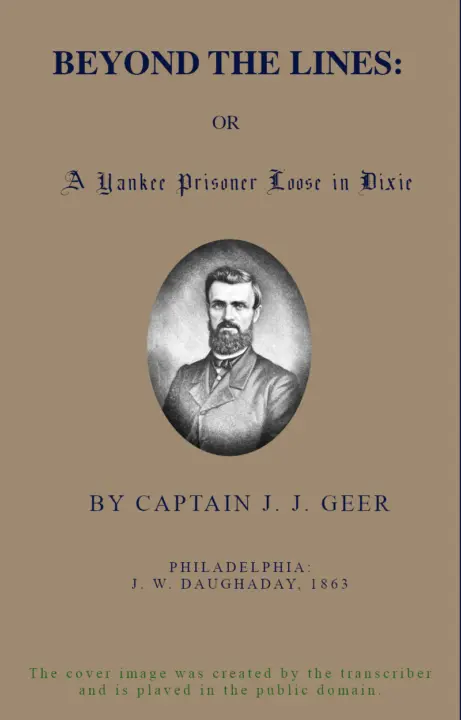
"Beyond the Lines; Or, A Yankee Prisoner Loose in Dixie" by John James Geer is a historical account written in the mid-19th century. The narrative details the experiences of Geer, a Union officer captured during the Civil War, as he recounts his struggles, sufferings, and eventual escape from Confederate captivity. The book offers a vivid insight into the realities faced by Union soldiers in the South, highlighting themes of bravery, survival, and the horrors of war. The opening of the narrative introduces us to Captain John J. Geer, who has recently left Camp Dennison with his regiment and is quickly thrust into battle at Shiloh, where he is captured. The tension of the battlefield is palpable as Geer describes witnessing the conflict and the suffering of civilians caught in the crossfire. Captured by rebel forces, he details the initial reactions of both the rebels, who are astonished to encounter a Union officer, and his own set of hardships as he faces threats from his captors. The early chapters set a dark tone, hinting at further trials ahead while establishing a framework for Geer's resilience and determination to escape.
Introduction adapted from the source catalogue; source summaries may be automatically generated.
Free to read · English · 57,584 words · No account needed
MAKE TIME FOR A GOOD BOOK
On by default. Untick to stop anonymous reading totals. Each page counts after 10 seconds in view. How this works.
Anonymous counting is on unless you have switched it off.
“Well,” said the other, “the lady was put in for hiding and feeding a
conscript.”
“Yes,” savagely rejoined the first, “and if that’s so, she ought to have been hung, and not put into prison.”
Upon returning to prison, I, in company with my tried friend, Captain Studman, went up stairs, where we both saw the lady and gentlemen in question. She had no hope whatever of escaping execution, and her pale, finely-formed face, though sorrowful, was determined in its expression. Her companions shared her imprisonment, because they had defended her, and to defend such an one was death or imprisonment.
When the appointed time for our departure arrived, we were soon ready. While standing in the street, drawn up in a rank, there was near us an old man, who, whenever he had an opportunity, would grossly insult us. The sun was broiling hot, and my temper, not being much cooler, I felt inclined to admonish this old rebel a little. But, not wishing to offend Captain Collins, who had treated me so well, I refrained, and listened for some time to the hoary-headed coward in silence.
A line of female negroes as long as our own, stood close to us watching us, and commented upon our appearance. While thus engaged, a little dog made his way through them, and commenced barking at, and playing with one of our number, a captain from Missouri.
The captain patted the little animal, and said, in half-joking tones:
“Well, puppy, I’ve got one friend in South Carolina, anyhow.”
At this, the old man rushed up to the prisoner, and exclaimed:
“What are you talking about? Them things’ll hang you before you leave
this place!”
“Whom do you think he’s talking to, sir?” I asked, in stern tones.
“He’s talking to them niggers, and he shall hang for it, before he
leaves the place.”
Just then, one of our number said sarcastically:
“Ah, now, my dear old gentleman, you are altogether mistaken. He’s not talking to your children, but your dog!”
This enraged him beyond measure, and he wanted to fight, and demolish the “whole crowd of d——d Yankees at once, and on the spot.”
Captain Collins, at length, thinking that he had amused himself long enough, quietly took hold of him, and passed him over to the guards, who, however, were unable to appease him, until they jagged a sharp bayonet into that delicate portion of his corporeal organization, where, doubtless, his feelings and his brains were seated.
Your reading position is saved on this browser. Take it to another device with a library code. Reading pages adapt to text, rather than matching a printed edition.
BEHIND THE BOOK
This eBook is for the use of anyone anywhere in the United States and most other parts of the world at no cost and with almost no restrictions whatsoever. You may copy it, give it away or re-use it under the terms of the Project Gutenberg License included with this eBook or online at www.gutenberg.org. If you are not located in the United States, you will have to check the laws of the country where you are located before using this eBook. Read the source licence.
The original source file, including credits and licence, is retained by this library. Request an original-format copy at no charge. Please include the book title and Project Gutenberg identifier #63120.
KEEP YOUR CURIOSITY GOING
Cécile Tormay

Moritz Busch
John L. Ransom
Frances Wright
Cécile Tormay

Mabel Potter Daggett