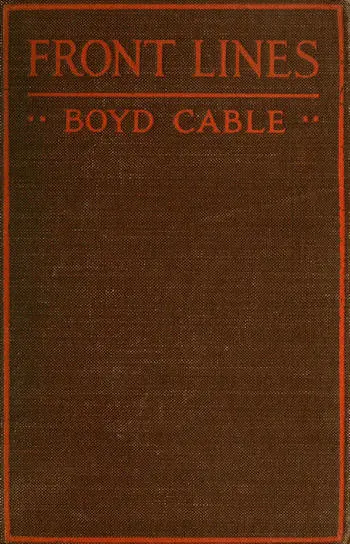
Front Lines
Boyd Cable
THE CLASSIC COLLECTION · 1915
"Between the Lines" by Boyd Cable is a war narrative written in the early 20th century. The book chronicles the experiences of soldiers during World War I, detailing life on the Western Front and the brutal realities of trench warfare. It aims to provide insight into the struggles faced by soldiers, highlighting their sacrifices and the stark contrasts between the grim truth of war and the sanitized accounts often reported back home. The opening of the narrative introduces the reader to the chaos and intense atmosphere of a frontline trench during battle. It vividly describes the sounds of warfare—cracking rifles, falling shells, and the cries of soldiers—as a lookout man strains to observe enemy movements amidst the chaos and mud. As he takes aim and fires from the parapet, the scene erupts into a savage melee, recounting the desperate fighting over territory as both sides suffer staggering losses. The passage captures not only the physical intensity of the combat but also the human emotions and experiences of the soldiers, setting the stage for a deeper exploration of their lives in a world torn apart by war.
Introduction adapted from the source catalogue; source summaries may be automatically generated.
Free to read · English · 55,957 words · No account needed
MAKE TIME FOR A GOOD BOOK
On by default. Untick to stop anonymous reading totals. Each page counts after 10 seconds in view. How this works.
Anonymous counting is on unless you have switched it off.
Two lines of trenches were taken; the line was advanced--advanced, it is true, a bare one or two hundred yards, but with lives poured out like water over each foot of the advance, with every inch of the ground gained marking a well-spring and fountain-head of a river of pain, of a suffering beyond all words, of a glory above and beyond all suffering.
'. . . have maintained and consolidated our position in the captured trench.'--EXTRACT FROM OFFICIAL DESPATCH.
Number nine-two-ought-three-six, Sapper Duffy, J., 'A' Section, Southland Company, Royal Engineers, had been before the War plain Jem Duffy, labourer, and as such had been an ardent anti-militarist, anti-conscriptionist, and anti-everything else his labour leaders and agitators told him. His anti-militarist beliefs were sunk soon after the beginning of the War, and there is almost a complete story itself in the tale of their sinking, weighted first by a girl, who looked ahead no further than the pleasure of walking out with a khaki uniform, and finally plunged into the deeps of the Army by the gibe of a stauncher anti-militarist during a heated argument that, 'if he believed now in fighting, why didn't he go'n fight himself?' But even after his enlistment he remained true to his beliefs in voluntary service, and the account of his conversion to the principles of Conscription--no half-and-half measures of 'military training' or rifle clubs or hybrid arrangements of that sort, but out-and-out Conscription--may be more interesting, as it certainly is more typical, of the conversion of more thousands of members of the Serving Forces than will ever be known--until those same thousands return to their civilian lives and the holding of their civilian votes.
By nightfall the captured trench--well, it was only a courtesy title to call it a trench. Previous to the assault, the British guns had knocked it about a good deal, bombs and grenades had helped further to disrupt it in the attacks and counter-attacks during the day, and finally, after it was captured and held, the enemy had shelled and high-explosived it out of any likeness to a real trench. But the infantry had clung throughout the day to the ruins, had beaten off several strong counter-attacks, and in the intervals had done what they could to dig themselves more securely in and re-pile some heaps of sandbags from the shattered parapet on the trench's new front. The casualties had been heavy, and since there was no passage from the front British trench to the captured portion of the German except across the open of the 'neutral' ground, most of the wounded and all the killed had had to remain under such cover as could be found in the wrecked trench. The position of the unwounded was bad enough and unpleasant enough, but it was a great deal worse for the wounded. A bad wound damages mentally as well as physically. The 'casualty' is out of the fight, has had a first field dressing placed on his wound, has been set on one side to be removed at the first opportunity to the dressing station and the rear. He can do nothing more to protect himself or take such cover as offers. He is in the hands of the stretcher-bearers and must submit to be moved when and where they think fit. And in this case the casualties did not even have the satisfaction of knowing that every minute that passed meant a minute farther from the danger zone, a minute nearer to safety and to the doctors, and the hospitals' hope of healing. Here they had to be throughout the long day, hearing the shriek of each approaching shell, waiting for the crash of its fall, wondering each time if this one, the rush of its approach rising louder and louder to an appalling screech, was going to be the finish--a 'direct hit.' Many of the wounded were wounded again, or killed as they lay; and from others the strength and the life had drained slowly out before nightfall. But now that darkness had come the casualties moved out and the supports moved in. From what had been the German second trench, and on this portion of front was now their forward one, lights were continually going up and bursts of rifle and machine-gun fire were coming; and an occasional shell still whooped up and burst over or behind the captured trench. This meant that the men--supports, and food and water carriers, and stretcher-bearers--were under a dangerous fire even at night in crossing the old 'neutral' ground, and it meant that one of the first jobs absolutely necessary to the holding of the captured trench was the making of a connecting path more or less safe for moving men, ammunition, and food by night or day.
Your reading position is saved on this browser. Take it to another device with a library code. Reading pages adapt to text, rather than matching a printed edition.
BEHIND THE BOOK
This eBook is for the use of anyone anywhere in the United States and most other parts of the world at no cost and with almost no restrictions whatsoever. You may copy it, give it away or re-use it under the terms of the Project Gutenberg License included with this eBook or online at www.gutenberg.org. If you are not located in the United States, you will have to check the laws of the country where you are located before using this eBook. Read the source licence.
The original source file, including credits and licence, is retained by this library. Request an original-format copy at no charge. Please include the book title and Project Gutenberg identifier #25076.
KEEP YOUR CURIOSITY GOING
Cécile Tormay

Moritz Busch
John L. Ransom
Frances Wright
Cécile Tormay

Mabel Potter Daggett