THE CLASSIC COLLECTION✦Plutarch’s Essays and Miscellanies, Vol. 4 (of 5)CLASSIC FREE BOOKS
Plutarch’s Essays and Miscellanies, Vol. 4 (of 5)
Plutarch
THE CLASSIC COLLECTION · 1899
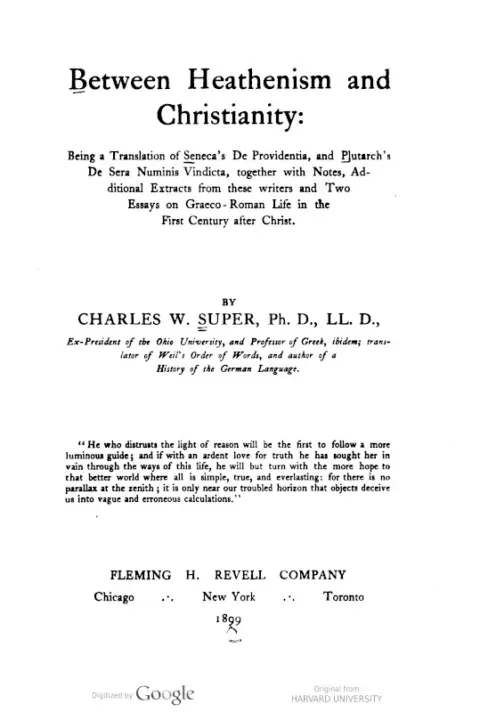
"Between Heathenism and Christianity" by Charles W. Super is a scholarly work that serves as a translation of Seneca’s "De Providentia" and Plutarch’s "De Sera Numinis Vindicta," supplemented with notes and essays on Graeco-Roman life during the first century after Christ. This work likely emerged in the late 19th century and explores the philosophical tensions between ancient pagan beliefs and the nascent Christian faith. The main focus is on how figures like Seneca and Plutarch embody the intersection of these two influential worldviews and how their teachings relate to early Christian thought. At the start of the book, Super provides a preface that sets the stage for the exploration of the notable historical transition from paganism to Christianity. He emphasizes the remarkable spread of Christianity despite its early association with the marginalized Jewish faith and the resistance it faced from Roman society and governance. The initial chapters introduce Seneca's life and philosophical contributions, positioning him on the cusp of Christianity, while also examining Plutarch’s insights on moral virtues. Super outlines the challenges and questions around morality, providence, and the human condition that these thinkers tackled, illuminating the complex ideological landscape of their time.
Introduction adapted from the source catalogue; source summaries may be automatically generated.
Free to read · English · 56,717 words · No account needed
MAKE TIME FOR A GOOD BOOK
On by default. Untick to stop anonymous reading totals. Each page counts after 10 seconds in view. How this works.
Anonymous counting is on unless you have switched it off.
De Pythia oraculis, (On the cessation of the Pythian oracles in
meter).
De defectu oraculorum, (On the cessation of oracles).
An virtus doceri possit, (Can virtue be taught)?
De virtute morali, (On moral virtue).
De cohibenda ira, (On the control of the temper).
De tranquillitate animi, (On peace of mind).
De fraterno amore, (On fraternal love).
De amore prolis, (On the love of offspring).
An vitiositas ad infelicitatem sufficiat, (Does vice of itself
make men unhappy)?
Animine an corporis affectiones sint peiores, (Are the sufferings of the mind more grievous than those of the body)?
De garrulitate, (On talkativeness).
De curiositate, (On meddlesomness).
De cupiditate divitiarum, (On the love of riches).
De vitioso pudore, (On excess of modesty).
De invidia et odio, (Concerning envy and hatred).
De se ipsum citra invidiam laudando, (On praising one’s self
without reproach).
De sera numinis vindicta, (Concerning those whom God is slow to
punish).
De fato, (On fate).
De genio Socratis, (On the tutelary deity of Socrates).
De exilio, (On exile).
Consolatio ad uxorem, (A letter of condolence to his wife).
Questionum convivialium libri IX, (Nine books of table-talk).
Amatorius, (A dialogue on love).
Amatoriae narrationes, (Love stories).
Maxime cum principibus philosopho esse disserendum, (On the
proposition that the philosopher ought chiefly to converse with
rulers).
Ad principem ineruditum, (To an uneducated ruler).
An seni res publica gerenda sit, (Should an old man hold a public
office)?
Praecepta gerendae rei publicae, (Political precepts).
De unius in re publica dominatione, populari statu et paucorum imperio, (On monarchy, democracy, and oligarchy).
De vitando aere alieno, (On avoiding debts).
X oratorum vitae, (The lives of the ten orators).
De comparatione Aristophanis et Menandri epitome (Abstract of a comparison between Aristophanes and Menander).
De Herodoti malignitate, (On the malice of Herodotus).
De placitis philosophorum libri V, (Five books of maxims of the
philosophers).
Aetia physica, (Problems in physics).
De facie quae in orbe lunae apparet, (Concerning the face that appears on the moon’s disk).
De primo frigido, (On the origin of cold).
Aquane an ignis sit utilior, (Is fire or water the more useful)?
Terrestriane an aquatilia animalia sint callidiora, (Are water or land animals the more cunning)?
Bruta animalia ratione uti, (On the use of reason by brutes).
De esu carnium, orationes duo, (On the eating of flesh, two
discourses).
Platonicae quaestiones, (Platonic questions).
De animae procreatione in Timaeo, (On the origin of the soul in
the Timaeus).
Epitome libri de animae procreatione in Timaeo, (Abstract of the book on the origin of the soul in the Timaeus).
De Stoicorum repugnantiis, (On contradictions of the Stoics).
Your reading position is saved on this browser. Take it to another device with a library code. Reading pages adapt to text, rather than matching a printed edition.
Plutarch
Plutarch
Plutarch
Plutarch
BEHIND THE BOOK
This eBook is for the use of anyone anywhere in the United States and most other parts of the world at no cost and with almost no restrictions whatsoever. You may copy it, give it away or re-use it under the terms of the Project Gutenberg License included with this eBook or online at www.gutenberg.org. If you are not located in the United States, you will have to check the laws of the country where you are located before using this eBook. Read the source licence.
The original source file, including credits and licence, is retained by this library. Request an original-format copy at no charge. Please include the book title and Project Gutenberg identifier #60831.
KEEP YOUR CURIOSITY GOING

David Patterson (Spirit) Hatch

David Patterson (Spirit) Hatch

David Patterson (Spirit) Hatch
Cécile Tormay

Moritz Busch
Coulson Kernahan