THE CLASSIC COLLECTION✦Plutarch’s Essays and Miscellanies, Vol. 4 (of 5)CLASSIC FREE BOOKS
Plutarch’s Essays and Miscellanies, Vol. 4 (of 5)
Plutarch
THE CLASSIC COLLECTION · 1899
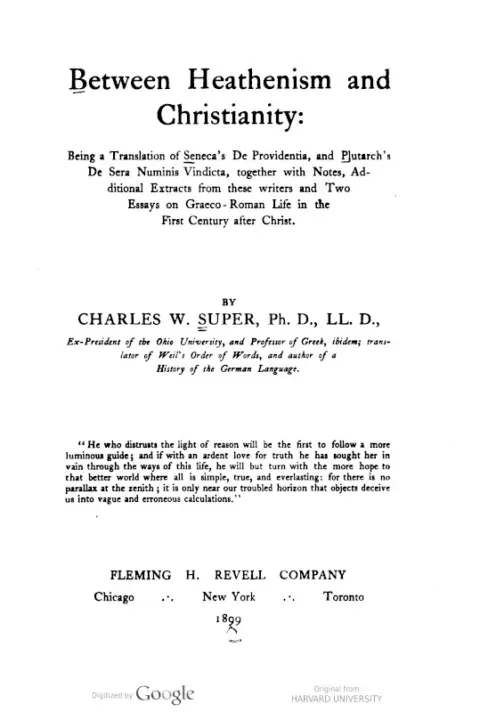
"Between Heathenism and Christianity" by Charles W. Super is a scholarly work that serves as a translation of Seneca’s "De Providentia" and Plutarch’s "De Sera Numinis Vindicta," supplemented with notes and essays on Graeco-Roman life during the first century after Christ. This work likely emerged in the late 19th century and explores the philosophical tensions between ancient pagan beliefs and the nascent Christian faith. The main focus is on how figures like Seneca and Plutarch embody the intersection of these two influential worldviews and how their teachings relate to early Christian thought. At the start of the book, Super provides a preface that sets the stage for the exploration of the notable historical transition from paganism to Christianity. He emphasizes the remarkable spread of Christianity despite its early association with the marginalized Jewish faith and the resistance it faced from Roman society and governance. The initial chapters introduce Seneca's life and philosophical contributions, positioning him on the cusp of Christianity, while also examining Plutarch’s insights on moral virtues. Super outlines the challenges and questions around morality, providence, and the human condition that these thinkers tackled, illuminating the complex ideological landscape of their time.
Introduction adapted from the source catalogue; source summaries may be automatically generated.
Free to read · English · 56,717 words · No account needed
MAKE TIME FOR A GOOD BOOK
On by default. Untick to stop anonymous reading totals. Each page counts after 10 seconds in view. How this works.
Anonymous counting is on unless you have switched it off.
3. When Patrocleas had concluded his remarks, Olympichus spoke up and said, “To what great absurdities do the delays and postponements of the Deity in such matters lead! Because this tardiness destroys faith in Providence, and the fact that retribution does not closely follow each particular act of wrong-doing but is later, thus making room for chance, men, by calling it a misfortune, not a penalty, are they in any wise bettered? Even though they may be grieved at what has befallen them, do they feel regret at what they have done? For just as the immediate stroke of the whip or the spur laid quickly to the horse that makes a false step or stumbles brings it to a sense of duty, but all the subsequent jerking and tugging at the reins and shouting seem rather to be done for some other reason than correction, because they produce pain but not betterment; so vice, if lashed and beaten for each act of villainy committed, would speedily become repentant and humble and fearful of God who beholds men’s acts and sufferings, if He did not postpone justice. And justice that according to Euripides procrastinates and with slow pace overtakes the wicked, seems more like an affair of chance than of Providence, because there is about it so much uncertainty, delay and lack of system. The result is that I do not see what use there is in the saying that the mills of the gods grind late, both because they obscure justice and take away the fear of evil-doing.”
4. Thereupon in reply to these remarks and while I was still absorbed in reflection, Timon said: “Shall I now add to the discussion the climax of my own perplexity or shall I pass it over until after the disposal of the main argument?” “What is the use,” said I, “of sending along a third wave to wash away the subject-matter, if it be found impossible to refute and invalidate the first objection? First, then, beginning, as we say, at the ingle-side and with the caution of the philosophers of the Academy in regard to the divinity, let us beware of assuming that we know just what to say on this subject. In truth, an affair of more serious moment is the consideration of supernal and divine things, for us who are human beings, than when one who has no ear for music discusses this art, or when one who has never served in the army discourses on military affairs; because, though ignorant of the plan of the artificer, we assume to be able to fathom his designs from what we suppose to be probable and fitting. It is not hard for one unacquainted with the healing art to comprehend the reasoning of a physician as to why he did not sooner perform a certain amputation rather than later, or why he ordered a bath yesterday and not to-day; in respect to God, on the other hand, it is not easy for a mortal to say any thing positive except that, knowing best the proper occasion for curing a man of his vices, He administers to each person chastisements as medicaments, but not equally severe in all cases nor at one and the same time. For that the healing art when applied to the soul is called right and righteousness and is the greatest of all arts, Pindar in addition to thousands of others, affirms, when he calls God the ruler and custodian of the whole universe, the ‘master builder,’ for the reason that He is the guardian of justice according to which it shall be determined when and how and to what degree every wicked man is to be punished. And of this art Plato says that Minos the son of Jove was a student, as it is not possible to properly dispense justice, or to recognize what is just unless one has learned and acquired a knowledge of the same. Not even the laws that men enact have always their clear and plain justification and some enactments even seem at first sight ridiculous. For instance, in Lacedaemon, the ephors, immediately upon taking office, issue an edict that no one is to wear a mustache and that the laws are to be obeyed in order that none may feel their severity. The Romans inflict a slight blow with a twig upon those whom they intend to emancipate; and when they make a will they bequeath their property to some persons as their heirs, but sell it to others,—which seems to be absurd. But most absurd one would think the law of Solon to be to the effect that he shall be deprived of civil rights, who, when there are parties and factions in the state, take sides with neither. In short, one could name many anomalies in law, if he did not know the intentions of the law-maker, and did not understand the reason for every single part of the decrees that have been issued. What wonder is it then, if, when it is so hard to see through human purposes, that it is not easy to say with respect to the gods for what reason they punish some transgressors later, others sooner.
Your reading position is saved on this browser. Take it to another device with a library code. Reading pages adapt to text, rather than matching a printed edition.
Plutarch
Plutarch
Plutarch
Plutarch
BEHIND THE BOOK
This eBook is for the use of anyone anywhere in the United States and most other parts of the world at no cost and with almost no restrictions whatsoever. You may copy it, give it away or re-use it under the terms of the Project Gutenberg License included with this eBook or online at www.gutenberg.org. If you are not located in the United States, you will have to check the laws of the country where you are located before using this eBook. Read the source licence.
The original source file, including credits and licence, is retained by this library. Request an original-format copy at no charge. Please include the book title and Project Gutenberg identifier #60831.
KEEP YOUR CURIOSITY GOING

David Patterson (Spirit) Hatch

David Patterson (Spirit) Hatch

David Patterson (Spirit) Hatch
Cécile Tormay

Moritz Busch
Coulson Kernahan