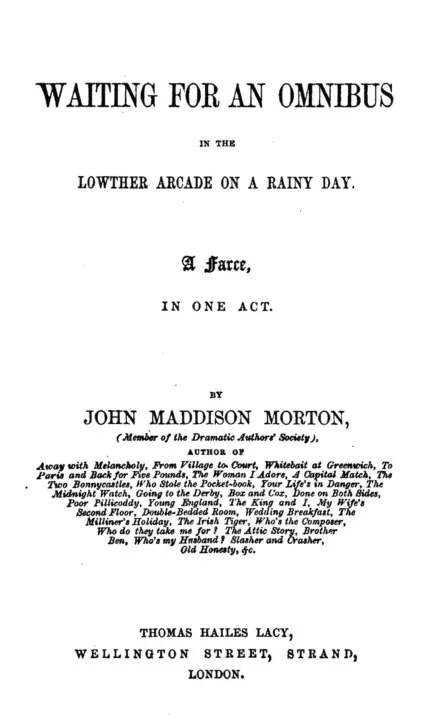
Waiting for an Omnibus in the Lowther Arcade on a Rainy Day: A Farce, in One Act
John Maddison Morton
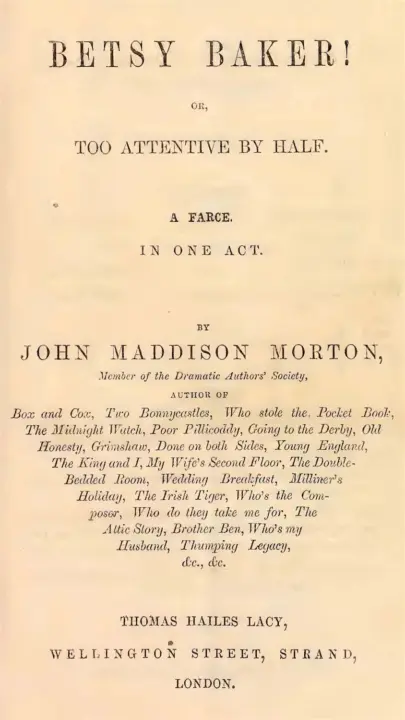
THE CLASSIC COLLECTION · 1850
"Betsy Baker! or, Too Attentive by Half; A Farce, in One Act" by John Maddison Morton is a comedic play written in the mid-19th century. The work falls under the category of farce, a theatrical genre characterized by exaggerated and improbable situations. Through its lighthearted and humorous nature, the play explores themes of love, jealousy, and the complexities of marital relationships, particularly focusing on the dynamics between husbands and wives. The plot revolves around Mr. Marmaduke Mouser, who is overly attentive to his wife, Mrs. Anastasia Mouser, to the point of suffocation. Their cousin, Mr. Crummy, realizes that this excessive affection is causing distress to Mrs. Mouser and devises a scheme to ignite her jealousy by suggesting that Mr. Mouser should fall in love with the laundress, Betsy Baker. As the farce unfolds, misunderstandings ensue, leading to a comical chase involving multiple characters. Meanwhile, Betsy becomes entangled in the plot, but as the comedy progresses, she asserts her own desires, ultimately revealing the absurdity of Crummy's plan. The play concludes with a humorous resolution that highlights the importance of balance in relationships and ends in a light-hearted manner as characters come together to celebrate their newfound understanding.
Introduction adapted from the source catalogue; source summaries may be automatically generated.
Free to read · English · 7,920 words · No account needed
MAKE TIME FOR A GOOD BOOK
On by default. Untick to stop anonymous reading totals. Each page counts after 10 seconds in view. How this works.
Anonymous counting is on unless you have switched it off.
CRUM. Well, I suppose I must believe you. But, intentionally or not, you certainly have made a most powerful impression on her youthful heart! She confessed as much to me just now.
MOUS. (gradually dropping his look of indignation, and with self-satisfaction) Poor Betsy! I’m very sorry for her, I’m sure! I say, Crummy, she’s a niceish little sort of a girl enough.
CRUM. Umph! so, so! (in a contemptuous tone)
MOUS. So, so! No, let’s be just, Crummy--let’s be just. She has good
eyes, Crummy, umph?
CRUM. (L.) Squints a little.
MOUS. Does she? I’ve never noticed her in the slightest degree whatever--but I’m damned if she squints!
CRUM. At any rate her eyes seem good enough to have noticed you. But, knowing you to be free from blame in the matter, I reasoned with her, told her the folly of fixing her affections upon a married man, but all in vain--so you’d better take her in hand.
MOUS. Do you think so?
CRUM. Certainly--you can talk to her seriously, but kindly.
MOUS. Of course, I shouldn’t go and behave like a brute to her! I shouldn’t go to blow Betsy up.
CRUM. Certainly not--for, after all, the poor girl is more to be
pitied than blamed.
MOUS. Crummy, that sentiment does you honour! It shows that the milk
of human kindness flows in your bosom, Crummy. (shaking CRUMMY’S
hand)
BETSY. (without, L. H.) Very well, ma’am, I’ll be sure to
remember it.
CRUM. That’s her voice! There’s something lively and cheerful about
it, eh?
MOUS. Yes, yes, it’s a pleasant voice, Crummy. (arranging his
cravat, &c.)
CRUM. She might have gone out by the back door, but, of
course, she knew that you were here. Ha, ha! (nudging
MOUSER, then retires up)
MOUS. Pooh! Go along! I believe you’re about right, though, ’pon my
life I do!
Enter BETSY BAKER, L. D.
BET. (seeing MOUSER) There stands my wretched victim! He little knows what’s going to happen to him.
CRUM. (C. aside to BETSY) Now then, attention! (aloud) Well, my dear, Mrs. Mouser was pleased with her veil I hope?
BET. (crossing C.) Oh, yes, sir; but in getting it up, somehow or other, I run the iron through it. I suppose I was thinking of something else. (looking languishingly at MOUSER, then aside to CRUMMY) How’s that?
CRUM. (aside to her) Capital!
MOUS. (in a plaintive tone, and approaching BETSY) Dear, dear, so you run the iron through it, did you? What a pity!
Your reading position is saved on this browser. Take it to another device with a library code. Reading pages adapt to text, rather than matching a printed edition.
John Maddison Morton
John Maddison Morton
John Maddison Morton
John Maddison Morton
BEHIND THE BOOK
This eBook is for the use of anyone anywhere in the United States and most other parts of the world at no cost and with almost no restrictions whatsoever. You may copy it, give it away or re-use it under the terms of the Project Gutenberg License included with this eBook or online at www.gutenberg.org. If you are not located in the United States, you will have to check the laws of the country where you are located before using this eBook. Read the source licence.
The original source file, including credits and licence, is retained by this library. Request an original-format copy at no charge. Please include the book title and Project Gutenberg identifier #64794.
KEEP YOUR CURIOSITY GOING
Maurice Baring
W. B. (William Butler) Yeats
Edward Martyn

John Brougham & Charlotte Brontë
Marguerite Merington
Leonid Andreyev