THE CLASSIC COLLECTION✦Kidnapped at the Altar; Or, The Romance of that Saucy Jessie BainCLASSIC FREE BOOKS
Kidnapped at the Altar; Or, The Romance of that Saucy Jessie Bain
Laura Jean Libbey
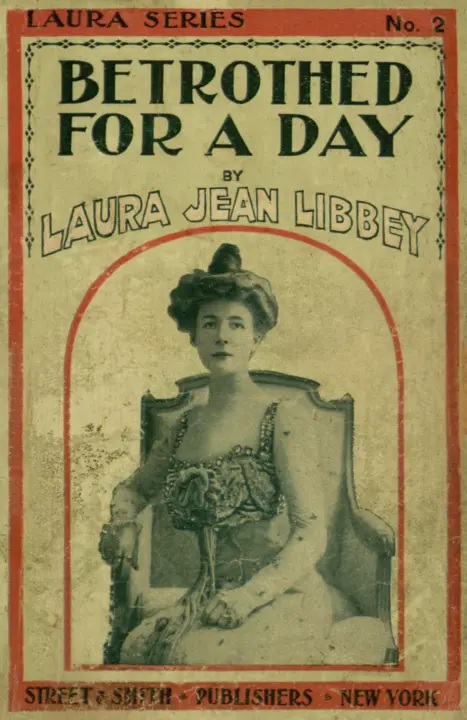
THE CLASSIC COLLECTION · 1901
"Betrothed for a Day: Or, Queenie Trevalyn's Love Test" by Laura Jean Libbey is a novel written in the early 20th century. The story revolves around the character of Queenie Trevalyn, a beautiful and ambitious young woman who finds herself at the center of romantic entanglements during the last night of the Newport social season. Through her interactions with attractive suitors, the narrative explores themes of love, wealth, and social obligation, as Queenie must navigate her feelings and ambitions in a society that places immense value on monetary success. At the start of the book, we are introduced to Queenie's vibrant social life at a lavish ballroom setting in Newport, where she is the belle of the ball. The opening chapters depict her close encounters with two suitors: the gallant John Dinsmore, who heroically rescues her from a malfunctioning elevator, and the wealthy heir Raymond Challoner, who seems to embody the wealth Queenie desires. As the story unfolds, Queenie's ambition for wealth supersedes her emotional attachments, particularly in her interactions with John, who aspires to win her love. The initial chapters set the stage for a romantic conflict, revealing Queenie's internal struggles between love and her relentless pursuit of financial security, ultimately teasing the tensions that will shape her choices and their consequences.
Introduction adapted from the source catalogue; source summaries may be automatically generated.
Free to read · English · 90,984 words · No account needed
MAKE TIME FOR A GOOD BOOK
On by default. Untick to stop anonymous reading totals. Each page counts after 10 seconds in view. How this works.
Anonymous counting is on unless you have switched it off.
“Friends,” she retorted; “I scorn you too much to hold you as a friend! From this hour we are enemies, Mr. Challoner--enemies to the death! You have insulted my pride, and mark me, the day will come when you will bitterly rue it!”
“I could never be an enemy to a fair young girl, let her do what she might, think of me as she may,” he returned, with mock gallantry; “and as for your revenge upon me, surely the withdrawing of your sunny face and smile from my dull existence will be a revenge cruel enough to satisfy the one most thirsty after vengeance!”
With one last look, the strangeness of which he never forgot, she turned, and with head proudly erect, walked with haughty step down the length of the cool, shady veranda, and disappeared through the arched doorway.
Raymond Challoner gazed after her with a strange expression on his usually placid countenance, as he remarked to himself:
“It’s a very disagreeable procedure. I hope she won’t do anything desperate. Those high-spirited girls are apt to kill themselves, or something else equally as terrible. She’s tremendously in love with me, poor little girl; and it’s flattering, but not at all pleasant under the circumstances.”
Queenie Trevalyn walked straight up to her own room with the same
proud, measured step.
Her mother, with a newspaper in her hand, was awaiting her in some trepidation. Her keen instinct told her as soon as she beheld her daughter’s marble-white face that in this instance surely the course of true love had not run smooth. Had it been as she feared, had the young man not received the story of her father’s failure kindly?
Without waiting for her mother to speak, Queenie announced, briefly:
“It’s all over between us, mamma; you are right, and I was wrong. It was my fortune that Raymond Challoner wanted, not me! So we parted!”
A shriek from her mother interrupted the recital of what took place.
“And it was for him that you threw over Mr. John Dinsmore!” groaned Mrs. Trevalyn, adding: “Just read that, Queenie! Oh, oh, oh!”
Mechanically the girl took the paper from her; the startling headlines on the first column on which her eyes fell told her of the wonderful news:
A fortune estimated at over three millions of dollars had come to John Dinsmore, the author, through the death of a relative, a London banker of note.
Without waiting for her daughter to read the column through, Mrs.
Trevalyn cried, excitedly:
“You must recall him, Queenie; indeed you must, my love!”
Your reading position is saved on this browser. Take it to another device with a library code. Reading pages adapt to text, rather than matching a printed edition.
Laura Jean Libbey
Laura Jean Libbey
Laura Jean Libbey
Laura Jean Libbey
BEHIND THE BOOK
This eBook is for the use of anyone anywhere in the United States and most other parts of the world at no cost and with almost no restrictions whatsoever. You may copy it, give it away or re-use it under the terms of the Project Gutenberg License included with this eBook or online at www.gutenberg.org. If you are not located in the United States, you will have to check the laws of the country where you are located before using this eBook. Read the source licence.
The original source file, including credits and licence, is retained by this library. Request an original-format copy at no charge. Please include the book title and Project Gutenberg identifier #68760.
KEEP YOUR CURIOSITY GOING
Coulson Kernahan

Maurice Baring
Frances Wright
Cécile Tormay

Frederic Jesup Stimson

W. H. P. (William Henry Pope) Jarvis